Best Road Trips In Morocco: Atlas To The Sahara
Plan the ultimate Morocco road trip – from Atlas mountain passes to Sahara dunes. Routes, driving tips, and everything you need to hit the road with confidence.
May 11, 20269.5K Shares127K Views
There's A Pass At 2,260 Metres That Ruins People
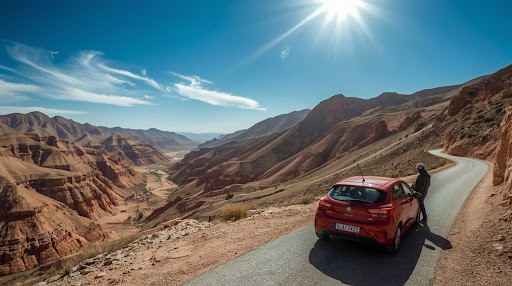
Not in a bad way. In the way where they pull over at the summit of Tizi n'Tichka – North Africa's highest paved road, connecting Marrakech to the pre-Saharan south – and stand there a little too long, trying to figure out why nobody told them it looked like this. The valleys below are red. The sky is enormous. The air smells like cold rock and something vaguely ancient. And the road ahead just keeps going.
That moment is, more or less, what a Morocco road trip is about.
It's a country that rewards movement – specifically, slow movement in your own car, with no fixed agenda for the afternoon. Public transport will get travelers to the cities. Organised tours will get them to the highlights. But the weird gorge road nobody marked on the map, the village with the Sunday market half-buried in the Atlas foothills, the way the dunes at Merzouga change colour in the twenty minutes before dark – that's car territory. Always has been.
Sorting The Car Before Sorting Anything Else
Here's the thing about Morocco logistics that most travel guides bury in paragraph nine: vehicle rental varies enormously by city, season, and booking timing. Walk-in rates at Marrakech airport on a busy spring weekend? Painful. Book a week ahead through a platform that covers Morocco properly? Different story entirely.
Services like Localrent.comaggregate options across Moroccan cities with transparent pricing – no surprise add-ons at the desk, no guesswork about what's actually available. For a trip built around driving, that foundation matters. A bad rental experience on day one has a way of colouring everything that follows.
Standard vehicles start around $35 per day on the main southern circuit. And no – a 4×4 isn't required. The classic Sahara route (Tichka Pass, Aït Benhaddou, Dades Valley, Todra Gorge, Merzouga) runs entirely on paved tarmac. A decent hatchback handles it fine. The 4×4 becomes relevant only for pushing further into unpaved desert tracks – which is its own category of trip entirely.
The Southern Circuit – The One Everyone Talks About, For Good Reason
~950 km. 7 to 10 days. Marrakech as the start and end point.
It's not the only Morocco road trip worth doing, but it's the one that tends to recalibrate people's sense of what a landscape can look like. Here's what's actually on it:
Tizi n'Tichka (Day 1) – The pass itself takes about 90 minutes from Marrakech. The switchbacks are genuinely dramatic going up; the descent into the pre-Saharan valleys is something else altogether – redder, more open, utterly unlike anything on the city side of the mountains. There are fossil sellers at the summit. Worth stopping even if the geology isn't interesting. The views are.
Aït Benhaddou (Day 1, afternoon) – UNESCO-listed since 1987, founded in the 11th century as a stop on the caravan route between Marrakech and Timbuktu. A ksar – a fortified earthen city – rising from the Ounila riverbed. Gladiator was filmed here. Game of Thrones too. Cross on foot, climb to the top granary, allow an hour and a half minimum. It's one of those places that earns its reputation.
Dades Valley and Gorge (Day 2–3) – The gorge road clings to the canyon edge above the Dades River, narrowing as it climbs. The rock formation known as "Monkey Fingers" – local name, accurate description – is genuinely strange and wonderful. Spend a night here if possible. The valley at dawn, before anyone else is up, is very quiet and very beautiful.
Todra Gorge (Day 3–4) – Limestone cliffs, 300 metres high, narrowing to a passage barely wider than a car. Walk in slowly. The scale only registers properly on foot. Climbers come here from across Europe – the walls are famously good. Non-climbers can simply stand in the canyon and feel appropriately small.
Erg Chebbi, Merzouga (Day 4–5) – The Sahara. Copper dunes at sunset, purple at dusk, cold and pale at dawn. A night in a desert camp – under actual stars, with actual silence – is one of those experiences that sounds clichéd until it's happening. It doesn't disappoint.
The return leg via the Draa Valley (Skoura's palm grove, the date palm oases near Zagora) adds texture to what might otherwise feel like retracing steps. It's a different landscape going north – greener, slower, with the mountains getting bigger on the horizon.
A Few Things To Know Before Driving Morocco's Mountain Roads
- Driving style is expressive. Horns mean hello, overtaking on bends is common, goats appear without warning. Patience is the correct response. Always.
- Fuel logic. Fill up whenever the gauge drops below half on remote stretches. Stations cluster around towns and disappear in the desert without ceremony.
- The stranger-stopping scam. Well-documented near Ouarzazate: a person flags down a car claiming breakdown, eventually leads to a cousin's "shop." Don't stop for anyone on remote roads. The anecdote is everywhere because it keeps working.
- No 4×4 required on the main circuit – but check rental terms. Some companies restrict certain vehicles from unpaved tracks even if the car is technically capable.
When To Go – And Why The Answer Isn't "summer"
October through May. That's the window. Spring (March to May) is the peak of the peak: the Atlas is green from winter rain, desert temperatures stay around 25°C, and the light in the gorges in the afternoon is the kind photographers plan trips around. Autumn (September to November) is the underrated choice – lower visitor numbers, stable weather, and the Draa Valley palm groves in harvest season.
Summer travel is entirely possible on the coast and at altitude. In the pre-Saharan valleys, between June and August, daytime temperatures routinely exceed 40°C. The Sahara does not negotiate.
Winter is cold – genuinely cold – in the Atlas, and snow occasionally closes Tizi n'Tichka. Worth checking conditions before committing to the southern circuit in January or February. But the desert in winter is spectacular, and crowds are at their lowest.
The Other Morocco Road Trip (the One Coastal People Swear By)
The southern circuit is the conversation, but the Atlantic coast is the counterargument. Essaouira – whitewashed, windswept, permanently photogenic – south to Agadir, then into the argan tree forests that exist nowhere else on earth, then Tiznit, then the long empty roads toward the Western Sahara. Dramatically different from the interior. Same country, completely different chapter.
Travel writer and Morocco specialist Sarah Hosking describes it plainly: "The coast gives you breathing room. The south gives you scale. Both are Morocco – just different chapters of the same story."
A two-week loop combining both – fly into Casablanca or Marrakech, south over the Atlas to the Sahara, west through the Draa Valley to the coast, north along the Atlantic – covers more of what Morocco actually is than any single route can.
Last Thoughts – From The Driver's Seat
The places that tend to stay with people longest from a Morocco road trip are rarely the UNESCO sites or the famous dunes. They're the unscheduled ones. The unmarked viewpoint on a mountain road where someone pulled over on instinct. The small café in a Dades Valley village with no English menu and extraordinary coffee. The twenty-minute stretch of empty desert road – windows down, nothing ahead – where the whole point of driving somewhere becomes briefly, perfectly obvious.
Getting the practical foundations right – the car sorted, the route loosely planned, the seasonal timing sensible – doesn't guarantee those moments. But it creates the conditions for them. And in a country like Morocco, that's usually enough.
Jump to
There's A Pass At 2,260 Metres That Ruins People
Sorting The Car Before Sorting Anything Else
The Southern Circuit – The One Everyone Talks About, For Good Reason
When To Go – And Why The Answer Isn't "summer"
The Other Morocco Road Trip (the One Coastal People Swear By)
Last Thoughts – From The Driver's Seat
Latest Articles
Popular Articles