David Hockney Net Worth 2026: Art, Prints, And More
David Hockney Net Worth in 2026 reflects sales of paintings, prints, and digital art, showing the value of his extensive, decades-long career.
Author:James RowleyDec 01, 202565 Shares64.9K Views
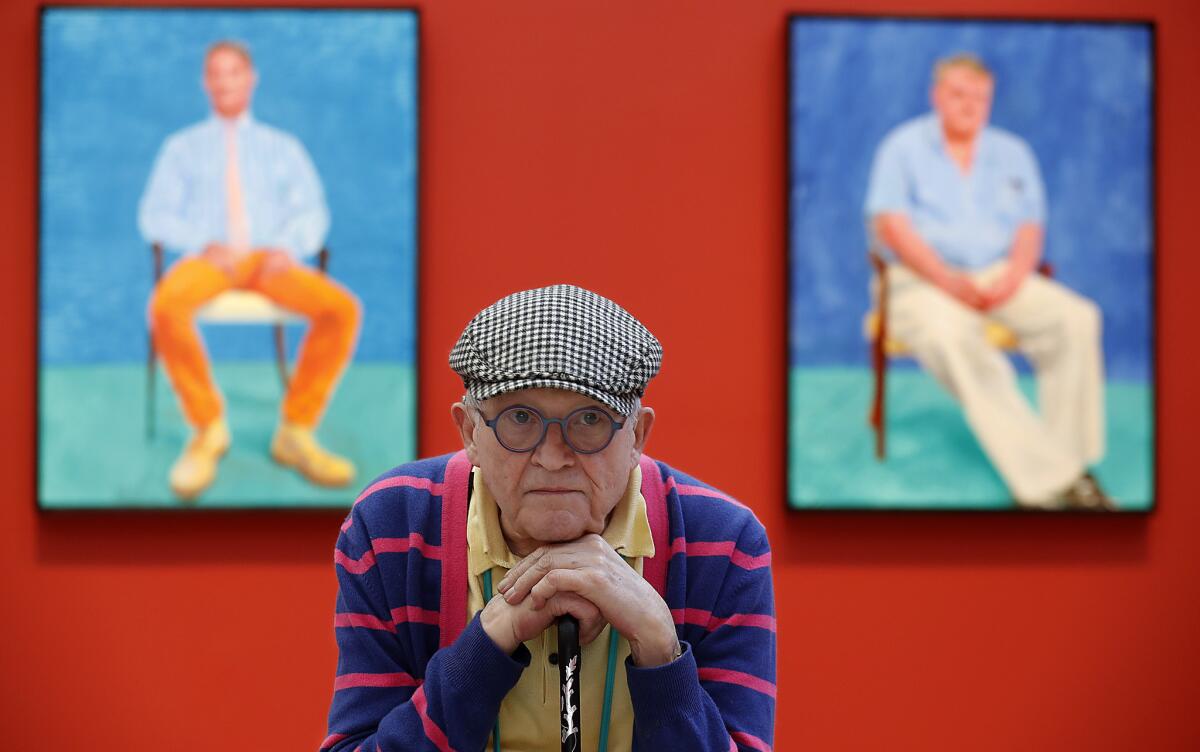
David Hockney was born on 9 July 1937 in Bradford in the West Riding of Yorkshire, England. Bradford was then an important industrial city with a long history in the wool trade. He grew up in a large family as the fourth of five children of Kenneth and Laura Hockney. His father, Kenneth, worked as an accountant’s clerk and held pacifist views, and his mother, Laura, was a devout Methodist and strict vegetarian.
Hockney began his schooling in 1941 at Wellington Primary School in the Eccleshill area of Bradford. In 1948 he won a scholarship to attend Bradford Grammar School. He was academically bright, but even in his school years he became deeply interested in art. As a child he loved books and was drawn to art, admiring painters such as Picasso, Matisse, and Fragonard. His parents encouraged these creative interests, giving him the freedom to doodle and explore art at home.
In 1953 Hockney left Bradford Grammar School and enrolled at the Bradford Regional Art School (later Bradford College of Art). He studied there through 1957 and graduated with honours, completing his formal art education in Bradford.
| Full Name | David Hockney |
| Date of Birth | 9 July 1937 |
| Place of Birth | Bradford, England |
| Family Background | Fourth of five children |
| Early Education | Wellington Primary; Bradford Grammar |
| Art Training | Bradford College of Art; Royal College of Art |
| Professional Honors | Royal Academician; Companion of Honour |
| Museum Retrospectives | Exhibitions in London and Los Angeles |
| Record Auction Sale | Painting sold for $90.3M (2018) |
| Recent Artistic Work | iPad art and landscape paintings |
| Net Worth (2026) | Not publicly disclosed |
David Hockney Career
David Hockney (b.1937) is an English painter, printmaker, photographer and stage designer who has been active for over six decades. He is widely acknowledged as one of Britain’s most influential modern artists. Rising to prominence in the 1960s, Hockney became a leading figure in the British Pop Art movement.
Over his career he has worked across many media, continually adopting new techniques from bold acrylic painting to digital drawing and has earned top honors (including the UK’s Order of Merit) while remaining a prolific creator into the 2020s.
Early Artistic Career & Education At Royal College Of Art
Hockney studied art in his native Yorkshire and then at London’s Royal College of Art (RCA). He attended Bradford School of Art (1953–57) and earned a first-class diploma in painting from the RCA (1959–62).
He was awarded the RCA’s prestigious Gold Medal upon graduation in 1962. After finishing his studies, Hockney embarked on an academic career: he taught at Maidstone College of Art in 1962 and then held visiting appointments in the United States (University of Iowa in 1964 and University of Colorado at Boulder in 1965).
By 1966–67 he was teaching in California (at UCLA and UC Berkeley), and in 1969 he took a faculty post at the Hochschule für bildende Künste in Hamburg, Germany. These early teaching roles paralleled his growing reputation as an artist.
Rise In The 1960s Pop Art Movement
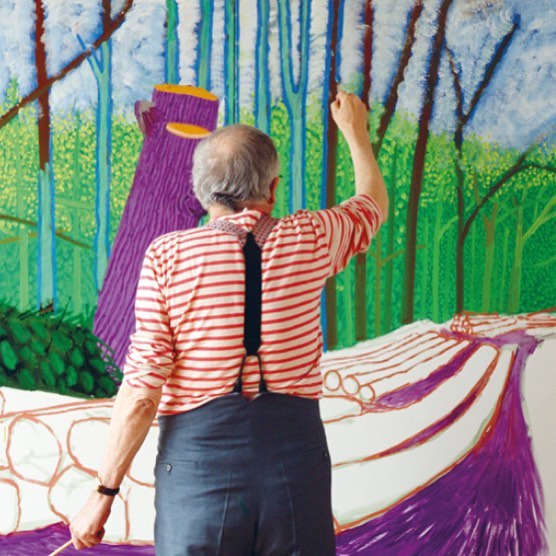
During the 1960s Hockney emerged as a central figure of British Pop Art. Still a student, he exhibited at the celebrated Young Contemporaries show in London (1960), an event regarded as the moment British Pop Art was born.
At the RCA he adopted vivid color and motifs drawn from popular culture – bright palettes and even graffiti-like text – which attracted the attention of critics. By the mid-1960s he began working in Los Angeles, and in 1967 he painted A Bigger Splash(a sunlit swimming pool scene).
This and other Californian works (along with portraits and domestic scenes) became iconic images of the era. Hockney’s first solo gallery show was held in London in 1963 (at John Kasmin Ltd), selling out quickly. By the end of the 1960s his dynamic, graphic style and subject matter (including the published Rake’s Progressetchings) had established him as a leading Pop artist in Britain and abroad.
Innovative Painting Style & Artistic Techniques
Hockney’s technique is notable for its inventive handling of perspective and space. He rejects the single-vanishing-point viewpoint of traditional painting, instead incorporating multiple angles of vision within one image.
As Hockney himself has observed, “the eye is always moving… The perspective alters according to the way I’m looking, so it’s constantly changing.” In practice this means his paintings often combine several viewpoints of a subject in a dynamic way.
In recent years he has even changed canvas shapes: around 2017 he began painting on hexagonal panels to achieve a “reverse perspective” effect, creating the illusion of a widening field. On this innovation he quips, “Someone said I was cutting corners, but actually, I’ve added two… Why didn’t I think of this twenty years ago?”
Hockney often works on a grand scale (for example, the monumental Grand Canyondiptych) and layers his compositions thoughtfully. His style has evolved continuously, but always retains a distinctive clarity of form and color (from the cropped interiors of the 1960s to the later landscapes and still lifes).
Photography, Stage Design & Multimedia Art Expansion
In parallel with his painting career, Hockney expanded into other arts. In the 1970s he made a significant move into stage design.
He was commissioned to design sets and costumes for opera productions: notably Stravinsky’s The Rake’s Progressat Glyndebourne (1975) and later productions for the Royal Opera and the Metropolitan Opera in New York. These theater works – often whimsical and richly drawn – became enduring successes and toured internationally.
Hockney also took up photography as an art form. Beginning in the 1980s he pioneered photographic collage: creating large “joiner” images assembled from many Polaroids or 35mm prints. Major exhibitions explicitly highlighted his composite Polaroid and photographic collage works.
He later developed what he calls “3D photography,” combining thousands of photographs taken around an object and editing them to produce a solid-looking three-dimensional image. In the 21st century Hockney embraced digital tools: he produces daily drawings on an iPhone/iPad, and his oeuvre now includes multi-screen digital video installations.
As one curator notes, his recent output “ranges from traditional oil painting and printmaking to digital art (iPhone, iPad drawings) and immersive video installations.” Hockney himself remarks that he sees “photography as a combination of photography and drawing and printing, each bringing out the best in the other.”
Major Exhibitions, Awards & Global Artistic Recognition
Hockney’s career has been punctuated by high honors and landmark retrospectives. In Britain he was elected a Royal Academician in 1991 and later appointed to the Order of Merit (2012) and the Order of the Companions of Honour (1997).
Internationally, he received prestigious awards including Japan’s Praemium Imperiale for painting (1989). American institutions have also honored him: he was inducted into the California Hall of Fame in 2015 and received the San Francisco Opera Medal (2017) and a Pratt Institute Lifetime Achievement Award (2018).
Hockney’s paintings and prints have been exhibited by the world’s leading museums (Tate Britain, MoMA New York, LACMA Los Angeles, Centre Pompidou, etc.). His work has been the focus of major traveling exhibitions: for example, the 2012 Royal Academy show “A Bigger Picture”(landscape paintings, later at Bilbao and Cologne) and 2013’s “A Bigger Exhibition”at San Francisco’s de Young.
A major retrospective at Tate Britain in 2017 (co-organized with the Centre Pompidou and New York’s Met) surveyed sixty years of Hockney’s work. Looking ahead, the April–August 2025 exhibition “David Hockney, 25”at Paris’s Fondation Louis Vuitton will span 400 works from 1955–2025, marking the largest retrospective of his career.
Current Artistic Work & Ongoing Influence In Contemporary Art
In recent years Hockney has remained exceptionally active, continually producing and showing new work. In 2021 he mounted The Arrival of Spring, Normandy, 2020at the Royal Academy of Arts in London (co-organized with Chicago), featuring hundreds of iPad and acrylic paintings made at his Normandy farmhouse.
He followed that with a Chicago presentation of the same series. Hockney continues to embrace digital media: he famously draws on his iPhone every day, noting that he “draw[s] flowers every day on [his] iPhone, and send[s] them to [his] friends so they get fresh flowers every morning.”
In spring 2025 the Fondation Louis Vuitton will present “Hockney, 25,”a Paris retrospective spanning seven decades. In 2026 he will open his first solo show at London’s Serpentine Galleries, presenting recent paintings alongside the 90-meter-long panoramic frieze A Year in Normandie(painted on iPad).
Even in his late 80s, Hockney’s prodigious output and technical innovation continue to inspire the contemporary art world. His ongoing exhibitions and new works demonstrate that he remains a vital and influential figure in 21st-century art.
David Hockney Net Worth
As of 2026, his net worth is not publicly disclosed, and no figure has been officially verified by major financial authorities. He generates income from sales of his original artwork (paintings, limited-edition prints, and photographs), several of which have fetched tens of millions of dollars at auction. He has also earned money from licensing his images for commercial products (for example, contributing a design to BMW’s Art Car series), although specific earnings figures from these activities are not publicly disclosed.
FAQs
Who Is David Hockney?
David Hockney is an English painter, printmaker, photographer, and stage designer born on 9 July 1937 in Bradford, England. He is widely regarded as one of the most influential British artists of the 20th and 21st centuries. Hockney became internationally known in the 1960s as a leading figure in the British Pop Art movement.
Where Was David Hockney Born?
David Hockney was born in Bradford, in the West Riding of Yorkshire, England. Bradford was an important industrial center at the time, known historically for its wool and textile industry.
What Art Movement Is David Hockney Associated With?
David Hockney is most closely associated with the British Pop Art movement of the 1960s. His early works used bright colors and contemporary themes influenced by popular culture, helping establish his reputation in modern art.
What Is David Hockney Famous For?
David Hockney is known for his vibrant paintings, innovative use of perspective, and depictions of everyday life and landscapes. Works such as A Bigger Splash(1967) and his California swimming-pool scenes are among his most recognizable paintings.
Where Did David Hockney Study Art?
Hockney studied at Bradford School of Art from 1953 to 1957. He later attended the Royal College of Art in London, graduating in 1962 with a diploma in painting.

James Rowley
Author
James Rowley is a London-based writer and researcher covering London life, cultural geography, and selected public figures across entertainment, sport, business, and public life.
For over 15 years, he has focused on verified sources, first-hand local context, and clear explanations that help readers understand both places and people more deeply. His work combines street-level London knowledge with careful research into career credits, media work, business interests, and, where relevant, transparently explained net worth estimates.
He writes every article published on London Webcam.
Latest Articles
Popular Articles