Dream Catcher First Person - Rules & Why London Loves It
Dream Catcher First Person explained for London nights in: wheel payouts, 2x/7x multipliers, and what GO LIVE changes.
Author:James RowleyMar 09, 2026

One fun day out in London that locals and tourists both love is jumping into a real-life game show-it's like stepping right onto a TV set for the afternoon. Spots like the Crystal Maze experience or the life-sized Monopoly board game are good examples.
Here’s the kind of game-show energy London experiences are known for:

Monopoly Lifesized London | Official Trailer
But sometimes the idea of crossing town - especially if it’s raining, you’ve had a long day, the train’s running late, or you end up spending half the evening in queues - is enough to make you stay in. That’s why many people also explore online game show options for an easy London night in that offer a similar feeling without the extra hassle.
Scheduled digital entertainment now extends well beyond game shows too. UK viewers can also access The Walking Dead Universe free TV channel, which uses the FAST model to stream franchise programming without a conventional subscription.
That’s where Dream Catcher First Personfits: it’s a bright, game-show wheel game you can play at your own pace, with the option to jump into a hosted live studio version via GO LIVE when you want a more live, hosted vibe.It’s usually offered on licensed real-money gaming sites, so treat it as entertainment and set limits.
Quick note:this article is about the online wheel game Dream Catcher First Person, not traditional dreamcatchers.
In 30 Seconds
- Pick a stake and one or more numbers (1, 2, 5, 10, 20, 40).
- Spin the wheel - if it lands on your pick, it pays that result.
- 2x / 7x don’t pay on their own; they trigger a re-spin and can multiply the next win.
- GO LIVE adds a host and live-stream vibe; the basic wheel idea stays the same.
- Best enjoyed as a quick London “night-in” mini-event - set a limit and keep it light.
Example: if you pick 10 and it lands on 10, it pays 10:1.
Dream Catcher First Person Explained
Dream Catcher First Person is a 3D, first-person wheel game-show built around one simple moment: you choose what you want the wheel to land on, then you spin and watch the pointer settle.
The wheel is split into numbered segments, each representing a different payout. You pick a number (or a few), place your stake, and spin - if it lands on a segment you chose, you get the associated payout.
This version is self-paced, and outcomes are decided by an RNG (random number generator), so it’s designed to feel like an easy, pick-up-and-play round rather than something you try to outthink.
How It Works (3 Simple Steps)
1) Choose A Stake + Pick Your Number(s)
You can select one number or spread your stake across a few. Think of it like choosing what you’d like the pointer to land on - quick and familiar.
2) Spin The Wheel
You start the round, the wheel spins, and the pointer lands on a result. If it lands on a number you chose, you get the payout for that number and your stake returns on a hit.
3) If A Multiplier Hits (2x Or 7x), Here’s What Changes
- 2x / 7x doesn’t pay out by itself.
- It triggers a re-spin with your existing picks staying in place.
- If your chosen number lands on the next spin, the payout is multiplied.
So if you picked 10 and 2x lands, the wheel spins again-if the next result is 10, the payout for that hit is multiplied.
Multipliers can also stack (rare, but it happens). If you hit 2x and then 7x, the next hit can be multiplied by 14x - that’s where the big “game show moment” feeling comes from.
Paytable (quick Guide)
- 1 usually pays 1:1
- 2 usually pays 2:1
- 5 usually pays 5:1
- 10 usually pays 10:1
- 20 usually pays 20:1
- 40 usually pays 40:1
(Always check the paytable inside your version - operators can differ. If your in-game paytable shows different amounts, trust the in-game info.)
Example:if you stake £1 on 10 and it lands on 10, it typically returns £10 profit (plus your £1 stake back), shown as a 10:1 payout.
What GO LIVE Actually Changes
Dream Catcher First Person also has the unique GO LIVE option. It transitions from the virtual version to a live version hosted by a presenter, live-streamed onto your screen.
GO LIVE is best thought of as an atmosphere switch.
- First Person: self-paced, you control the tempo, and it feels more low-key.
- GO LIVE: you’re taken into the hosted live studio version, where you get the presenter, the stream vibe, and that more social feel (including chat reactions).
What it doesn’t do: it doesn’t turn it into a different game you can outsmart - it’s just a different way to experience the same style of wheel.
What You’ll Actually See On Screen (First Person Mode)
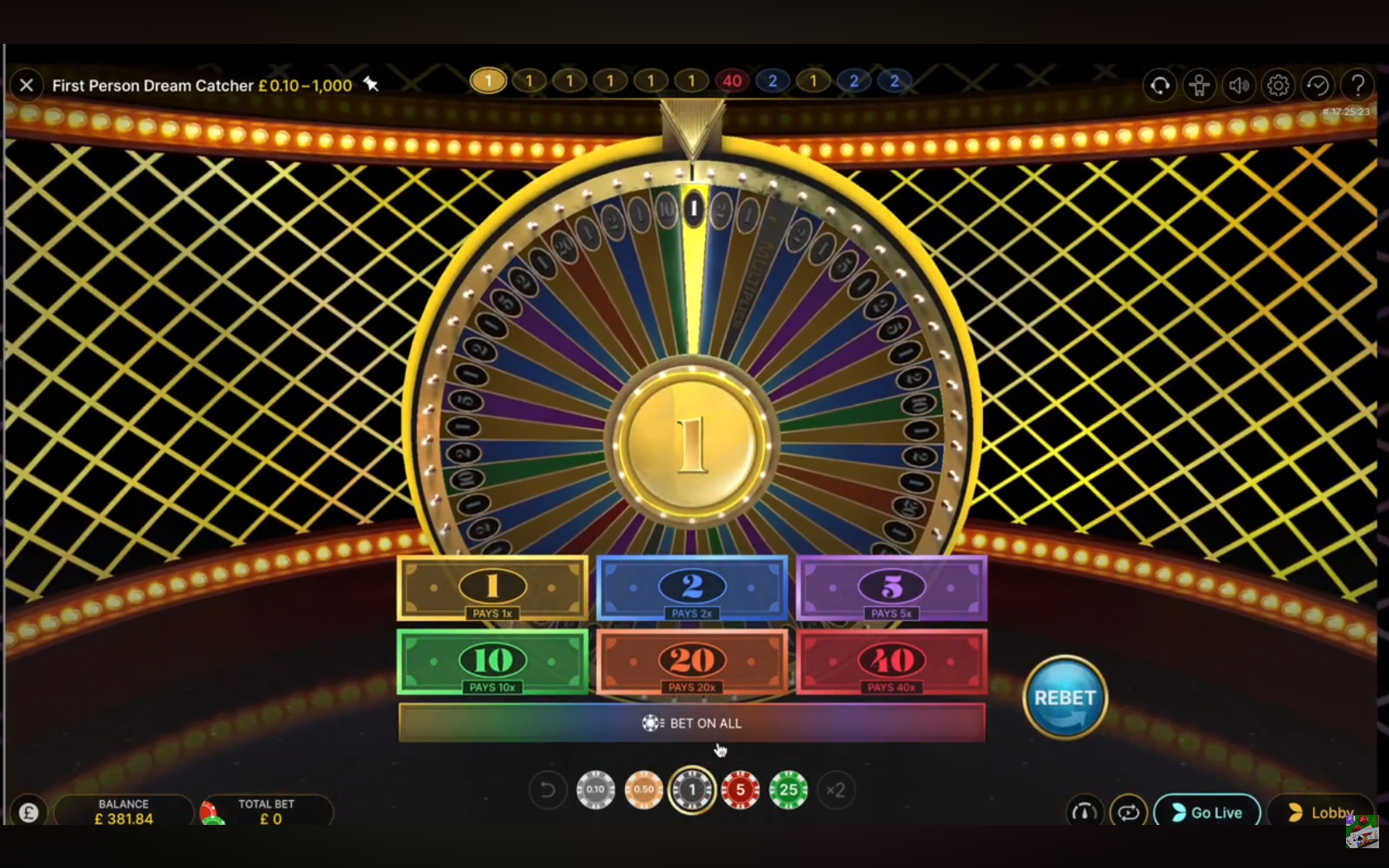
If you’re brand new, these are the bits worth spotting on your first visit (the layout can vary slightly by site, but the idea is consistent):
When you open Dream Catcher First Person, the wheel takes up most of the screen, with a fixed pointer at the top showing where it “lands.” The last few results usually sit in a small strip across the top too, so you can see what’s just happened at a glance.
Along the bottom is where you’ll actually play:
- Number tiles (your picks):big, colour-coded boxes for 1, 2, 5, 10, 20, 40, each labelled with what it pays (so you don’t have to guess).
- Stake chips:a row of chips lets you set your stake quickly (and you’ll often see a x2/double option nearby).
- Bet shortcuts:a REBET button repeats your last picks, and you may also see a “bet on all” option if you want to cover every number.
- Balance + total stake: usually shown at the bottom so you can keep track without digging into menus.
- GO LIVE + Lobby:a clear GO LIVE button (to switch to the hosted live studio vibe) and a Lobby option to exit or change game.
- Settings/info icons:small buttons in the top corner for help, sound, and settings; bet limits are often shown near the top too.
If a multiplier (2x/7x) lands, the game typically makes it obvious with a re-spin prompt/animation before the next spin.
Why Londoners Are Getting Into Live Digital Experiences
Live events in Londonare everywhere - comedy, gigs, theatre, immersive pop-ups - but they also take time, planning, and energy. And you see the same appetite for “being part of it” in big brand experiences too, like the Netflix House immersive experience, where the point is to step into the world instead of just watching it.
But on a weeknight - when it’s already gone seven, you’ve just reheated dinner, and the thought of swapping lines feels like effort - you might not fancy a cross-town mission just to get that event feeling.
That’s where live digital game shows can feel like a handy alternative: a queue-free, commute-free bit of entertainment you can start in minutes.
It’s the kind of thing you dip into when you’ve finally got the shoes off and you still want a little buzz without turning it into a whole plan.
A London Night-in Way To Play
- 10-minute mini-event: pick one or two numbers, small stake, a few spins.
- Post-work decompression: try GO LIVE for the presenter vibe, then switch back to First Person.
- Rainy-night background buzz: keep it low-stakes and treat it like a little show on while you unwind.

Watch Game Show Network on YouTube TV
Games such as Dream Catcher First Person remove the need for booking tickets or waiting in queues, so you can get a lively atmosphere without busy crowds.
And with the addition of a live-streamed host and 3D graphics, many people feel they aren’t missing the “event” feeling of in-person experiences-especially now that live streaming is a normal way to watch and interact with entertainment.
Streaming now covers very different viewing models, from interactive live formats to scheduled FAST channels and on-demand libraries. One current example is our guide to where to watch The Walking Dead in the UK.
Common First-timer Mistakes (easy To Avoid)
- Spreading tiny stakes across too many numbers (it can be hard to feel wins).
- Chasing multipliers (treat them as a surprise, not a target).
- Using autoplay/rebet and losing track of time or spend.
- Thinking GO LIVE changes odds (it changes vibe, not the basic wheel idea).
Quick Tips To Keep It Fun (and Keep It Light)
- Set a budget or time limit before you start - it’s easier to enjoy when there’s a clear stop point.
- If your site offers it, try demo mode first to get used to the multipliers and pacing.
- Treat multipliers as a bonus moment, not something you’re “owed.”
- Keep your stakes comfortable - this game is most enjoyable when it stays casual.
- If you’re not enjoying it, pause. The best sessions are the ones that feel like entertainment, not a task.
FAQs
What Is A Dream Catcher First Person?
A self-paced, game-show-style wheel where you choose numbers, spin, and get payouts when your picks land - with occasional 2x/7x multiplier re-spins.
Is Dream Catcher First Person The Same As Live Dream Catcher?
They’re closely related. First Person is self-paced (RNG-based). The live version adds a real host and a streamed studio feel.
How Do You Play Dream Catcher First Person?
Choose a stake, pick one or more numbers (1, 2, 5, 10, 20, 40), spin, and see where the pointer lands.
What Happens If It Lands On 2x Or 7x?
It triggers a re-spin with your picks staying in place. If your number lands next, the payout is multiplied.
Do Multipliers Stack?
Yes - if you hit multipliers back-to-back, they combine (e.g., 2x then 7x becomes 14x on the next hit).
What Does GO LIVE Do?
It switches you into the hosted live studio version for a more “live show” atmosphere. It doesn’t change the basic idea of the wheel.
Quick Recap
Dream Catcher First Person is a simple, game-show wheel experience: pick a stake, pick numbers, spin, and enjoy the reveal - with the occasional multiplier re-spin to add drama. For a London “nights-in” vibe, it works because it’s quick, low-effort, and feels like a mini-event - especially on those evenings when you can’t be bothered to cross the city.
Jump to
In 30 Seconds
Dream Catcher First Person Explained
How It Works (3 Simple Steps)
What GO LIVE Actually Changes
What You’ll Actually See On Screen (First Person Mode)
Why Londoners Are Getting Into Live Digital Experiences
Common First-timer Mistakes (easy To Avoid)
Quick Tips To Keep It Fun (and Keep It Light)
FAQs
Quick Recap

James Rowley
Author
James Rowley is a London-based writer and researcher covering London life, cultural geography, London travel, live London webcam pages and selected public figures across entertainment, sport, business and public life.
For over 15 years, he has focused on verified sources, first-hand local context and clear explanations that help readers understand both places and people more deeply. His work combines street-level London knowledge with careful research into career credits, media work, business interests and, where relevant, transparently explained net worth estimates.
He writes and reviews articles published on LondonWebcam.
Latest Articles
Popular Articles