How To Make Friends In London And Expand Your Social Circle
Earn how to make friends in London through recurring groups, classes, volunteering and local events, with practical follow-up and online safety tips.
Author:James RowleyNov 19, 2026

How To Expand Your Social Circle In London
To expand your social circle in London, choose one recurring activity you genuinely enjoy, attend often enough to become a familiar face and follow up with one person after each session.
Classes, volunteering, sports, local events and interest groups work best when they create repeated contact rather than a string of one-off meetings.
Start with one commitment close to home, work or study. After each session, learn one name, continue one conversation and make one specific, low-pressure invitation. Give the activity several visits before deciding whether it suits you.
If loneliness is affecting your daily life or mental health, the NHS has practical advice and explains where to get further support. Its guidance includes setting manageable targets, joining a group or class based on something you enjoy and seeking further support when needed.
Start With What You Already Love

Choose A Recurring Hobby Group
Shared interests make introductions easier. Choose an activity you genuinely enjoy, then favour a group with a regular schedule, a manageable journey and enough structure for repeated conversation.
Running clubs, book groups, pottery classes, choirs, chess societies, board-game nights, dance groups and amateur sports teams are all possibilities.
The best choice is not necessarily the busiest or most fashionable one. It is the activity you can realistically attend consistently.
Before joining, check:
- The latest meeting dates
- The cost and cancellation policy
- The location and journey time
- Accessibility information
- Whether beginners and newcomers are welcome
- Whether the group meets regularly
- Any membership rules or equipment requirements
At the first session, introduce yourself to one or two people and ask a simple question about the activity. At the next session, use their names and continue the conversation. Familiarity grows when people see one another repeatedly.
Try A Multi-Week Class
Longer courses can be useful for forming friendships because the same people meet repeatedly. City Lit, for example, offers thousands of in-person and online short courses, many taught in 10 weeks or less.
Its subjects include languages, art, photography, writing, performing arts, humanities and wellbeing.
If meeting people is part of the goal, choose an in-person course that runs for several sessions and is realistic for your budget and journey.
Arrive a few minutes early, speak to someone before the class and avoid leaving immediately every week.
One-day workshops can still make conversation easier because everyone already has a shared subject.
However, treat them as practice or a starting point rather than the most reliable route to a lasting social circle. Ask whether there is a follow-on course, practice group, mailing list or related event.
Get Out Into The Neighbourhoods
Explore Local Events
Council, library, community-centre and neighbourhood-group websites can help you find free or low-cost markets, festivals, talks, workshops, clean-ups and outdoor events.
Use the GOV.UK local council finderto reach the correct borough website, then confirm that the event is current, suitable and, where relevant, recurring.
Libraries are particularly useful because they may run book groups, language sessions, craft activities, talks, family events and community programmes.
Local volunteer centres, places of worship, cultural organisations and resident groups may also advertise opportunities that do not appear on large event platforms.
For wider inspiration, the LondonWebcam guide to things to do in Londoncan help you compare activities by area, interest, budget and situation.
Prioritise options close to home, work or study. A monthly book group or weekly community activity within a manageable journey is often easier to sustain than a major event on the other side of London.
Volunteer Regularly
Volunteering can create repeated contact around a shared purpose. In the 2024/25 Community Life Survey, 26% of adults who had formally volunteered during the previous 12 months said that meeting people or making friends was one reason they took part.
Food banks, community gardens, charity shops, befriending schemes, mentoring projects and event-support roles can all provide opportunities to work alongside other people. The cause, organisation and commitment should suit you first.
You can search London volunteering opportunities by interest, location and skillthrough the resources provided by London City Hall. The page also links to local volunteer centres and particular types of opportunity.
Before committing, ask:
- How often the same volunteers attend
- Whether the role involves working with a regular team
- What training or checks are required
- How long each shift lasts
- Whether travel expenses are available
- What support the organisation provides
A one-off event can be worthwhile, but a weekly or fortnightly role usually creates more opportunities to recognise people and continue conversations.
Use Online Groups To Find Real Activities
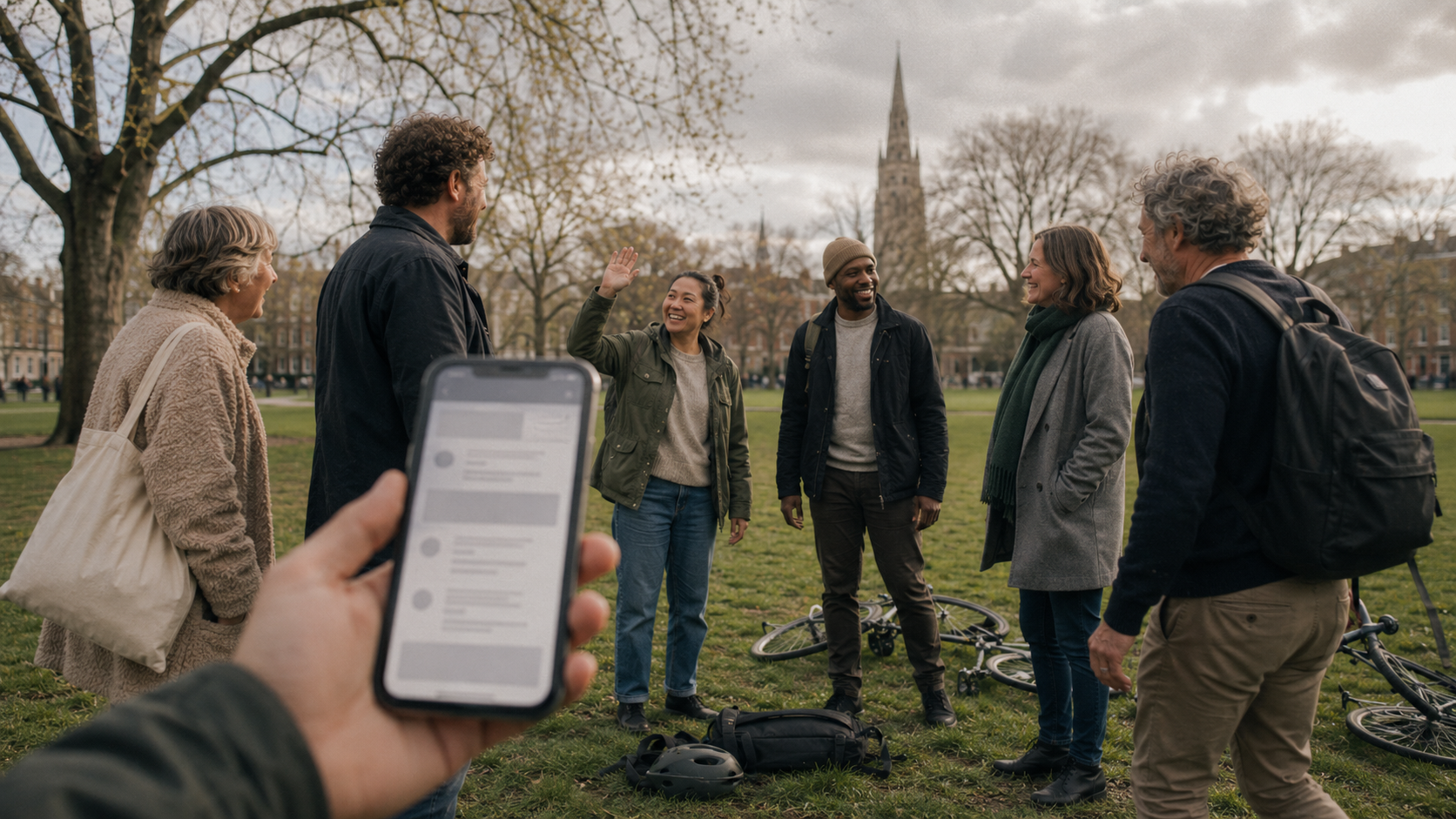
Choose Active, Organised Groups
Online platforms are most useful when they lead to a specific group, activity or event. Meetup’s Greater London listingsare one place to browse local interest groups and events.
People who want to build confidence starting conversations can also talk to new people onlinebefore joining more structured local activities, while still protecting personal information and following the safety steps below.
Search by activity and location, then check:
- Recent and upcoming event dates
- The organiser’s profile and history
- Group rules
- Venue details
- Prices and booking conditions
- Whether events have recent attendee activity
- Whether the same people appear to attend regularly
- Whether the activity is suitable for newcomers
Do not treat a large membership number as proof that a group is active, welcoming or appropriate. Look for clear organisers, recent events and signs of repeated participation.
Neighbourhood forums and social-media groups can also reveal local activities, but verify the organiser and destination independently. Do not send money or personal documents simply because someone appears friendly online.
Meet Online Contacts Safely
For a first meeting, choose a busy public place, tell someone where you are going and arrange your own journey home.
Keep your home address, workplace, routine, financial information and other sensitive details private until trust has developed.
Take a charged phone, plan an exit and leave if the situation feels wrong. Use the platform’s reporting tools if someone behaves suspiciously, aggressively or inappropriately.
The Suzy Lamplugh Trust’s online-safety guidancerecommends telling someone where you are going, planning transport, protecting personal details, meeting in a public place and having an exit strategy.
Online tools work best as a route into organised activities and repeated contact. A platform’s promotional language, membership total or safety claim does not prove that every user or meeting is safe.
Create More Chances To Meet Again
Accept Manageable Invitations
Accept invitations that feel safe, affordable and genuinely interesting, especially when they involve people you already know slightly. That might be an after-work drink, a colleague’s birthday, a class social or an event organised by a friend of a friend.
You do not need to agree to everything or perform a more extroverted personality. Set a smaller target instead:
- Stay for 30 minutes
- Speak to one new person
- Accept one suitable invitation this month
- Attend with someone you already know
- Plan your journey home in advance
The aim is repeated, manageable contact, not pretending to be someone else.
When you cannot attend, avoid automatically ending the opportunity. Thank the person, explain briefly and suggest another suitable time if you genuinely want to meet.
Host Something Small
You do not need a large home or a big budget. Suggest a coffee after class, choose one of the best parks in Londonfor a walk or picnic, or arrange a casual meal for two to four people.
Make the invitation specific by proposing a place, day and approximate duration:
“Would you like to get a coffee after next Thursday’s class?”
“I’m planning a walk in Victoria Park on Saturday afternoon. Would you like to join?”
A clear plan is easier to answer than “We should meet sometime”. Choose a public place that is convenient for everyone and easy to leave from.
Do not be discouraged when someone is unavailable. Adult schedules are complicated, and a declined invitation is not always a rejection. See whether the person suggests another time before deciding how to interpret it.
Work And Study Environments

Make More Of Your Workplace
Colleagues can become friends because regular contact already exists, but keep invitations low-pressure and respect professional boundaries.
Eat lunch away from your desk, join an optional staff activity, suggest a short walk or invite a colleague to an event related to a shared interest.
Start with people you already speak to comfortably rather than approaching every colleague as a potential close friend.
For hybrid or remote work, use planned office days, voluntary team activities or appropriate interest channels. A regular group outside work may still be useful when colleagues rarely meet in person.
Be especially careful where there is a reporting or power relationship. A manager inviting an employee may create pressure even when none is intended.
Do not assume that every colleague wants a friendship outside work, and accept a polite decline without pursuing it.
Meet People Through University Life
Check your students’ union society directory, departmental events, sports clubs, volunteering programmes and groups for postgraduate, mature, commuting or international students.
Freshers’ fairs are a useful starting point, but they are not a deadline. Societies, course communities and volunteering groups can welcome new members throughout the academic year.
Choose one or two activities you can attend regularly rather than signing up to everything. Course study groups can also provide a quieter alternative to large social events.
After a session, suggest a coffee, study break or the next event to someone you spoke with. A small follow-up is often more realistic than expecting the society itself to create a friendship automatically.
Be Patient And Realistic

Friendship Usually Takes Repeated Time Together
Busy schedules and long journeys can slow new friendships in London, so a delayed reply or declined invitation is not automatically rejection.
A University of Kansas studyestimated roughly 50 hours together to move from acquaintance to casual friend, about 90 hours to reach friendship and more than 200 hours to become close friends.
These are broad estimates from specific study groups, not a timetable or guarantee for every relationship. Mutual interest matters, and the research found that shared social time counted more strongly than simply working together.
Do not measure progress only by whether someone has become a close friend. Smaller signs also matter:
- They remember your name
- Conversations become easier
- You speak outside the main activity
- They introduce you to someone else
- Either person suggests another plan
- You begin attending events together
A social circle often develops as several weaker connections gradually become more familiar.
Be Direct When You Want To Connect
If you enjoyed speaking to someone, make the next step specific and easy to answer:
“I enjoyed chatting. Fancy a coffee after next week’s class?”
A date, context and low-pressure option are clearer than “We should meet sometime”.
Exchange contact details only when both people are comfortable. Follow up once with a clear plan.
If they decline without suggesting another time or do not respond, leave the invitation open and move on without applying pressure.
Continue attending the wider group rather than making your experience depend on one person. Some connections will remain friendly acquaintances, while others may develop gradually.
A Simple Four-Week Social Circle Plan
- Week 1:Choose one recurring activity within a realistic travel time and budget. Book or note the next two sessions.
- Week 2:Attend again, introduce yourself to one or two people and try to remember their names.
- Week 3:Continue one previous conversation and invite one person for a coffee, walk or the next related event.
- Week 4:Follow up respectfully, attend the activity again and decide whether to continue or try one alternative.
Measure progress by actions you control: attending, starting conversations, remembering names and making clear invitations.
Not every group or person will be the right fit. Give a promising activity several visits, but do not force yourself to remain somewhere that feels unsafe, unwelcoming, unaffordable or unsuitable.
Frequently Asked Questions
How Do Adults Make Friends In London?
The most effective approach is to join a recurring activity where the same people meet regularly. Classes, hobby groups, volunteering, sports clubs and local community events make it easier to become familiar with people over time.
Attend consistently, start small conversations and suggest a specific follow-up plan when you connect with someone.
Where Can I Meet New People In London For Free?
Libraries, council events, community groups, volunteering projects, walking groups, park activities and some museum or cultural events may be free.
Use the GOV.UK local council finderto check official borough listings and confirm whether an event is free before travelling.
How Long Does It Take To Make Friends In London?
There is no fixed timetable. Research suggests friendships often require many hours of repeated social contact, but personality, availability, mutual interest, and the type of activity all affect how quickly a connection develops.
Focus on attending regularly and allowing acquaintances to become familiar rather than expecting an immediate close friendship.
How Often Should I Attend A Group Before Giving Up?
Try to attend at least three or four sessions when the activity feels safe, affordable, and reasonably welcoming. The first meeting may feel awkward because people do not recognise you yet.
Leave sooner if the group feels unsafe, discriminatory, badly organised, or unsuitable for your needs.
Are Friendship Apps And Online Groups Safe?
No platform can guarantee that every user is genuine or safe. Choose organised groups with clear event details and active organisers, protect personal information, and meet new contacts in a busy public place.
Tell someone where you are going, arrange your own transport, and leave if anything feels wrong.
How Can An Introvert Make Friends In London?
Choose structured activities that provide a natural topic of conversation, such as a class, book group, volunteering role, or walking group. Smaller recurring gatherings may feel easier than large parties or unstructured networking events.
Set manageable goals, such as speaking to one person or staying for 30 minutes, rather than trying to appear highly extroverted.
What Should I Say When Inviting Someone To Meet Again?
Make the invitation specific and easy to answer. For example:
“I enjoyed chatting. Would you like to get a coffee after next week’s class?”
Suggesting a place, time or shared activity is clearer than saying, “We should meet sometime.”
Final Takeaway
The most reliable way to make friends in London is to choose one recurring activity, attend consistently, start small conversations and follow up with one person at a time. Use online groups to find organised activities, not as proof that a stranger or platform is safe.
Start with one commitment close enough to repeat. Give it several meetings before judging it, and keep invitations specific, low-pressure and respectful.
A social circle is more likely to grow from familiar faces and steady follow-through than from one dramatic night out.
Jump to
How To Expand Your Social Circle In London
Start With What You Already Love
Get Out Into The Neighbourhoods
Use Online Groups To Find Real Activities
Create More Chances To Meet Again
Work And Study Environments
Be Patient And Realistic
A Simple Four-Week Social Circle Plan
Frequently Asked Questions
Final Takeaway

James Rowley
Author
James Rowley is a London-based writer and researcher covering London life, cultural geography, London travel, live London webcam pages and selected public figures across entertainment, sport, business and public life.
For over 15 years, he has focused on verified sources, first-hand local context and clear explanations that help readers understand both places and people more deeply. His work combines street-level London knowledge with careful research into career credits, media work, business interests and, where relevant, transparently explained net worth estimates.
He writes and reviews articles published on LondonWebcam.
Latest Articles
Popular Articles