Andrew Lloyd Webber Net Worth 2026: £516m Estimate Explained
Andrew Lloyd Webber’s net worth is estimated at £516m by the 2026 Sunday Times Rich List. See why older £820m and unverified $1.2bn figures differ.
Author:James RowleyJul 20, 2026

What Is Andrew Lloyd Webber’s Net Worth?
Andrew Lloyd Webber’s net worth is estimated at £516 million, but his exact wealth is not publicly confirmed.
The £516 million figure comes from the 2026 Sunday Times Rich List. The 2025 listput his fortune at £500 million, so the published estimate increased by £16 million from one annual list to the next.
A rich-list figure is not an audited personal balance sheet. Lloyd Webber has not disclosed the complete value of his musical rights, private companies, property, investments, art, cash or liabilities.
Several celebrity-finance websites state that he is worth approximately $1.2 billion. That figure does not come with a transparent valuation showing how his assets and debts were calculated.
The £516 million figure is therefore the strongest current public benchmark, rather than a verified statement of his personal wealth.
| Financial detail | Current position |
| Latest public estimate | £516 million in 2026 |
| Previous annual estimate | £500 million in 2025 |
| Exact personal wealth confirmed? | No |
| 2019 reported estimate | £820 million |
| Repeated alternative | About $1.2 billion, unverified |
| Main sources of wealth | Musical rights, royalties, licensing, productions and theatre-company interests |
| Verified personal salary | Not publicly disclosed |
| Verified annual royalty income | Not publicly disclosed |
Andrew Lloyd Webber’s fortune was not built from one salary. It grew through a network of musical rights, international licensing, theatrical productions, recordings, adaptations and interests in companies that operate major London theatres.
His official profilesays his shows have run continuously in London’s West End for 50 years and ran for 43 uninterrupted years on Broadway.
Why Do Andrew Lloyd Webber’s Net Worth Estimates Differ?
Andrew Lloyd Webber’s reported wealth has changed substantially over time.
The Sunday Times Rich List valued him at £820 million in 2019. The estimate fell to £525 million in 2021, reached £500 million in 2025and then increased to £516 million in 2026.
| Year | Reported estimate |
| 2019 | £820 million |
| 2021 | £525 million |
| 2025 | £500 million |
| 2026 | £516 million |
Business Insider reportedthe £820 million estimate from the 2019 Sunday Times Rich List. At the exchange rate used at the time, it was worth more than $1 billion, which helped establish Lloyd Webber’s former reputation as a billionaire.
The Guardianreported that Lloyd Webber’s fortune fell by £275 million to £525 million during the year leading into the 2021 Rich List, as his London theatres remained closed for months during the pandemic. That £275 million year-on-year fall is not the same as the £295 million difference between the separate 2019 (£820 million) and 2021 (£525 million) estimates.
Likewise, the £304 million difference between the 2019 (£820 million) and 2026 (£516 million) estimates does not prove that Lloyd Webber personally spent or lost £304 million in cash. The rise from £500 million in 2025 to £516 million in 2026 is also a change between annual estimates, not proof that his personal wealth increased by exactly £16 million.
Rich-list estimates may change because of:
- revised private-company valuations;
- changing expectations for future royalties;
- theatre closures or weaker ticket sales;
- property and investment revaluations;
- business borrowing and other liabilities;
- changes to corporate or family ownership structures;
- different methods used to value intellectual property.
The complete calculations behind the Sunday Times figures are not public, so the fall cannot be assigned to one specific cause.
Why Some Websites Still Say $1.2 Billion
The $1.2 billionfigure appears on Celebrity Net Worth and is repeated by numerous entertainment websites.
Celebrity Net Worth does not provide a sufficiently detailed current calculation showing the values assigned to Lloyd Webber’s musical catalogue, companies, theatres, property, investments and liabilities.
The repeated appearance of the same number does not mean that every website completed an independent valuation. Several pages may simply be repeating the same underlying estimate.
Currency also creates confusion. A previous figure stated in pounds may have been converted into dollars when exchange rates were different, then left online long after the original sterling estimate changed.
The most useful comparison keeps each estimate in its original currency and attaches it to its publication year.
Why His Exact Wealth Cannot Be Calculated Publicly
Net worth is the value of a person’s assets after liabilities have been deducted.
For Lloyd Webber, the asset side could include:
- shares in private companies;
- musical and publishing rights;
- theatre interests;
- property;
- art and collectibles;
- cash and investments.
The liability side could include:
- personal borrowing;
- property debt;
- business-related guarantees;
- tax obligations;
- other private financial commitments.
Only parts of that calculation are publicly visible.
Musical Rights Do Not Have A Fixed Price
A musical catalogue is valued partly on the income it may produce in the future.
That value can depend on:
- how often each musical is staged;
- which countries and territories are licensed;
- the success of revivals and tours;
- royalty and publishing agreements;
- film, television and recording opportunities;
- merchandise and other licensed products;
- contractual shares belonging to collaborators;
- the risk that future productions will fail.
A work such as The Phantom of the Operamay continue generating income for decades. Its present value still cannot be calculated accurately without seeing confidential contracts and future revenue projections.
Private Companies Have No Daily Market Price
Publicly traded businesses have visible share prices. Lloyd Webber’s entertainment and theatre companies do not.
Companies House recordscan confirm company names, filings, officers and control. They do not establish what an outside buyer would pay for the businesses today.
They also do not show Lloyd Webber’s complete personal debts, investments, tax position or the private division of family and corporate assets.
Companies House records provide company information. Published rich-list estimates come from separate sources, and neither provides a complete personal balance sheet.
| Companies House can show | Companies House cannot show |
| Registered company names, numbers and filing dates | A complete personal balance sheet |
| Filed officers and people with significant control | Total personal annual income |
| Filed turnover, profit, cash and net-asset figures | The current market value of private businesses or musical rights |
| Accounting periods and filed documents | Confidential royalty rates and contracts |
| Registered charges and selected corporate relationships | Exact personal cash, investments, debts and taxes |
How Andrew Lloyd Webber Made His Money
Andrew Lloyd Webber’s wealth is built around a connected rights, production and theatre business.
His major income sources include:
- composer royalties;
- music publishing;
- professional production licences;
- international theatrical licensing;
- production and co-production interests;
- cast recordings and commercial recordings;
- film and television adaptations;
- merchandise and authorised products;
- interests in theatre ownership and operations.
These income sources do not all reach Lloyd Webber directly. Money may pass through companies, partnerships and production structures before costs and contractual payments are deducted.
Composer Royalties And Music Publishing
Lloyd Webber composed the music for works including Cats, Evita, Jesus Christ Superstar, Joseph and the Amazing Technicolor Dreamcoat, Sunset Boulevardand The Phantom of the Opera.
Those works can generate income when their music is recorded, performed, broadcast, streamed or incorporated into authorised productions.
Possible income streams include:
- stage-performance royalties;
- music-publishing income;
- cast recordings;
- commercial recordings and cover versions;
- broadcast and public-performance income;
- film and television music rights.
The amount belonging to Lloyd Webber can vary by work. Lyricists, writers, publishers, producers, estates and other rights holders may also hold contractual interests.
He does not personally receive every pound generated by a song, recording or production.
Grand Rights And Theatrical Licensing
One of Lloyd Webber’s most important financial advantages was retaining substantial control over the theatrical use of his work.
In a 2018 review of Lloyd Webber’s memoir, The New Yorker reportedthat he had retained at least 80% of the Grand Rights discussed in that account. This is historical evidence of how he built control over theatrical licensing, not proof that he currently owns the same percentage of every work.
A successful musical can be licensed for:
- West End and Broadway productions;
- international productions;
- touring shows;
- regional theatre;
- amateur productions;
- school and youth editions;
- translated or adapted versions.
This allows an established title to generate income long after its original production has closed.
The current ownership position may vary between works. A musical can include separate rights for its music, lyrics, script, publishing, recordings, film adaptation and individual territories.
Producing And Commercial Participation
Lloyd Webber’s businesses also develop, produce and promote stage projects.
A producer can benefit from a successful show, but production carries substantial risk. Money must be spent before a show opens, and the production must continue earning enough to cover its weekly costs.
Typical expenses include:
- performers and musicians;
- technical and backstage staff;
- theatre rent;
- scenery and costumes;
- marketing;
- insurance;
- ticketing;
- administration;
- royalties;
- investor repayments.
A recognisable title and strong ticket sales do not guarantee that a production will recover its initial investment.
Film, Television And Recordings
Lloyd Webber’s musicals can produce further income through:
- feature-film adaptations;
- filmed stage performances;
- television specials;
- original and revival cast albums;
- soundtracks;
- streaming and physical recordings.
These uses can create royalties, licensing fees or production income. The financial terms depend on the contracts governing each musical and adaptation.
A film’s worldwide box office should not be treated as Lloyd Webber’s personal earnings. Cinemas, studios, producers, distributors and other rights holders receive portions of the revenue.
Merchandise And Licensed Products
Programmes, clothing, souvenirs, collectables and other authorised products add another commercial layer to successful musicals.
Merchandise is unlikely to account for most of Lloyd Webber’s fortune. It does show how an established theatrical title can support several income streams beyond ticket sales.
Gross Box Office Is Not Personal Income
A production’s worldwide ticket sales are not the same as the composer’s earnings.
A £100 theatre ticketmay need to cover taxes, venue costs, performers, musicians, technical staff, marketing, administration, producers, investors and contractual rights holders.
The composer may receive a royalty or another form of participation. The amount depends on the individual contract and is rarely disclosed.
The difference is especially important for long-running shows. A musical can generate billions in ticket sales across many decades without the composer receiving anything close to the total gross.
What The Latest LW Entertainment Accounts Show
LW Entertainment’s latest Companies House accountscover the year ending 30 June 2025 and were filed on 27 March 2026.
Companies House lists Really Useful Holdings Limited as owning at least 75% of the shares and voting rights. It separately lists Andrew Lloyd Webber as having significant influence or control. The company was previously named The Really Useful Group Limited.
Those records establish company control, not the value of Lloyd Webber’s personal stake, salary or annual income.
These are company-level figures from LW Entertainment Limited’s 2025 accounts. They should not be treated as Andrew Lloyd Webber’s personal income, assets or net worth.
| LW Entertainment 2025 figure | Reported amount |
| Turnover | £43.48 million |
| Operating profit | £2.52 million |
| Profit before tax | £1.78 million |
| Net profit | £656,912 |
| Cash | £7.19 million |
| Net assets | £19.76 million |
| Aggregate directors’ remuneration | £1.42 million |
The filed figures show that turnover increased from approximately £35 million to £43.48 million.
Operating profit rose to £2.52 million, while profit before tax fell from approximately £6.07 million to £1.78 million.
The fall in pre-tax profit was linked partly to distributions received in the previous year that did not recur, a fair-value adjustment and a provision against a theatrical investment.
Company Revenue Is Not Lloyd Webber’s Personal Income
LW Entertainment’s £43.48 million turnoverrepresents company revenue before expenses. It is not Lloyd Webber’s salary.
The company’s £19.76 million in net assetsis an accounting figure. It does not necessarily reflect the full commercial value of musical rights capable of generating income for many years.
The £1.42 million directors’ remunerationfigure covers the company’s directors collectively. The filing does not establish that the amount was paid entirely, or even primarily, to Lloyd Webber.
No verified current personal salary for Andrew Lloyd Webber was found in the available records.
What The Filed Accounts Do Not Reveal About Personal Royalties
The filed accounts do not disclose Andrew Lloyd Webber’s total annual royalty income or provide a current market valuation for his musical catalogue.
Rights income may pass through companies and contractual arrangements before costs, collaborator shares and tax are deducted. Company accounts therefore cannot be converted into a verified personal royalty figure.
The Six London Venues Operated By LW Theatres
LW Theatres operates six major venues in London.
| Theatre | Ownership or operating position |
| The London Palladium | LW Theatres venue |
| Theatre Royal Drury Lane | LW Theatres venue |
| His Majesty’s Theatre | LW Theatres venue |
| Cambridge Theatre | LW Theatres venue |
| Gillian Lynne Theatre | LW Theatres venue |
| Adelphi Theatre | Co-owned with Nederlander International |
The portfolio includes the London Palladium, Theatre Royal Drury Lane and His Majesty’s Theatre, the London home of The Phantom of the Opera.
The Adelphi Theatre is held through a co-ownership arrangement with Nederlander International.
The theatre portfolio gives Lloyd Webber an interest in the venues where productions are presented, rather than limiting his financial participation to composing or licensing.
Theatres also require substantial spending on employees, restoration, maintenance, safety, technology and building improvements.
Related reading:Compare The Phantom of the Operawith other current West End productions in our guide to the best theatre shows in London.
What The Latest LW Theatres Group Filing Confirms
Companies House recordsshow that LW Theatres Group Limited filed full accounts for the period ending 29 June 2025 on 24 February 2026. These are newer than the full accounts for the year ending 30 June 2024.
The 2024 figures still provide useful historical context for the scale of the theatre business. For the year ending 30 June 2024, LW Theatres Group reported:
- £198.1 million in turnover;
- £11.6 million in pre-tax profit;
- £131.4 million in box-office takings;
- approximately 3.3 million visits across its venues.
These are historical 2024 figures, not the latest 2025 results.
Company accounts are useful evidence about the business, but they do not establish Andrew Lloyd Webber’s personal salary or the current market value of his theatre interests. Company revenue, profit and assets should not be added directly to his personal net-worth estimate.
LW Entertainment says every penny of profit at LW Theatres is reinvested in conserving and improving its six venues and that more than £100 million has been reinvested since 2006. Reinvestment may support the long-term value of the theatre business without becoming personal cash income for Lloyd Webber.
The Musicals Behind Andrew Lloyd Webber’s Fortune
A relatively small group of long-running works created recurring opportunities across stage productions, recordings, tours, film adaptations, merchandise and revivals.
The Phantom Of The Opera
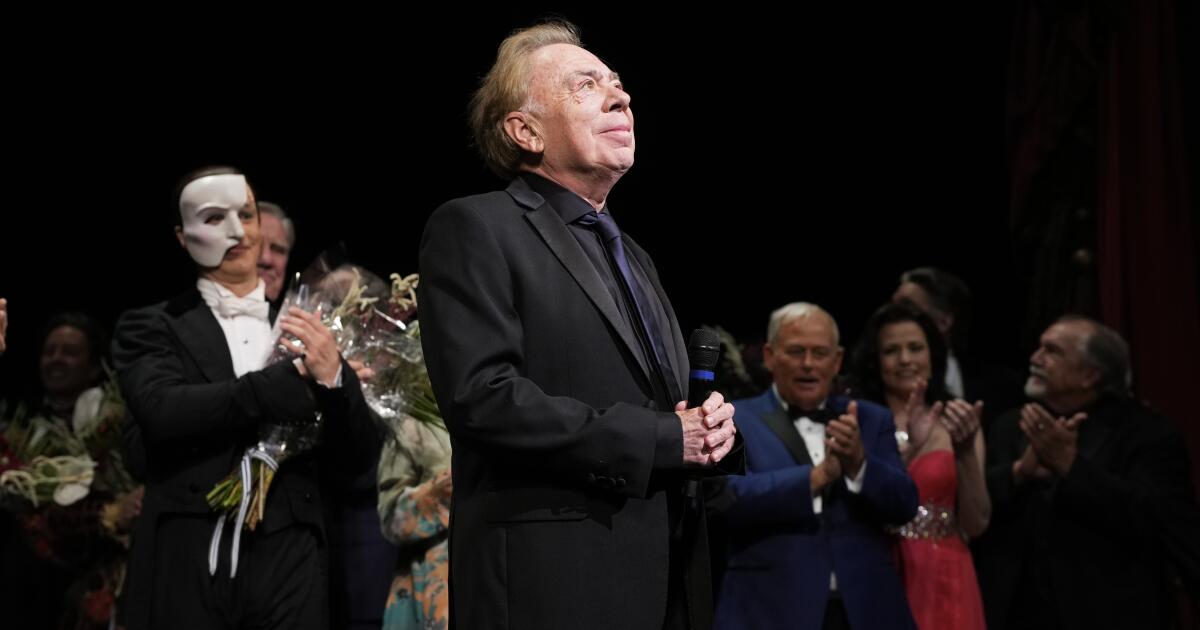
The Phantom of the Operaopened in London in 1986 and became one of the most commercially successful musicals in theatre history.
Its financial importance extends beyond its original West End and Broadway productions. The musical has supported international productions, touring versions, recordings, a feature film, licensed products and later theatrical interpretations.
The Broadway production closed in 2023 after becoming the longest-running show in Broadway history. The musical continues to be staged elsewhere, including at His Majesty’s Theatre in London.
Cats
Catsopened in London in 1981 and developed into a global theatrical property.
Its original West End and Broadway runs were followed by tours, licensed productions, revivals, recordings and a film adaptation.
Not every version has produced a profit. The value lies in the title’s ability to support repeated commercial use across different markets and formats.
Jesus Christ Superstar And Evita
Lloyd Webber’s collaborations with Tim Rice helped create valuable theatrical and musical rights before his theatre business reached its later scale.
Jesus Christ Superstarand Evitagenerated opportunities through recordings, stage productions, international licensing, tours and screen adaptations.
Each successful revival or adaptation can renew interest in the underlying score and create another commercial cycle.
Sunset Boulevard And School Of Rock
Sunset Boulevarddemonstrates the value of major revivals. A successful revival can generate new ticket sales, recordings, touring opportunities and future licensing demand.
School of Rockopened on Broadway in 2015 and later expanded into other markets. It broadened Lloyd Webber’s commercial catalogue beyond the works most closely associated with the 1970s and 1980s.
How One Musical Can Produce Several Income Streams
A successful musical can create value through several stages:
- The music and songs establish protected intellectual property.
- An original production creates a recognisable title.
- Professional productions and tours pay contractual fees and royalties.
- Regional, amateur and school productions expand the licensing market.
- Recordings, films and television create additional uses.
- Merchandise adds another revenue source.
- Revivals renew public interest and begin another commercial cycle.
Not every production succeeds, and not every payment belongs solely to the composer. The value comes from having several possible uses for works that remain popular over long periods.
Can Productions Linked To Andrew Lloyd Webber Lose Money?
Yes. A production connected with Lloyd Webber can fail to recoup its investment even when ticket sales appear strong, but that does not show that he personally lost the same amount.
A recent example is Cats: The Jellicle Ball on Broadway. The Guardian reportedthat the production cost $18 million and was taking about $1 million a week in grosses, yet was set to close without recouping because of high running costs.
A show can therefore attract strong reviews and substantial ticket sales while still failing to return all of its investors’ money. This is another reason box-office gross cannot be converted directly into a composer’s personal earnings.
Andrew Lloyd Webber’s Property And Art
Property and art may form part of Lloyd Webber’s wealth, but no reliable current total is publicly available.
Hampshire Property
Lloyd Webber has long been associated with a historic country estate in Hampshire.
No dependable current valuation was found that could be added to his estimated net worth. A property’s contribution also depends on its ownership structure, debt, taxes and maintenance costs.
Art Collection
Lloyd Webber is known for collecting Victorian and Pre-Raphaelite art.
The collection may contain valuable works, but its current contents and ownership structure are not fully public. Paintings may also be bought, sold, donated or transferred over time.
No reliable current valuation of his personal collection is available.
Foundation Assets Are Not Personal Assets
In 2010, the Andrew Lloyd Webber Foundation sold a Picasso portrait for £34.7 million, according to The Wall Street Journal.
The seller was Lloyd Webber’s charitable foundation rather than Lloyd Webber acting personally.
Assets owned by a charity should not be added to the founder’s personal wealth simply because the organisation carries that person’s name.
Does Andrew Lloyd Webber Own His Musicals?
Andrew Lloyd Webber controls major rights connected with his compositions, but ownership of a complete musical is rarely simple.
A production can involve separate rights for:
- the music;
- the lyrics;
- the script or book;
- publishing;
- recordings;
- film and television adaptations;
- merchandise;
- individual territories;
- specific productions.
Collaborators and their estates may retain interests alongside Lloyd Webber and his companies.
It is therefore more accurate to say that he controls substantial musical and theatrical rights than to say he personally owns every part of every production.
Is Andrew Lloyd Webber A Billionaire?
Andrew Lloyd Webber is not confirmed as a current dollar billionaire.
Business Insider reported that the 2019 Sunday Times Rich List estimate of £820 million was equivalent to about $1.074 billion at the conversion used in its report. That historical figure explains why older coverage described him as a dollar billionaire.
The 2026 Sunday Times Rich List estimate is £516 million. Celebrity Net Worth still displays a $1.2 billion estimate, but its page does not provide a transparent current valuation of Lloyd Webber’s musical rights, companies, property, investments and liabilities. The £516 million Rich List estimate is the stronger current public benchmark.
How Reliable Is The £516 Million Estimate?
The £516 million figure is the strongest recent public estimate, but it remains an estimate.
Several important figures remain private:
- the current value of Lloyd Webber’s musical catalogue;
- his annual royalty income;
- his share of individual productions;
- the current value of his property and art;
- personal cash and investments;
- personal borrowing and tax liabilities.
Companies House filings confirm control and provide useful company figures. They do not reveal Lloyd Webber’s complete personal finances.
Company turnover, cash and net assets cannot be added together to estimate personal wealth. Turnover is revenue measured over a period, while cash and net assets are balance-sheet figures at a point in time. All three are company figures rather than Andrew Lloyd Webber’s personal assets or income.
The most accurate current description is that the Sunday Times Rich List estimated Andrew Lloyd Webber’s fortune at £516 million in 2026, while the exact value remains private.
Frequently Asked Questions
What Is Andrew Lloyd Webber’s Net Worth In 2026?
Andrew Lloyd Webber’s net worth is estimated at £516 millionby the 2026 Sunday Times Rich List. It is a public estimate rather than a confirmed statement of his exact assets and liabilities.
How Did Andrew Lloyd Webber’s Estimate Change From 2025 To 2026?
The Sunday Times Rich List estimate rose from £500 million in 2025 to £516 million in 2026. These are separate publication-year estimates, not a verified range for his current wealth.
Why Do Some Websites Say Andrew Lloyd Webber Is Worth $1.2 Billion?
The $1.2 billion figure is published by Celebrity Net Worth and repeated by other entertainment websites. It does not come with a complete current valuation of his musical rights, companies, property, investments and debts.
Is Andrew Lloyd Webber Still A Billionaire?
Andrew Lloyd Webber is not confirmed as a current dollar billionaire. Business Insider reported that the 2019 £820 million Rich List estimate was equivalent to about $1.074 billion at the conversion used then. The 2026 Sunday Times Rich List estimate is £516 million, while the widely repeated $1.2 billion figure lacks a transparent current valuation.
What Is Andrew Lloyd Webber’s Main Source Of Income?
His main long-term income sources are musical rights, composer royalties, publishing, international licensing, theatrical productions and theatre-company interests.
Does Andrew Lloyd Webber Still Earn Royalties From Cats And Phantom?
Authorised productions, recordings and adaptations can continue generating royalties and licensing income. His exact annual payments and contractual percentages are private.
How Much Does Andrew Lloyd Webber Earn Each Year?
No verified total for his annual personal income is publicly available. Company turnover, theatre box-office receipts and aggregate directors’ remuneration are not his personal salary.
How Many London Theatres Does LW Theatres Operate?
LW Theatres operates six London venues: the Adelphi, Cambridge, Gillian Lynne, His Majesty’s, London Palladium and Theatre Royal Drury Lane. The Adelphi is co-owned with Nederlander International. This does not mean that each property is held directly by Andrew Lloyd Webber as a personal asset.
Final Verdict
Andrew Lloyd Webber’s latest public net-worth estimate is £516 million, but his exact wealth remains private.
His fortune is supported by valuable musical rights, worldwide licensing, production interests, recordings, adaptations and interests in companies operating six major London venues.
The £516 million Sunday Times figure is the strongest current benchmark. Older £820 million estimates and the widely repeated $1.2 billion claim should not be treated as his confirmed present wealth.
Jump to
What Is Andrew Lloyd Webber’s Net Worth?
Why Do Andrew Lloyd Webber’s Net Worth Estimates Differ?
Why His Exact Wealth Cannot Be Calculated Publicly
How Andrew Lloyd Webber Made His Money
What The Latest LW Theatres Group Filing Confirms
The Musicals Behind Andrew Lloyd Webber’s Fortune
Can Productions Linked To Andrew Lloyd Webber Lose Money?
Andrew Lloyd Webber’s Property And Art
Does Andrew Lloyd Webber Own His Musicals?
Is Andrew Lloyd Webber A Billionaire?
How Reliable Is The £516 Million Estimate?
Frequently Asked Questions
Final Verdict

James Rowley
Author
James Rowley is a London-based writer and researcher covering London life, cultural geography, London travel, live London webcam pages and selected public figures across entertainment, sport, business and public life.
For over 15 years, he has focused on verified sources, first-hand local context and clear explanations that help readers understand both places and people more deeply. His work combines street-level London knowledge with careful research into career credits, media work, business interests and, where relevant, transparently explained net worth estimates.
He writes and reviews articles published on LondonWebcam.
Latest Articles
Popular Articles