Expert Programmers In London: How To Hire The Right Fit
Find expert programmers in London: hiring routes, recruiters, vetted networks, marketplaces, cost bands, IR35 basics, and a practical vetting scorecard.
Author:James RowleyMar 11, 20266.1K Shares103.2K Views

Programmers In London: How To Find And Hire The Right Fit Without Guesswork
A London-based founder receives an urgent message at 8:17 am: We need a senior engineer by yesterday. Payments are failing.
By lunchtime, they’ve opened five tabs: an agency list, a freelancer marketplace, a recruiter’s pitch deck, a salary page, and a Slack thread full of DM me replies. Everything looks promising. Nothing feels certain.
London is brilliant at producing options. The hard part is choosing the right option-and proving the person you hire is genuinely expert, not just good at sounding senior.
Below is a London-first hiring playbook: where expert programmers are actually identified, what an expert looks like in evidence, not titles, what it typically costs, and a vetting process you can run even if you’re not a CTO.
Key Takeaways:
- Pick a route based on urgency and risk:vetted networks for speed, recruiters for niche searches, marketplaces for breadth, agencies for delivery teams.
- Define expert with proof:shipped systems, clear trade-offs, and credible references beat years-of-experience claims.
- Budget with real ranges, then triangulate: salary trackers and job-ad data often disagree - use at least two sources and real quotes before committing.
- Vetting beats vibes:a brief system-design chat, a paired session, and a small paid trial are more predictive than trivia.
- Don’t sleep on IR35 if contracting:determine status early and document the engagement using HMRC guidance and tools.
Quick Look:
Data as of early 2026
| Feature | The Reality for Employers |
| Top Sourcing Hubs | King's Cross AI/ML PhDs, Shoreditch Product/UI, Canary Wharf Low-Latency C++. |
| Most Competitive Roles | AI/ML Engineers, Python/PyTorch and Quant Developers C++. |
| Cost of Expert Talent | £90,000 - £160,000+ Base salary budget for Senior/Staff roles. |
| Key Competitors | DeepMind, Google, Meta, Revolut, Tier 1 Investment Banks. |
| The Hook | Experts are drawn to autonomy, Shoreditch or prestige/pay City. |
The Geography Of Talent: Where Experts Gather

London is not a monolith; it is a collection of villages. In the tech sector, these villages are defined by the problems they solve. I’ve spent years walking these districts, and the difference in atmosphere is palpable.
Silicon Roundabout & Shoreditch: The Creative Engine

Ten years ago, the Silicon Roundabout at Old Street was the undisputed heart of London tech. While the hype has matured, the area remains the spiritual home of the startup.
Walking through Shoreditch, past the converted warehouses and co-working spaces like Huckletree or Second Home, you sense a distinct energy.
This is the habitat of the Product Engineer-experts who build user-facing applications. The code here is often JavaScript, TypeScript, or Ruby.
The attire is casual, the hours are flexible, but the pressure to ship features is intense. It is less about algorithmic perfection and more about product-market fit.
If you see a developer sketching a system architecture on a napkin in a coffee shop on Redchurch Street, they are likely building the next fintech unicorn or creative agency platform.
King’s Cross: The Knowledge Quarter

Travel a few miles west to King's Cross, and the atmosphere shifts. This is the Knowledge Quarter, anchored by the British Library and the Alan Turing Institute.
Dominating the skyline is the Landscraper-Google’s massive HQ - and the offices of Google DeepMind.
Here, the expertise is academic and research-heavy. The programmers walking these streets are often PhDs in machine learning or computational neuroscience. The dominant language is Python, specifically PyTorch and TensorFlow.
The focus is on the long game: Artificial General Intelligence AGI and solving protein folding. It feels less like a business district and more like an elite university campus that happens to have a multi-billion-pound budget.
Canary Wharf & The City: The Financial Fortress

Take the Jubilee Line east, and you emerge into the steel canyons of Canary Wharf. The wind is colder here, and the dress code is sharper. This is the domain of High-Frequency Trading HFT and institutional banking.
The experts here are arguably the most disciplined engineers in the world. They work in C++ and require a deep understanding of hardware architecture. In this habitat, latency is the enemy. A delay of a microsecond can cost millions.
The culture is higher stress and less forgiving than Shoreditch, but the financial rewards are significantly higher. You aren't paid to be creative; you are paid to be faster than the competition.
Local Insight: Don't overlook the FinTech Fringe, bridging the City and Shoreditch areas like Moorgate and Liverpool Street. Companies like Revolut and Monzo sit here, blending the aggression of Canary Wharf with the agility of Shoreditch.
What An Expert Really Means When You’re Hiring In London

You’ll leave this section with a practical definition of an expert you can use in job briefs, interviews, and stakeholder conversations, without hiding behind buzzwords.
Proof Signals That Beat Titles
In London’s hiring market, senior is a common term. An expert needs evidence. The simplest way to make it measurable is to look for proof of complex delivery plus good judgment under constraints.
A candidate is closer to an expert when they can show:
- End-to-end ownership:they didn’t just code tickets; they shaped the approach, handled trade-offs, and carried responsibility for outcomes.
- Complexity experience:systems with real users, real failure modes, real performance/security constraints.
- Reasoned trade-offs:they can explain why they chose one architecture or toolchain over another, and what they’d do differently now.
- Quality habits that scale:testing discipline, code review culture, observability, and documentation that helps the next engineer move fast.
If you want a neutral benchmark for what good looks like at different levels, the UK Government’s Software developer role levels in the Government Digital and DataDDaT capability framework can help you translate seniority into observable responsibilities.
The Specialist Stacks London Buyers Pay Extra For
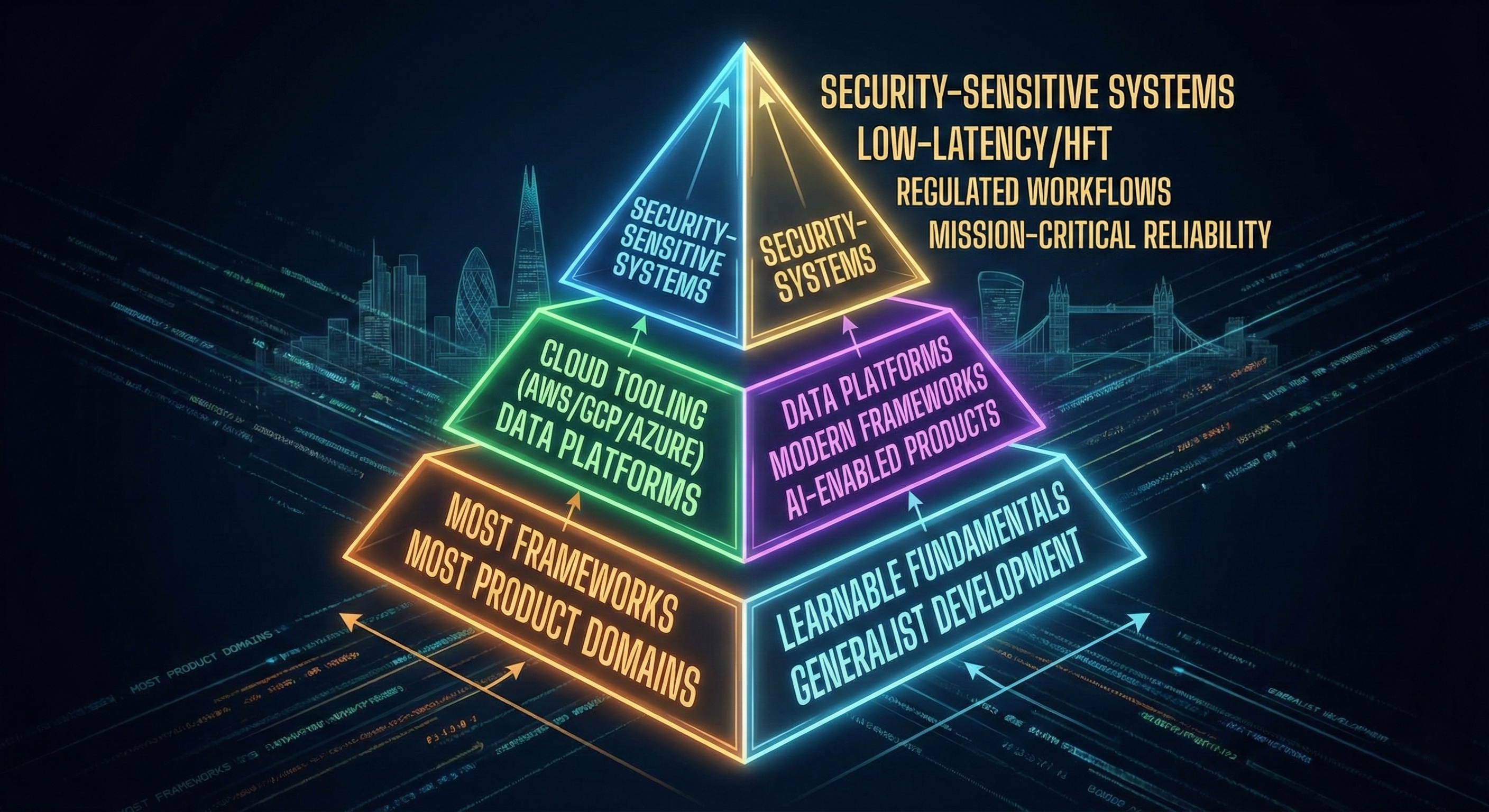
London demand tilts toward certain domains-fintech, security, data platforms, and AI-enabled products. That doesn’t mean you must hire a unicorn; it means you should be honest about what’s must-have versus learnable.
A useful split:
- Must-have:security-sensitive systems, regulated workflows, mission-critical reliability, hard latency/performance constraints.
- Learnable with strong fundamentals:most frameworks, most cloud tooling, most product domains-if the engineer is genuinely strong.
One thing:experts ask better questions early. They’ll probe risk, data flows, failure modes, and ownership boundaries before they pitch solutions.
Red Flags That Waste Weeks
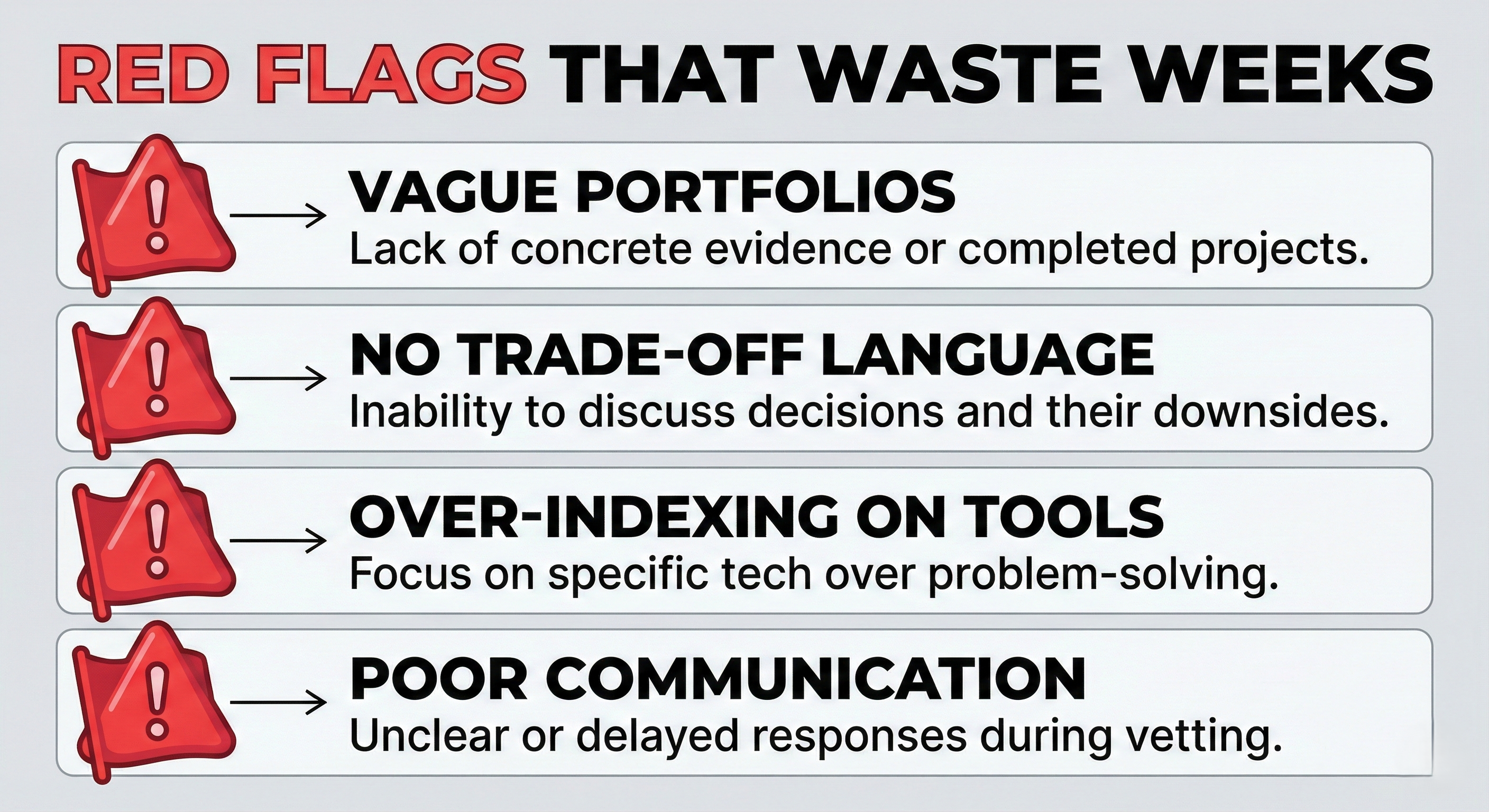
London’s biggest hiring time-sink is confusing confidence for competence. Common red flags:
- Vague portfolios:lots of I led with no concrete scope, constraints, or results.
- No trade-off language:every choice is best practice, nothing is context-dependent.
- Refusal to discuss failure:experts have war stories; they also have the humility to name what went wrong and what they changed.
- Over-indexing on tools:a blur of libraries without clear reasoning or outcomes.
Takeaway:Define expert as proof + judgment, then use that definition to guide where you source and how you assess, because London will happily sell you confidence in bulk.
The Best Ways To Hire Expert Programmers In London, And When Each Wins
Vetted Networks: Speed Vs Premium
Vetted networks reduce noise. You pay more fees or higher rates, but you often get:
- Faster shortlists
- Better screening
- Less admin overhead
This route tends to win when you need someone within 1–3 weeks, and the role has high downside risk payments, security, and data integrity.
Marketplaces: Breadth Vs Screening Burden
Marketplaces offer breadth and price variation. The trade-off is that you become the screening engine. If your team can vet well, it’s a strong option; if not, it’s easy to burn time on interviews that go nowhere.
Recruiters/headhunters: Niche Reach Vs Fees, Including Oliver Recruitment Context
Specialist tech recruiters are common in London, and they can be valuable when:
- The role is a niche, rare stack, regulated domain, and a leadership hire
- You need speed with a tighter fit
- You want candidates who aren’t actively applying
Agencies like Oliver Bernard, Client Server, or Understanding Recruitment are deeply embedded in the London ecosystem.
The key is transparency:
- What screening happened before the intro?
- What does senior mean in their rubric?
- What are the fees, terms, and replacement policies?
Agencies/teams: Delivery Capacity Vs Less Direct Control
Agencies can be the right call when you need a team outcome, not just an individual, especially for time-boxed builds. You trade some control for delivery capacity and project management.
Be cautious with the top agencies in London list sites: they’re useful for finding names, but rarely explain fit. Your process has to do that.
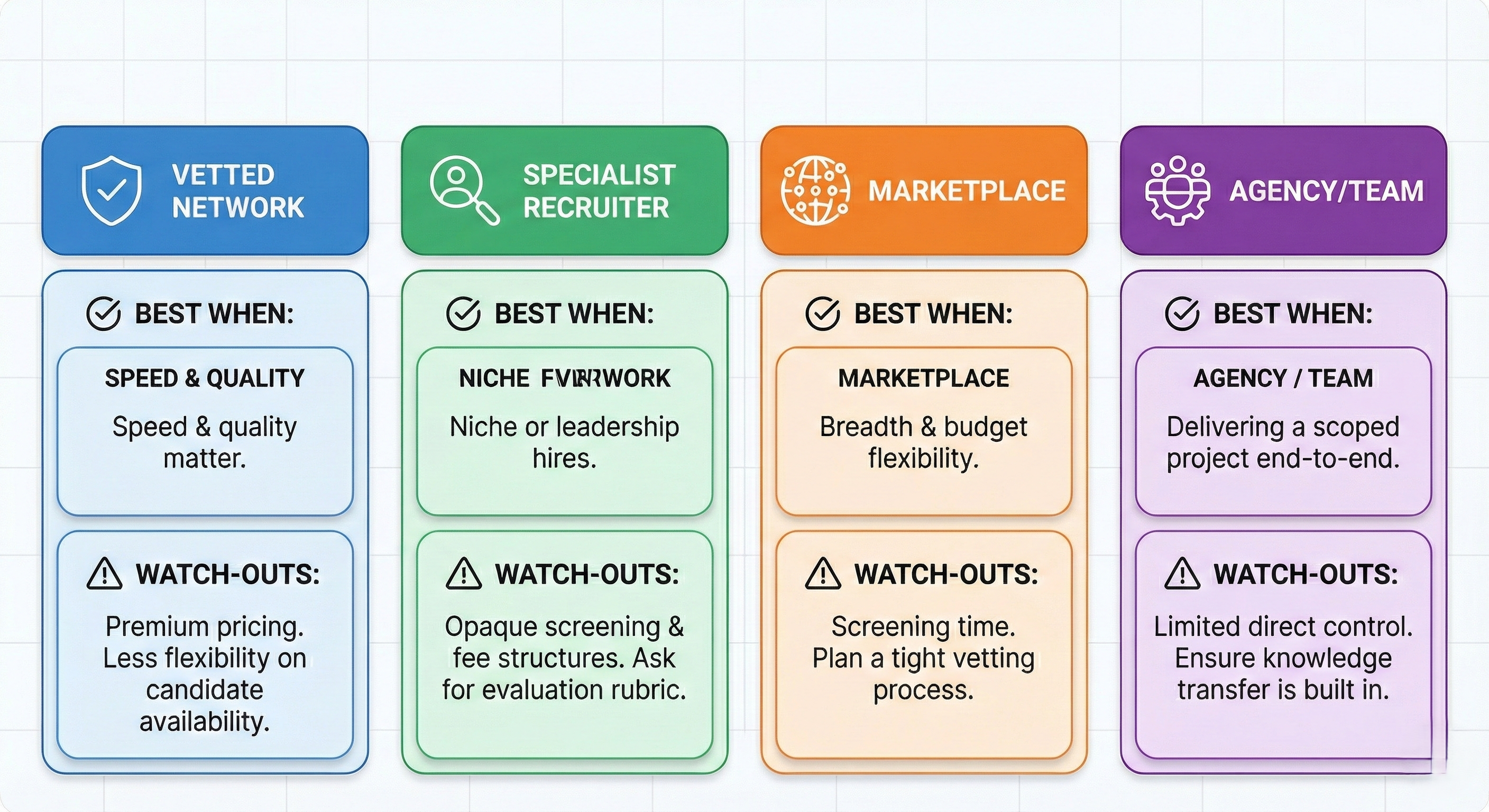
Decision Table: Which Route Fits Your Situation?
| Hiring route | Best when / watch-outs |
| Vetted network | Best when speed and quality matter; watch for premium pricing and less flexibility on candidate availability. |
| Specialist recruiter | Best for niche or leadership hires; watch for opaque screening and fee structures-ask for their evaluation rubric. |
| Marketplace | Best for breadth and budget flexibility; watch for screening time, plan a tight vetting process. |
| Agency/team | Best for delivering a scoped project end-to-end; watch for limited direct control and ensure knowledge transfer is built in. |
| Community sourcing | Best for high-signal referrals; watch for poor outreach leads with problem clarity and respect the space. |
Takeaway:Pick the channel that matches your urgency and your team’s ability to assess; then lock in a repeatable vetting process before you talk to candidates.
Cost Reality-London Salaries, Day Rates, And What You’ll Really Spend

You’ll get realistic benchmarks and a budgeting method that avoids the classic London mistake: underestimating the total cost of hiring.
Salary Benchmarking And Why Sources Disagree
Salary numbers vary because different sources measure different things:
- Job-ad vacancy data reflects what employers offer in adverts.
- Self-reported salary platforms reflect what individuals report, sometimes mixing titles/levels.
- Official statistics are methodologically strong but may not match your exact role definition.
A practical benchmark:IT Jobs Watch reports a median Software Developer salary in London of £70,000 based on advertised roles in the six months leading to 30 November 2025.
Self-reported platforms can land lower or show different distributions. For example, Glassdoor’s London software developer pages show a range with a reported average around the mid-£50k area.
How to use this without getting trapped in numbers:
- Use two sources to establish a band.
- Get three real quotes from candidates or recruiters for your exact stack and seniority.
- Budget for total cost, see below, not just base salary.
For a wider earnings context and methodology, the Office for National Statistics’ Annual Survey of Hours and EarningsASHE explains how UK earnings data is compiled.
Contractor Day Rates And Market Guides: How To Sanity-check
For contracting, the same triangulation rule applies.
IT Jobs Watch reports a median Software Developer daily rate in London of £550 based on vacancies in the six months leading to 17 January 2026.
Rates depend heavily on:
- Inside vs outside IR35 status
- Niche skills cloud, security, low-latency, and certain data stacks
- On-site expectations
- How urgently do you need someone
If you want a market narrative rather than a single number, Hays publishes a UK tech contractor day-rate guide. Access is gated, but it’s useful for trend context.
Worked Budget Example: 12-week Build Vs 12-month Hire
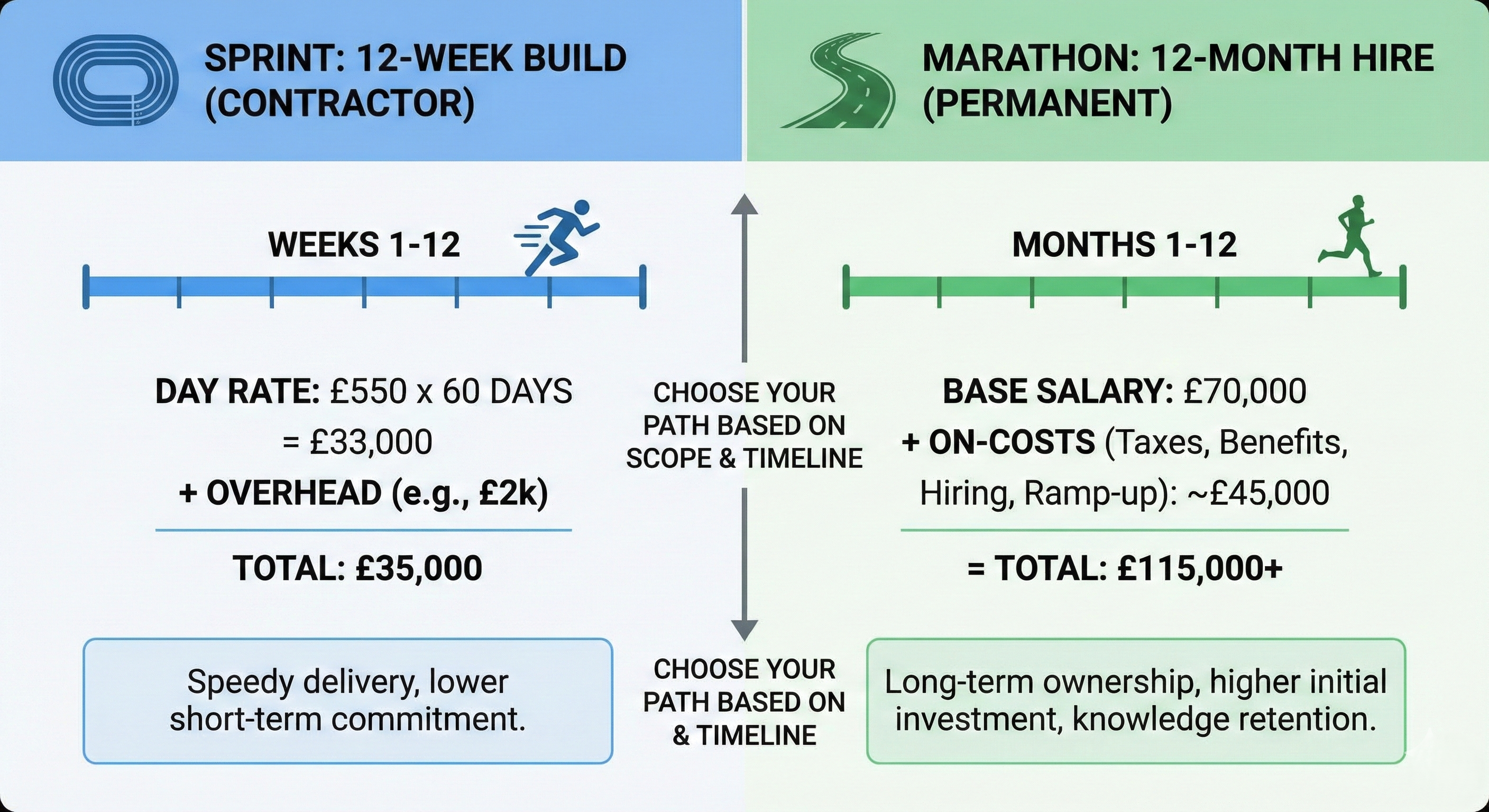
Here’s a simple scenario a London product team might face:
Scenario A:12-week rescue build with a contractor
- Contractor day rate:£550/day, London median; Data as of Jan 2026
- Days:5 days/week × 12 weeks = 60 days
- Contractor cost headline:60 × £550 = £33,000
Add Realistic Overhead:
- Interview + onboarding time internal:10–20 hours
- Tooling/licences and environments
- A contingency buffer for scope creep
Scenario B:12-month permanent hire
Salary headline:£70,000 median advert benchmark.
Realistic additions:
- Employer on-costs, pension, NI, and benefits vary by employer setup
- Hiring time multiple interview hours across the team
- Ramp-up time before full productivity
How to use this example:
- If the work is urgent and scoped, contracting can be cheaper in the short term.
- If the work is core to the business and will keep changing, a permanent hire often wins on long-term ownership.
Takeaway:In London, the winning budget isn’t the cheapest headline number-it’s the one that includes hiring time, ramp-up, and the cost of getting it wrong.
Contracts And Compliance In The UK: IR35, IP, And Data Basics
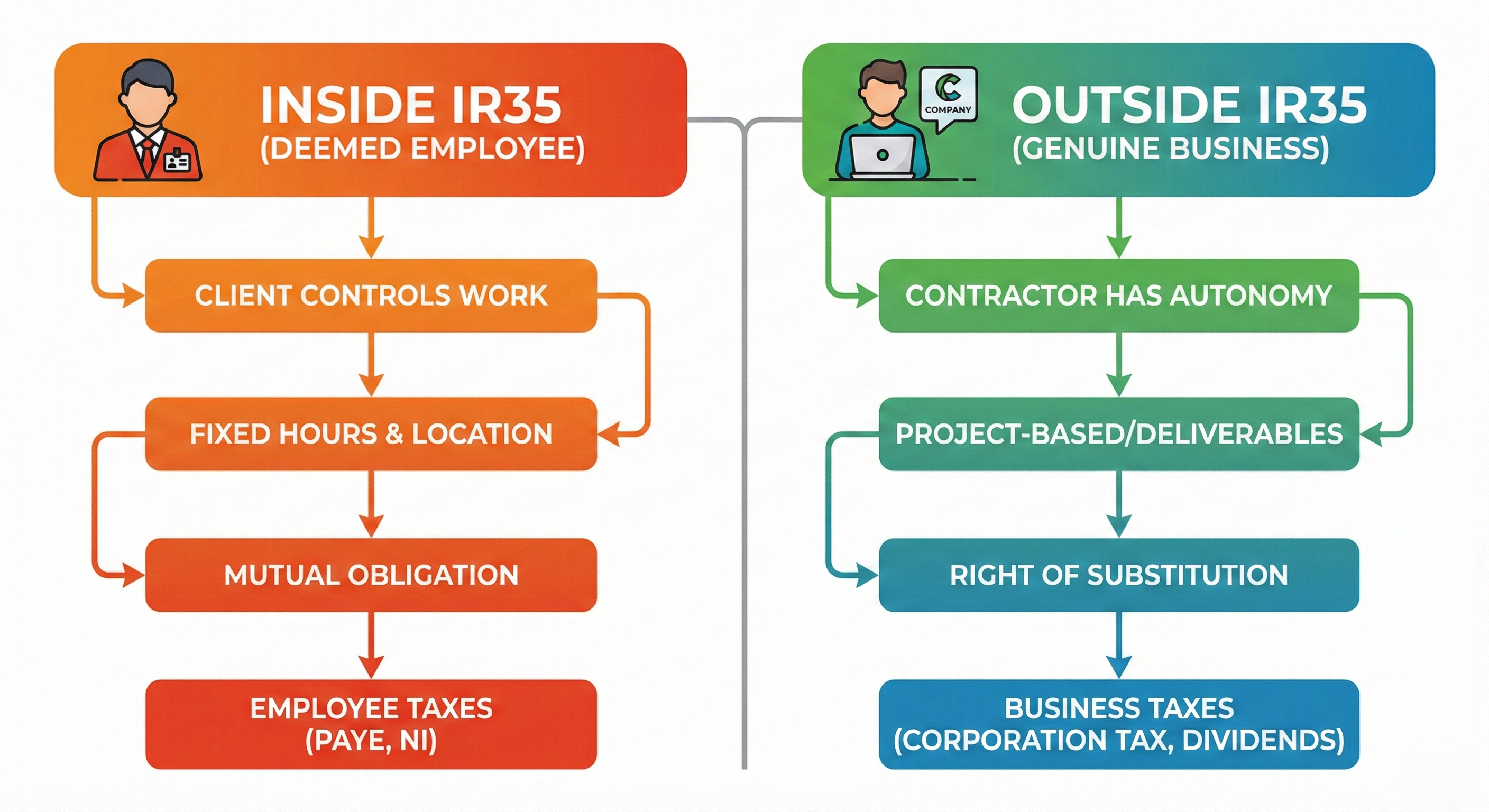
IR35 In Plain English And Where Teams Go Wrong
IR35 off-payroll working rules affect whether a contractor engagement should be treated like employment for tax purposes. HMRC’s guidance explains the framework and why correct classification matters.
A common point teams miss:since 6 April 2021, medium and large clients are generally responsible for determining a contractor’s employment status for tax purposes in relevant engagements.
Practical Steps To Reduce Risk Engagement Structure + Documentation
Risk reduction here is mostly about clarity:
- Use a clear statement of work deliverables, timelines, and acceptance criteria.
- Define decision rights and autonomy realistically.
- Avoid engagement patterns that look like employment in practice where relevant.
- Document the status determination process and keep it consistent.
HMRC provides a free tool to help determine status for tax:Check Employment Status for Tax CEST.
IP Assignment And Data Basics
Expert programmers often touch core IP fast. Contracts should cover:
- IP assignment: who owns what’s built
- Confidentiality
- Data handling expectations,s especially if you process sensitive customer data.
If your org isn’t mature here, it’s worth getting a lightweight legal templat reviewed, because fixing IP gaps after the fact is expensive.
Takeaway:Great engineering hires don’t just reduce technical risk; the right contracting setup reduces business risk, especially for London’s contractor-heavy hiring routes.
Keeping Access To London’s Best Talent Once You’ve Hired Them
Promise:You’ll learn how to keep expert programmers effective and engaged, so you’re not back in the market three months later.
Onboarding That Experts Respect
Experts move fast when the problem is clear. The highest-leverage onboarding moves are:
- A crisp problem statement and success metrics
- A tour of how decisions get made
- Access to logs, dashboards, and environments on day one
- A first task that teaches the system without burying them in busywork
The Government’s Digital, Data and Technology Playbook highlights the importance of building in knowledge transfer, good advice, even outside government.
Community Presence And Referrals Are A Sustainable Sourcing Flywheel
In London, reputation travels through communities faster than job ads. Teams that consistently hire well tend to:
- Share learning talks, blog posts, and open-source contributions where appropriate
- Treat candidates respectfully, tight timelines, and clear feedback
- Keep relationships warm-even with non-now candidates
That’s how a future hire becomes a referral rather than another scramble.
Takeaway:Hiring expert programmers in Londongets easier when your team becomes the kind of place experts recommend.
Legends Of The Local Scene: Famous Figures
London has its own pantheon of tech royalty. While the global media focuses on Silicon Valley figures, London’s icons are often more understated but equally influential.
The Celebrity Coder: Demis Hassabis

If there is a face of London’s coding prowess, it is Sir Demis Hassabis. A former chess prodigy and video game designer, he co-founded DeepMind in London before it was acquired by Google.
He represents the quintessential London Expert:academically rigorous, crossing disciplines of neuroscience and computer science, and deeply embedded in the city’s intellectual culture. His presence in King's Cross attracts talent from all over the globe, solidifying London's status as an AI capital.
Global Icons Vs. Local Reality
I often get asked if figures like Elon Musk or Bill Gates are London programmers. They aren't, but their influence shapes the city.
The Musk effect-a push for hardcore engineering culture - is visible in the new wave of London AI startups trying to replicate the intensity of SpaceX.
However, London tends to reject the move fast and break things ethos when it clashes with regulation. The expert programmer here navigates a world that values innovation, but respects the rules of the Financial Conduct Authority FCA.
Frequently Asked Questions
Where Can I Find Expert Programmers In London Quickly?
Use vetted networks, specialist recruiters, or targeted London communities-then shortlist using a repeatable scorecard and a small paid trial to confirm fit.
What Makes A Programmer An Expert, Not Just A Senior?
Evidence of complex delivery, strong fundamentals, clear trade-offs, and reliable outcomes, validated by references and practical assessments.
Freelancer, Agency, Or In-house Hire - Which Is Best?
Choose by urgency and control: freelancers for speed, agencies for delivery teams, in-house for long-term ownership.
How Much Does It Cost To Hire A Software Developer In London?
Expect wide ranges by level and stack; benchmark salaries/day rates, then budget for hiring time, tooling, and management overhead.
What’s A Typical London Contractor Day Rate?
Day rates vary by seniority and niche; use reputable market data, for example, vacancy-based rate trackers, and validate with multiple quotes.
How Do I Vet An Expert Programmer If I’m Not Technical?
Use a structured scorecard: portfolio proof, scenario questions, a short paired session or paid task, and a reference check focused on outcomes.
What Interview Format Best Predicts Real Performance?
A short system-design discussion plus a pairing session on your stack tends to show thinking, communication, and practical delivery better than trivia.
What Are The Red Flags When Hiring Expert Developers?
Vague project details, overconfident claims without evidence, refusal to discuss trade-offs, and no clear ownership of outcomes are common red flags.
Should I Use A Tech Recruiter In London?
Use one when speed matters or the role is niche; insist on transparent screening criteria and clear fee and replacement terms.
What Is IR35 And Why Should I Care?
IR35 affects how contractors are taxed and assessed; misclassification can create cost and admin risk for the hiring company. See HMRC guidance for specifics.
How Do I Reduce IR35 Risk When Engaging Contractors?
Use clear statements of work, genuine autonomy, and a documented status determination process aligned with HMRC off-payroll guidance and tools.
Can I Hire And Sponsor A Developer From Abroad For London?
Potentially, if the role matches eligible occupations and requirements, start with the official Skilled Worker eligibility and sponsorship obligations.
Where In London Is The Tech Talent Concentrated?
East London clusters like Old Street/Shoreditch remain symbolic hubs, but talent is citywide and often hybrid communities matter more than postcodes.
What Should My Job Brief Include To Attract Experts?
Business problem, constraints, stack, success metrics, decision rights, and interview timeline-experts screen for clarity and ownership.
How Long Does It Take To Hire An Expert Programmer In London?
Timelines vary by channel; it’s often faster with vetted networks and tight scopes, and slower for permanent hires with multi-stage interviews.
Is Remote Or Hybrid Work Reducing The Need For London-based Workers?
Yes, many teams hire UK-wide; London still helps for in-person cadence and networking, but it’s not always a hard requirement.
Final Thoughts
London is a city of layers. You can walk past a 300-year-old pub and have no idea that the building next door houses a server rack processing billions in cryptocurrency.
For the expert programmer, London offers something unique: a chance to work at the bleeding edge of technology without sacrificing the rich, historic texture of a great world city.
Whether you find your home among the creatives of Shoreditch, the academics of King's Cross, or the traders of Canary Wharf, the opportunity is here. The code is the new foundation of this capital, and those who can write it hold the keys to the city.
Jump to
Programmers In London: How To Find And Hire The Right Fit Without Guesswork
The Geography Of Talent: Where Experts Gather
What An Expert Really Means When You’re Hiring In London
The Best Ways To Hire Expert Programmers In London, And When Each Wins
Cost Reality-London Salaries, Day Rates, And What You’ll Really Spend
Contracts And Compliance In The UK: IR35, IP, And Data Basics
Keeping Access To London’s Best Talent Once You’ve Hired Them
Legends Of The Local Scene: Famous Figures
Frequently Asked Questions
Final Thoughts

James Rowley
Author
James Rowley is a London-based writer and researcher covering London life, cultural geography, and selected public figures across entertainment, sport, business, and public life.
For over 15 years, he has focused on verified sources, first-hand local context, and clear explanations that help readers understand both places and people more deeply. His work combines street-level London knowledge with careful research into career credits, media work, business interests, and, where relevant, transparently explained net worth estimates.
He writes every article published on London Webcam.
Latest Articles
Popular Articles