London Slang Words And Meanings: 90+ Terms Explained
London slang words and meanings made practical: learn common phrases, Cockney classics, roadman slang and when to use, recognise or avoid each term.
Author:James RowleyMay 03, 202613.4K Shares210.5K Views
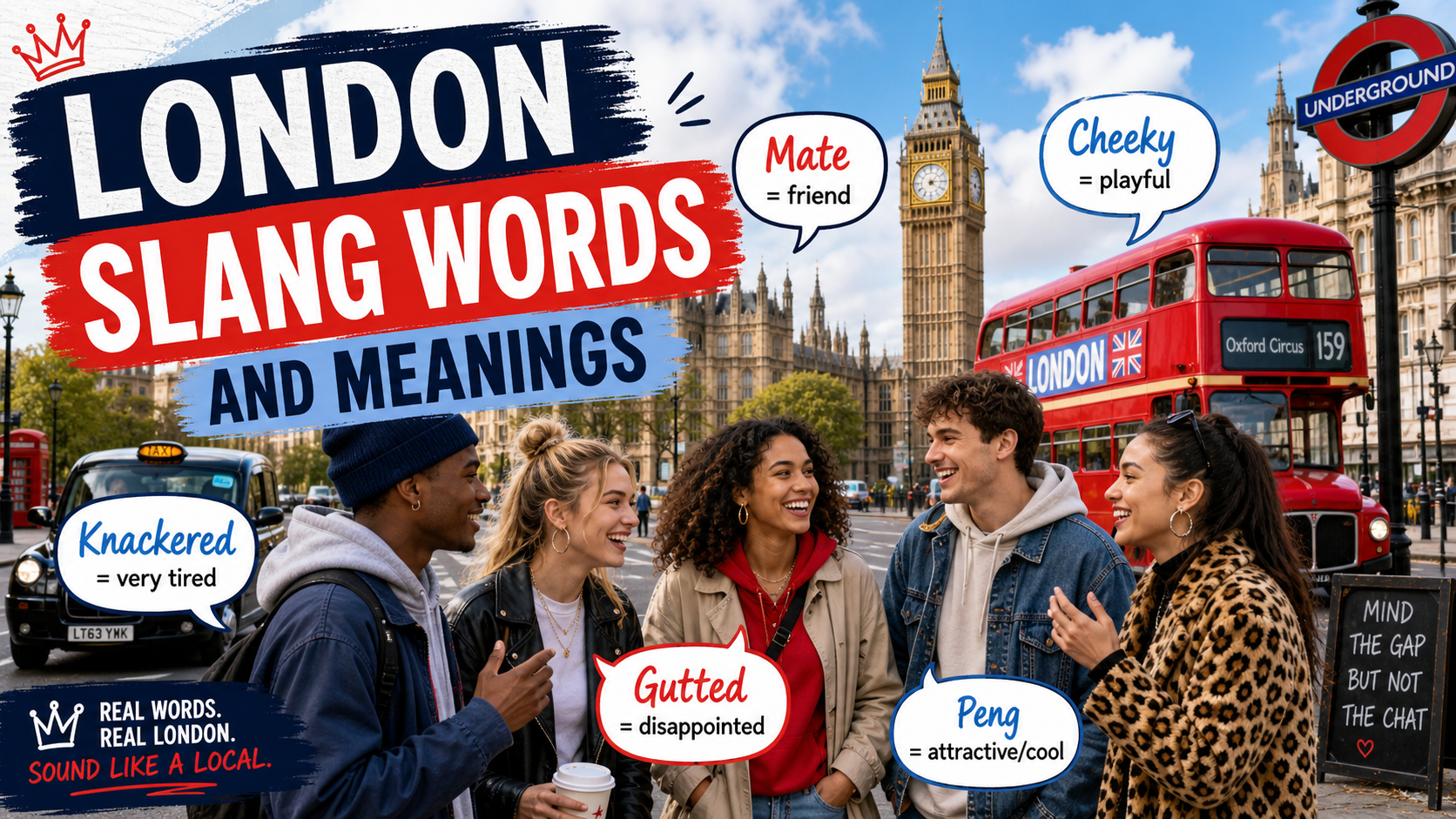
London Slang Words And Meanings: What To Use, Recognise And Avoid
Trying to understand Londonslang can feel like tuning into three conversations at once: everyday British English, old East End Cockney, and modern youth slang shaped by music, migration, school, social media, and local identity.
The trick is not to memorise every word. It is to know what a word means, where it belongs, and whether you should actually use it. A common mistake is treating every slang word as interchangeable. “Cheers,” “innit,” “peng,” and “apples and pears” all belong to different social worlds, even though you might hear or read them under the same “London slang” label.
Slang changes quickly, especially online and among younger speakers. Use this as a practical recognition guide first, and a speaking guide only when the context feels natural.
Key Takeaways
- London slangincludes everyday British slang, Cockney rhyming slang, Multicultural London English, and roadman-adjacent youth slang.
- Common modern London words include peng, bare, bruv, fam, ends, bait, peak, safe, and mandem.
- Cockney phrases such as apples and pearsand dog and boneare culturally important, but many are now more heritage than everyday youth speech.
- Some slang is harmless; some is rude, class-coded, gendered, or linked to crime stereotypes.
- The safest rule is: understand first, copy slowly, avoid insults unless you know the relationship and setting.
Quick London Slang Cheat Sheet
These are some of the most useful London slang words to recognise first.
| Must-know London slang | Quick meaning |
| Peng | Attractive, tasty, excellent, or very good. |
| Bare | A lot, many, or very. |
| Bruv | Brother, bro, or mate. |
| Fam | Close friend or chosen family. |
| Ends | Local area or neighbourhood. |
| Peak | Bad, unlucky, awkward, or unfair. |
| Safe | Good, okay, thanks, or no problem. |
| Innit | Informal tag for agreement or emphasis. |
| Allow it | Stop it, leave it, or don’t bother. |
| Mandem | Group of male friends. |
| Wagwan | What’s going on? Use carefully. |
| Apples and pears | Cockney rhyming slang for stairs. |
| Quid | One pound sterling. |
Here is the quick “use or recognise” filter:
| Slang type | Example - Best approach |
| Everyday British slang | cheers, mate, quid - Usually safe in casual settings |
| London/MLE-influenced slang | peng, bare, ends - Recognise first; use carefully |
| Roadman-adjacent slang | mandem, feds, skeng - Mostly recognise; avoid performative use |
| Cockney rhyming slang | apples and pears - Good to understand; use lightly |
| Insults | mug, wasteman, wanker - Avoid unless you are very sure |
The rest of this page explains the words, the context, and the judgement calls that simple slang lists usually miss.
What Is London Slang?
London slang is not one single dialect. It is a living mix of old and new language, shaped by neighbourhoods, class, age, ethnicity, music, humour, and the constant movement of people through the city.
London Slang Vs British Slang
British slangcovers informal words used across the UK, such as mate, cheers, quid, knackered, gutted, and chuffed.
London slangis narrower. It includes words strongly associated with London speech and culture, such as ends, bare, peng, mandem, bruv, allow it, and Cockney rhyming slang like apples and pears.
Some words sit in the middle. Innit, for example, is heard beyond London, but it is strongly associated with London and south-east English speech.
If you want to go more local, it also helps to separate London by area. East London has its own long connection with Cockney and market speech, while South London is often linked with modern youth slang, music culture, and MLE-influenced phrases.
London Slang, British Slang, And Regional UK Slang: The Difference
Not all British slang is London slang. This is one of the biggest mistakes in many slang guides.
| Type of slang | How to understand it |
| London slang | Words strongly associated with London speech, such as ends, bare, peng, bruv, allow it, and mandem. |
| British slang | UK-wide informal words, such as mate, cheers, quid, knackered, gutted, and dodgy. |
| Cockney slang | East London heritage slang, especially rhyming slang such as apples and pears and dog and bone. |
| Regional UK slang | Words linked to other parts of the UK, such as howay in Geordie, canny in the North East, cwtch in Welsh English, or dreich in Scots. |
| Roadman-adjacent slang | Urban youth slang often linked with MLE, music, street style, and social media. Some terms are useful to recognise but risky to copy. |
This guide focuses on words you are more likely to hear, read, or need to understand in London. Regional UK terms are only included when they are also useful in London or help explain the difference.
Why London Slang Changes So Quickly
London slang changes because London changes. New words move through schools, estates, workplaces, music scenes, football culture, comedy, TikTok, and group chats.
Linguists at the University of York’s Multicultural London English projectdescribe Multicultural London English, or MLE, as a London English dialect that emerged from the early 1980s in areas with high levels of immigration. They note that it is based partly on traditional East End Cockney, but has different sounds and grammatical patterns.
That means modern London slang is not just “new Cockney.” It is a broader urban language mix, and many words carry social context as well as dictionary meaning.
The Four Main Layers: Cockney, MLE, Roadman Slang, Everyday British Slang
To understand London slang properly, split it into four layers:
- Everyday British slang- words like mate, cheers, quid, and knackered.
- Cockney slang- East London heritage terms, especially rhyming slang.
- Multicultural London English- modern London speech shaped by language contact and urban identity.
- Roadman-adjacent slang- youth and street-culture slang popularised through music, social media, and TV.
The key takeaway: a good London slang guide should tell you not only the meaning, but also the register, the risk, and the social setting.
Common London Slang Words And Meanings
This section gives you the words you are most likely to search, hear, or see online. Read the examples as recognition tools, not scripts to copy word-for-word.
People And Greetings: Bruv, Fam, Mate, Bossman, Mandem, Gyaldem
Bruvmeans brother, bro, or mate. Example: “You alright, bruv?”
Fammeans family, but in slang it often means a close friend. Example: “You good, fam?”
Matemeans friend. It is widely used across Britain and is one of the safest informal words to use. Example: “Cheers, mate.”
Bossmanis often used for a shopkeeper, takeaway worker, or man serving you, especially in casual city speech. Example: “Bossman, can I get chips?”
Mandemusually means a group of male friends. Example: “I’m linking the mandem later.”
Gyaldemusually means a group of girls or women. Use this one carefully, because context matters and it may sound unnatural from outsiders. Example: “The gyaldem are going out.”
Takeaway: mateand cheersare easy to use; mandemand gyaldemare better to recognise unless they already fit your social circle.
Reactions And Feelings: Peak, Gassed, Safe, Shook, Long
Peakmeans bad, unlucky, unfair, or awkward. Example: “You missed the train? That’s peak.”
Gassedmeans excited, hyped, or full of confidence. Example: “He was gassed after scoring.”
Safecan mean okay, good, cool, or thanks. Example: “Safe, I’ll see you later.”
Shookmeans nervous, shocked, or unsettled. Example: “I was shook when I saw the bill.”
Longmeans too much effort, annoying, or not worth it. Example: “Going across town for that is long.”
Takeaway: these words are useful because they express mood quickly, but they are still informal.
Places And Identity: Ends, Yard, Manor
Endsor endzmeans your neighbourhood, local area, or where you are from. Example: “I’m heading back to my ends.”
Yardcan mean home or house. Example: “Come round my yard later.”
Manormeans someone’s local area or patch. It is older and sometimes has a territorial feel. Example: “This is his manor.”
Takeaway: London slang often ties language to place. Words like endsare about belonging, not just geography.
Style And Appearance: Peng, Buff, Garms, Creps, Drip
Pengmeans attractive, excellent, tasty, or very good. Example: “That food looks peng.”
Buffmeans attractive or good-looking. Example: “She looked buff.”
Garmsmeans clothes. Example: “New garms for the party.”
Crepsmeans trainers or shoes. Example: “Those creps are fresh.”
Dripmeans stylish clothing, jewellery, or overall fashion. It is used beyond London too. Example: “He’s got serious drip.”
Takeaway: style slang spreads fast through music and social platforms, so always check whether a word still feels current in your setting.
Everyday Phrases: Innit, Allow It, Swear Down, You Get Me
Innitcomes from “isn’t it,” but it is often used as a general tag for agreement or emphasis. Example: “Cold today, innit?”
Allow itmeans stop it, leave it, or don’t bother. Example: “Allow it, that’s not worth arguing about.”
Swear downmeans “I’m telling the truth” or “seriously.” Example: “Swear down, I saw him there.”
You get memeans “do you understand?” or “you know what I mean?” Example: “It was just awkward, you get me?”
For a broader list of everyday expressions you might hear in shops, streets, pubs, markets, and group chats, see our guide to common london phrases.
Takeaway: these phrases are common in casual speech, but they can sound forced if every sentence is loaded with them.
Modern London Slang And Multicultural London English
Modern London slang makes more sense when you understand MLE. This section explains why some words feel newer, younger, and more urban than classic British slang.
What MLE Means
MLEstands for Multicultural London English. It is a modern London dialect, not just a list of slang words.
The University of York describes MLE as a dialect of London English that emerged in parts of the city with high immigration from the early 1980s onwards. It draws on traditional East End Cockney but has its own sounds and grammar.
This matters because many “London slang” words are not random internet phrases. They sit inside a wider way of speaking, especially among younger Londoners.
How Music, Social Media, And Youth Culture Spread Slang
Words such as peng, ting, bare, bait, and certihave travelled far beyond their original communities through UK rap, grime, drill, comedy clips, football culture, and TikTok.
A 2024 report from The Guardian on UK rap and languagedescribed how MLE-influenced terms have spread nationally through music and social media, especially among younger audiences.
That does not mean everyone in London uses these words. It means more people recognise them.
Where Modern London Slang Comes From
Modern London slang is shaped by several overlapping influences rather than one single source.
- Cockney and East End speech: Contributes older London words, humour, rhythm, and rhyming slang.
- Caribbean language influence: Helps explain words and patterns heard in London youth speech, music, and informal conversation.
- African and South Asian London communities: Add to the city’s multilingual soundscape and everyday language mixing.
- Schools and peer groups: Spread words quickly between young people from different backgrounds.
- Music and social media: Push local words into national and international use.
- Neighbourhood identity: Gives words like ends, yard, and manortheir social meaning.
London’s slang also reflects how multilingual the city is. Many everyday expressions, accents, and speech patterns are shaped by the languages spoken across London’s communities. For more context, see our guide to the most spoken languages in london.
This is why London slang is best understood as living city language, not just a dictionary of funny words.
Why “Jafaican” Is Not The Best Term
You may see the media term “Jafaican”used for MLE-influenced speech. It is better to avoid it.
The term can sound dismissive because it suggests people are “faking” Jamaican speech, when linguists treat MLE as a real London dialect shaped by many influences. York’s MLE project explicitly discusses the media label while defining MLE in linguistic terms.
Use Multicultural London Englishwhen you want to be accurate and respectful.
Currentness Warning: Why Meanings Shift By Group And Context
Data as of May 2026: slang terms can shift by borough, age, ethnicity, school, friendship group, platform, and music scene.
For example, pengcan describe food, a person, an outfit, or something generally excellent. Safecan mean “okay,” “cool,” “thanks,” or “no problem.” The meaning comes from the sentence, tone, and relationship.
Takeaway: modern London slang is best learned in context, not as isolated flashcards.
Roadman Slang Words: Meanings, Examples, And Caution
Roadman slang attracts lots of searches, but it needs careful handling. This section helps you understand the terms without turning them into a costume.
What Roadman Slang Is
Roadman slangrefers to urban UK youth slang associated with street culture, estates, music, fashion, and MLE-influenced speech. It is not the same as “how all Londoners talk.”
The word roadmanitself can carry stereotypes. It can refer to a young man associated with street style or street life, but it is often used lazily by outsiders to flatten complex London identities.
Common Roadman-adjacent Terms
| Roadman-adjacent term | Meaning, example, and use note |
| Bare | Means a lot, many, or very. Example: “Bare people came.” Informal; use casually only. |
| Bait | Means obvious, exposed, or too noticeable. Example: “That excuse is bait.” Fairly common. |
| Bruv | Means brother, bro, or mate. Example: “You good, bruv?” Use lightly. |
| Fam | Means close friend or chosen family. Example: “Safe, fam.” Context-specific. |
| Ends | Means local area or neighbourhood. Example: “Back to my ends.” Recognise first. |
| Feds | Means police. Example: “The feds came.” Informal; avoid in formal speech. |
| Garms | Means clothes. Example: “New garms.” Casual. |
| Gassed | Means excited or hyped. Example: “She was gassed.” Common online and in casual speech. |
| Link up | Means to meet someone. Example: “Let’s link up later.” Broad casual use. |
| Mandem | Means a group of male friends. Example: “The mandem arrived.” Recognise first. |
| Peng | Means attractive, excellent, tasty, or very good. Example: “That burger is peng.” Informal. |
| Wagwan | Means “what’s going on?” Example: “Wagwan, fam?” Use with care. |
| Wasteman | Means a useless or unreliable person. Example: “He’s a wasteman.” Insult; avoid. |
| Skeng | Means a weapon, often a knife. Example: “He had a skeng.” Recognise only. |
| Yute | Means young person. Example: “Some yute shouted.” Context-sensitive. |
Which Terms Are Okay To Recognise But Risky To Copy
Some terms are best understood rather than used:
- Skeng- linked to weapons.
- Feds- slang for police.
- Wasteman- insult.
- Pagans- enemies or rivals.
- Beef- conflict, sometimes violent.
- Gyaldem- context-sensitive and can sound awkward.
- Wagwan- widely recognised, but easy to overperform.
This is where many slang guides go wrong. They tell readers “say this to fit in,” when the better advice is: recognise the word, understand the tone, and decide if silence sounds more natural.
How To Avoid Sounding Forced, Mocking, Or Offensive
Use this quick checklist:
- Use slang only in casual settings.
- Do not copy an accent you do not naturally have.
- Avoid slang linked to crime, weapons, or threats.
- Avoid insults unless the relationship is clearly playful.
- Do not string five slang words into one sentence.
- If unsure, ask: “What does that mean?”
Takeaway: roadman slang is useful to understand London culture and media, but it is not a script for sounding “authentic.”
Cockney Rhyming Slang: Classic East London Phrases
Cockney slang is London’s best-known heritage slang. This section explains how it works and why it should not be confused with modern youth slang.
How Cockney Rhyming Slang Works
Cockney rhyming slangreplaces a normal word with a phrase that rhymes with it. Often, the rhyming part is dropped.
For example:
- Apples and pears= stairs.
- Dog and bone= phone.
- Butcher’s hook= look.
- Barnet Fair= hair.
The joke is that the final rhyming word may disappear, so the phrase becomes harder for outsiders to decode.
Classic Examples: Apples And Pears, Dog And Bone, Adam And Eve
| Cockney phrase | Meaning and example |
| Apples and pears | Means stairs. Example: “Mind the apples.” |
| Dog and bone | Means phone. Example: “I’ll call on the dog.” |
| Adam and Eve | Means believe. Example: “Would you Adam and Eve it?” |
| Butcher’s hook | Means look. Example: “Have a butcher’s.” |
| Barnet Fair | Means hair. Example: “Sort your Barnet out.” |
| Ruby Murray | Means curry. Example: “Fancy a Ruby?” |
| Plates of meat | Means feet. Example: “My plates are aching.” |
| Trouble and strife | Means wife. Example: “The trouble wants me home.” |
Some are still recognised. Others are more likely to appear in comedy, nostalgia, pubs, markets, tourist copy, or conversations about old London.
Is Cockney Slang Still Used Today?
Yes, but not in the same way.
Lancaster University reported in 2010 that research by sociolinguist Paul Kerswill suggested traditional Cockney would move out of London’s streets over the following 30 years and be replaced in many areas by MLE.
More recent University of Essex analysis of accent changesays Cockney and received pronunciation are no longer commonly spoken among young people in the south-east of England, based on research with 193 people aged 18 to 33 from London and the south-east.
That does not mean Cockney vanished. It means its role changed.
Cockney Vs Modern London Slang
Cockney is older, East London-rooted, and often associated with working-class heritage. Modern London slang is more likely to be shaped by MLE, youth culture, Caribbean influence, African influence, South Asian influence, UK rap, and online platforms.
Queen Mary University of London has also described Cockney as evolving rather than simply dying out, with newer forms of multicultural London English changing how East London speech is understood.
Takeaway: Cockney gives London slang its historical backbone, but MLE and youth culture explain much of what people search for today.
Funny London Slang Phrases
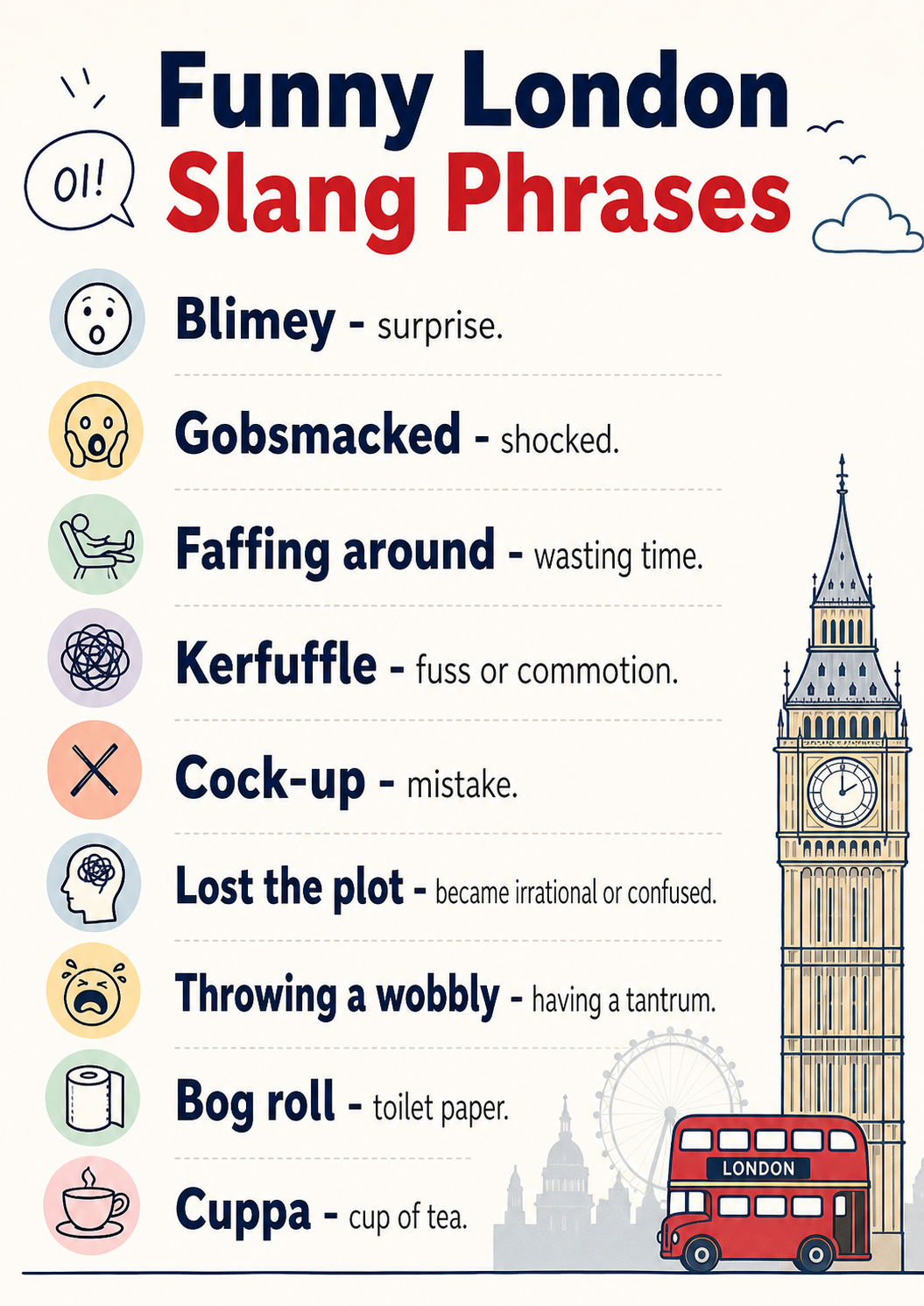
London slang can be funny because it is playful, compressed, dramatic, and sometimes deliberately indirect. This section separates genuinely useful phrases from novelty phrases.
Funny But Harmless Phrases
These are generally safe to understand and sometimes safe to use:
- Blimey- surprise.
- Gobsmacked- shocked.
- Faffing around- wasting time.
- Kerfuffle- fuss or commotion.
- Cock-up- mistake.
- Lost the plot- became irrational or confused.
- Throwing a wobbly- having a tantrum.
- Bog roll- toilet paper.
- Cuppa- cup of tea.
Example: “There was a massive kerfuffle because someone made a cock-up with the booking.”
Funny Phrases That Are Dated
Some phrases are funny because they sound old-fashioned:
- Trouble and strifefor wife.
- Apples and pearsfor stairs.
- Dog and bonefor phone.
- Jolly goodfor very good.
- Toodle-oofor goodbye.
- Lovely jubblyfor excellent.
They are part of British and London cultural memory, but using too many at once can sound like a sketch.
Why “funny” Slang Can Still Be Context-sensitive
A phrase can be funny and still risky. Words such as bird, slag, chav, and wastemanmay appear in slang lists, but they carry baggage.
Takeaway: funny slang is safest when it targets situations, not people.
British Slang Words You’ll Also Hear In London
Not every word heard in London is London-specific. This section covers broader British slang that still belongs in a useful London guide.
Common Overlap Terms: Cheers, Quid, Dodgy, Knackered, Chuffed, Gutted
| British slang term | Meaning and example |
| Bloke | Means man. Example: “That bloke helped me.” |
| Lad | Means boy or young man. Example: “He’s a good lad.” |
| Bonkers | Means crazy or wild. Example: “That plan is bonkers.” |
| Daft | Means silly. Example: “Don’t be daft.” |
| Leg it | Means run away. Example: “We had to leg it.” |
| Trollied / plastered | Means very drunk. Example: “He was trollied.” |
| Quid | Means pounds sterling. Example: “It cost ten quid.” |
| Fiver | Means a five-pound note. Example: “Lend me a fiver.” |
| Tenner | Means a ten-pound note. Example: “It was a tenner.” |
| Dodgy | Means suspicious or poor quality. Example: “That looks dodgy.” |
| Gobsmacked | Means very surprised. Example: “I was gobsmacked.” |
| Knackered | Means exhausted. Example: “I’m knackered.” |
| Chuffed | Means very pleased. Example: “She was chuffed.” |
| Gutted | Means very disappointed. Example: “I’m gutted.” |
| Skint | Means broke or short of money. Example: “I’m skint until payday.” |
| Nosh / grub | Means food. Example: “Let’s get some nosh.” |
| Bog / loo | Means toilet. Example: “Where’s the loo?” |
| Cracking | Means excellent. Example: “That was cracking.” |
| Faff | Means to waste time. Example: “Stop faffing.” |
| Minging | Means disgusting. Example: “That smells minging.” |
| Proper | Means very or really. Example: “That’s proper good.” |
London-specific Vs UK-wide Words
Use this simple test:
- If people across Britain use it, it is probably British slang.
- If it is tied to East London heritage, it may be Cockney.
- If it feels urban, youth-led, and London-associated, it may be MLE-influenced.
- If it appears in drill, grime, or street-culture contexts, it may be roadman-adjacent.
Some overlap is normal. Language does not obey neat category labels.
Formal Vs Informal Usage
Do not use slang in job interviews, legal situations, medical settings, formal emails, or when speaking to someone who may not understand it.
Safer casual words include:
- cheers
- mate
- quid
- cuppa
- dodgy
- knackered
- gutted
Riskier words include:
- insults
- sexual slang
- crime-linked slang
- words tied to identity or class stereotypes
Takeaway: broader British slang helps you understand London, but London-specific slang needs more judgement.
London Slang Insults And Words To Use Carefully
This section is about recognition and caution. Some words are common in slang lists, but that does not make them safe to use.
Mild Insults And Teasing Terms
These may be playful between friends, but rude with strangers:
- Mug- fool or gullible person.
- Muppet- silly or clueless person.
- Prat- stupid or annoying person.
- Plonker- foolish person.
- Wally- silly person.
- Numpty- fool, often softer or comic.
Example: “You forgot your keys again, you muppet.”
That might be affectionate between close friends. It can sound insulting from someone else.
Stronger Terms To Avoid
Avoid these unless you fully understand the relationship, tone, and setting:
- Wanker
- Twat
- Slag
- Sod off
- Git
- Wasteman
- Butters
- Clapped
Some are direct insults. Some target appearance. Some can become sexist or classist depending on use.
Gendered, Class-coded, Or Stereotype-heavy Words
Be especially careful with:
- Bird- can sound dated or sexist when used for a woman.
- Chav- class-coded and derogatory.
- Roadman- can become stereotype-heavy.
- Wifey- can sound possessive or patronising.
- Gyaldem- context-sensitive and identity-linked.
- Slag- strongly derogatory, especially toward women.
If a word reduces someone to class, gender, ethnicity, sexuality, appearance, or perceived social status, do not use it casually.
Safer Alternatives For Learners
Instead of insults, use plain English:
| Risky slang | Safer alternative |
| “He’s a mug.” | “He was fooled.” |
| “That’s chavvy.” | “That looks a bit rough.” |
| “She’s clapped.” | “That’s unkind; avoid commenting.” |
| “He’s a wasteman.” | “He let people down.” |
| “Sod off.” | “Please leave me alone.” |
Takeaway: understanding insults helps you follow conversations, but avoiding them helps you avoid unnecessary offence.
How To Use London Slang Without Sounding Awkward
This section is the practical part. London slang is easiest to get wrong when you try too hard.
Listen Before Using
Spend time hearing how a word is used before saying it. Notice who says it, where they are, what mood they are in, and whether the word sounds friendly, annoyed, sarcastic, or aggressive.
A word like safecan sound warm in one setting and dismissive in another.
Use One Word At A Time
Do not say: “Wagwan fam, bare peng garms, innit bruv?”
That sounds like a phrasebook wearing a tracksuit.
Try one natural word instead:
- “Cheers, mate.”
- “That’s peak.”
- “I’m knackered.”
- “That food looks peng.”
One well-placed word beats a sentence stuffed with slang.
Avoid Roadman Performance
Do not copy an accent, posture, or identity. Slang is tied to real communities, and exaggerated imitation can sound mocking.
It is fine to understand mandem, ends, wagwan, and bait. It is not always fine to perform them.
Don’t Use Slang In Formal Settings
Avoid slang in:
- job interviews
- professional emails
- school essays
- customer complaints
- official forms
- legal or medical conversations
Use standard English when clarity matters.
When In Doubt, Ask What A Word Means
A simple question works: “What does that mean?” Most people would rather explain than hear you misuse it.
Takeaway: good slang use is mostly restraint, timing, and context.
If You Hear This In London, What Does It Mean?
| Situation | What it probably means |
| Someone says “safe” after you help them | They probably mean thanks, okay, or no problem. |
| A friend says “that’s peak” | They mean it is unlucky, bad, unfair, or awkward. |
| Someone says “bare people were there” | They mean lots of people were there. |
| Someone says “allow it” | They mean stop, leave it, or don’t bother. |
| Someone says “that food is peng” | They mean the food looks or tastes very good. |
| Someone says “I’m going back to my ends” | They mean they are going back to their local area. |
| Someone calls you “mate” | It usually means friend, but tone decides whether it is warm or sharp. |
| Someone says “wagwan” | They are saying “what’s going on?” but it is context-sensitive. |
Real-life context is the difference between understanding slang and misusing it.
Pronunciation Notes For Key London Slang
These are simple listening notes, not strict phonetic rules.
| Word | Pronunciation note |
| Innit | Sounds like “in-it,” often said quickly. |
| Wagwan | Often sounds like “wah-gwaan.” |
| Bruv | Rhymes with “love.” |
| Garms | Hard “g,” from “garments.” |
| Creps | Short “e,” like “steps.” |
| Peng | Short and sharp, rhyming roughly with “leng.” |
| Mandem | Often said like “man-dem.” |
| Allow it | Often spoken quickly, almost like “allowit.” |
| Yute | Sounds like “yoot.” |
| Vexed | Sounds like standard English “vekst.” |
Use pronunciation notes to recognise words in speech, not to force an accent.
A-Z London Slang Words And Meanings
This A-Z list gives you a clear view of the London slang, Cockney phrases, roadman-adjacent terms, and common British slang words mentioned in this guide.
| Slang word or phrase | Quick meaning and use note |
| Adam and Eve | Cockney rhyming slang for believe. Heritage phrase. |
| Alright? | Casual greeting, similar to “hello” or “how are you?” Safe casual use. |
| Allow it | Stop it, leave it, or don’t bother. Informal London slang. |
| Apples and pears | Cockney rhyming slang for stairs. Heritage phrase. |
| Bait | Obvious, exposed, or too noticeable. Informal but common. |
| Bare | A lot, many, or very. Informal London/MLE-influenced slang. |
| Barnet Fair | Cockney rhyming slang for hair. Often shortened to “Barnet.” |
| Beef | Conflict, argument, or hostility. Recognise first; can imply serious conflict. |
| Blimey | Expression of surprise. Safe and widely understood. |
| Bloke | A man. General British slang. |
| Blud / blad | Brother, mate, or close friend. Recognise first; can sound forced if copied. |
| Bog / loo | Toilet. Casual British slang. |
| Bog roll | Toilet paper. Casual British slang. |
| Bollocks | Nonsense, rubbish, or a rude body-related term. Rude; use carefully. |
| Bonkers | Crazy, wild, or ridiculous. General British slang. |
| Bossman | Casual term for a shopkeeper, takeaway worker, or man serving you. Context-specific. |
| Brolly | Umbrella. Safe British slang. |
| Bruv | Brother, bro, or mate. Informal; use lightly. |
| Buff | Attractive or good-looking. Informal. |
| Butcher’s hook | Cockney rhyming slang for look. Often shortened to “butcher’s.” |
| Butters | Ugly or unattractive. Avoid using about people. |
| Canny | Good or nice in North East English. Regional UK slang, not core London slang. |
| Certi | Certified, trusted, or genuine. Modern youth slang; context-sensitive. |
| Chav | Derogatory class-coded insult. Avoid. |
| Cheers | Thanks, goodbye, or a drinking toast. Safe casual British slang. |
| Cheeky | Playfully bold, slightly rude, or indulgent. Common British slang. |
| Chirps / chirpsing | Flirting or chatting someone up. Informal. |
| Chuffed | Very pleased or delighted. Safe British slang. |
| Clapped | Worn out, unattractive, or in bad condition. Avoid using about people. |
| Cock-up | A mistake or failure. Mildly rude. |
| Creps | Trainers or shoes. Casual modern London slang. |
| Cuppa | A cup of tea. Safe and widely understood. |
| Cwtch | A cuddle or hug in Welsh English. Regional UK slang, not core London slang. |
| Daft | Silly or foolish. Mild British slang. |
| Dodgy | Suspicious, unreliable, or poor quality. Safe casual slang. |
| Dog and bone | Cockney rhyming slang for phone. Heritage phrase. |
| Dreich | Gloomy or bleak, especially weather. Scots term, not London slang. |
| Drip | Stylish clothing, jewellery, or overall fashion. Used beyond London too. |
| Ends / endz | Local area or neighbourhood. Recognise first. |
| Faff / faffing around | Waste time or take too long doing something. Safe casual British slang. |
| Fam | Close friend or chosen family. Context-specific. |
| Feds | Police. Informal; avoid in formal speech. |
| Fiver | A five-pound note. Safe British slang. |
| Fresh | Stylish, clean-looking, or good. Casual. |
| Garms | Clothes. Casual modern London slang. |
| Gassed | Excited, hyped, or very pleased. Informal. |
| Git | Unpleasant or foolish person. Insult; use carefully. |
| Gobsmacked | Shocked or amazed. Safe British slang. |
| Gutted | Very disappointed. Safe casual slang. |
| Gyaldem | A group of girls or women. Recognise first; context-sensitive. |
| Howay | “Come on” in Geordie/North East English. Regional UK slang, not core London slang. |
| Innit | Informal tag from “isn’t it,” used for agreement or emphasis. Informal. |
| Jam | Relax, chill, or stay where you are. Informal. |
| Jokes | Funny or entertaining. Casual and low-risk. |
| Jolly good | Very good. Dated or old-fashioned British phrase. |
| Kerfuffle | Fuss, commotion, or minor disagreement. Safe British slang. |
| Knackered | Very tired. Casual British slang. |
| Kotch | Sit, relax, or hang around. Informal. |
| Lad | Boy or young man. Common British slang. |
| Leg it | Run away or leave quickly. Casual British slang. |
| Link up | Meet someone. Broad casual use. |
| Long | Too much effort, annoying, or not worth it. Informal modern London slang. |
| Lost the plot | Became irrational, angry, or confused. Casual British phrase. |
| Lovely jubbly | Excellent or lovely. Dated/funny British phrase. |
| Mandem | A group of male friends. Recognise first. |
| Manor | Someone’s local area or patch. Older London/local identity term. |
| Mate | Friend. Safe and widely used. |
| Minging | Disgusting or unpleasant. Casual British slang. |
| Mug | Fool or gullible person. Insult; use carefully. |
| Muppet | Silly or clueless person. Mild insult. |
| Naff | Tacky, uncool, or poor quality. Mild British slang. |
| Nosh / grub | Food. Casual British slang. |
| Numpty | Fool or silly person. Often softer or humorous. |
| Pagans | Enemies or rivals. Recognise only; can sound aggressive. |
| Pants | Underwear in the UK; can also mean bad. Useful UK/US difference. |
| Peak | Bad, unlucky, awkward, or unfair. Informal modern London slang. |
| Peng | Attractive, tasty, excellent, or very good. Informal. |
| Plates of meat | Cockney rhyming slang for feet. Heritage phrase. |
| Plonker | Foolish person. Mild British insult. |
| Prat | Stupid or annoying person. Insult; use carefully. |
| Proper | Very or really. Casual British slang. |
| Quid | One pound sterling. Safe British slang. |
| Roadman | A young man associated with street style or street culture. Can be stereotype-heavy. |
| Rubbish | Nonsense or poor quality. Safe British slang. |
| Ruby Murray | Cockney rhyming slang for curry. Heritage phrase. |
| Safe | Good, okay, thanks, or no problem. Casual London slang. |
| Skeng | Weapon, often a knife. Recognise only. |
| Skint | Broke or short of money. Casual British slang. |
| Slag | Strong derogatory insult, especially toward women. Avoid. |
| Snog | Kiss passionately. Informal British slang. |
| Sod off | Go away. Rude; use carefully. |
| Swear down | Seriously, honestly, or “I’m telling the truth.” Informal. |
| Ta | Thank you. Safe casual British slang. |
| Tenner | A ten-pound note. Safe British slang. |
| Ting | Thing, person, or situation depending on context. Context-sensitive. |
| Toodle-oo | Goodbye. Dated or playful British phrase. |
| Trouble and strife | Cockney rhyming slang for wife. Dated and gendered; recognise only. |
| Trollied / plastered | Very drunk. Informal British slang. |
| Twat | Strong insult. Avoid in polite conversation. |
| Vex / vexed | Annoyed, irritated, or angry. Informal. |
| Wagwan | What’s going on? Use carefully. |
| Wally | Silly person. Mild British insult. |
| Wanker | Strong insult. Avoid. |
| Wasteman | Useless or unreliable person. Insult; avoid. |
| Wifey | Girlfriend, wife, or close female partner/friend depending on context. Can sound possessive. |
| Yard | Home or house. Context-specific. |
| You get me | Do you understand, or “you know what I mean?” Informal. |
| Yute | Young person. Context-sensitive. |
Takeaway: the table gives you the meanings, but the category and use note tell you how careful to be.
How This Guide Was Checked
This guide prioritises terms that appear across current London slang, British slang, Cockney, MLE, and roadman slang references. Definitions were reviewed for London relevance, casual or formal context, cultural sensitivity, and whether a learner should use, recognise, or avoid the term.
For language background, the guide uses authoritative linguistic sources such as the University of York’s work on Multicultural London English, University of Essex writing on Cockney and accent change, and reputable reporting on UK rap and language.
For modern slang terms, the guide treats meanings as context-sensitive because slang shifts quickly by age, borough, friendship group, music scene, and platform.
FAQs About London Slang Words And Meanings
What Is London Slang?
London slang is informal language used in London, shaped by everyday British speech, Cockney, Multicultural London English, music, migration, and youth culture.
What Is The Most Common London Slang?
Common London slang includes innit, mate, bruv, fam, bare, peng, ends, safe, peak, and allow it.
What Does Peng Mean?
Pengusually means attractive, excellent, tasty, or very good. You might hear it about food, people, clothes, or an experience.
What Does Bare Mean?
Baremeans a lot, many, or very. For example, “bare people” means lots of people.
What Does Mandem Mean?
Mandemusually means a group of male friends or boys. It is informal and strongly linked to urban youth speech.
What Does Innit Mean?
Innitcomes from “isn’t it,” but it is often used as a general tag for agreement, emphasis, or confirmation.
Is Cockney Slang Still Used?
Some Cockney slang is still recognised, especially heritage phrases, but younger London speech is now more strongly shaped by MLE and other accent changes. Data as of May 2026.
Is Roadman Slang Offensive?
Roadman slang is not automatically offensive, but some terms are insults, stereotype-heavy, or linked to crime. Recognise more than you use.
Can Tourists Use London Slang?
Tourists can use light slang such as cheers, mate, quid, and cuppa. They should avoid forced roadman slang, insults, and accent imitation.
What London Slang Should I Avoid?
Avoid strong insults, sexualised terms, weapon-related words, crime-linked slang, and words tied to class, gender, ethnicity, or stereotypes.
The Bottom Line
London slang is useful because it tells you more than a dictionary meaning. It tells you about humour, identity, age, neighbourhood, music, history, and who feels comfortable saying what.
Start with the safe words: cheers, mate, quid, knackered, gutted, cuppa, and dodgy. Then learn the modern London terms: peng, bare, peak, safe, ends, fam, and bruv. Treat Cockney as cultural heritage, and treat roadman-adjacent slang as something to understand before you imitate.
The best way to sound natural is not to sound like a slang list. Listen first, use less than you know, and let context do the work.
Jump to
London Slang Words And Meanings: What To Use, Recognise And Avoid
What Is London Slang?
Common London Slang Words And Meanings
Modern London Slang And Multicultural London English
Roadman Slang Words: Meanings, Examples, And Caution
Cockney Rhyming Slang: Classic East London Phrases
Funny London Slang Phrases
British Slang Words You’ll Also Hear In London
London Slang Insults And Words To Use Carefully
How To Use London Slang Without Sounding Awkward
If You Hear This In London, What Does It Mean?
Pronunciation Notes For Key London Slang
A-Z London Slang Words And Meanings
How This Guide Was Checked
FAQs About London Slang Words And Meanings
The Bottom Line

James Rowley
Author
James Rowley is a London-based writer and researcher covering London life, cultural geography, London travel, live London webcam pages and selected public figures across entertainment, sport, business and public life.
For over 15 years, he has focused on verified sources, first-hand local context and clear explanations that help readers understand both places and people more deeply. His work combines street-level London knowledge with careful research into career credits, media work, business interests and, where relevant, transparently explained net worth estimates.
He writes and reviews articles published on LondonWebcam.
Latest Articles
Popular Articles