Most Popular Baby Names In London - Latest Official Rankings
Most Popular Baby Names in London from the latest official ONS data. See the top 10 boys’ and girls’ names, borough winners and London-wide trends.
Author:James RowleyMar 16, 202631 Shares30.7K Views
Popular Baby Names In London: What The Latest ONS Data Shows
A Londonbaby-name headline can look simpler than it really is. One list tells you what rose to the top across the capital as a whole; another shows which names won inside individual boroughs, where tiny differences in registrations can completely change the local picture.
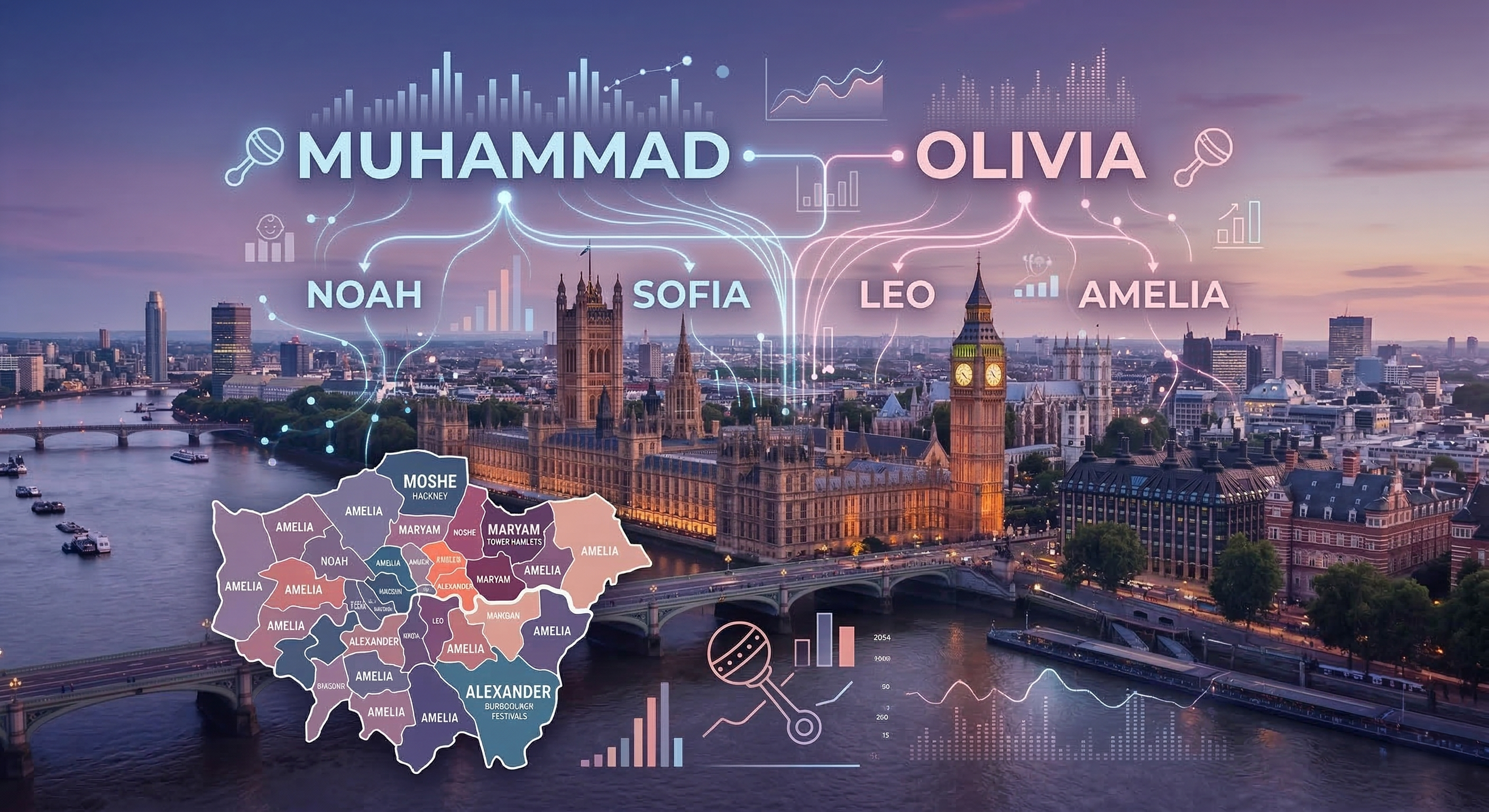
That is why the latest London naming data is worth reading carefully rather than casually. Using the Office for National Statistics’ 2024 birth-registration release, plus London-specific borough roll-ups built from that data, the clearest picture is this: Muhammad led London boys’ names overall, Olivia led London girls’ names overall, but the borough map told a more varied story.
Key Takeaways
- Muhammad was the most popular boys’ name across London in 2024, while Olivia was the most popular girls’ name across London.
- Borough-level results were different: Amelia dominated many girls’ borough charts, while boys’ borough winners were more fragmented, with Alexander notably surging and Noah failing to top any borough despite ranking second citywide.
- ONS local results are based on the mother’s usual area of residence, not the hospital where the baby was born.
- ONS counts exact spellings, so Muhammadand Mohammed are ranked separately.
- For anyone choosing a name, the useful question is not only What is popular in London? But also, what feels common where I live?
Most Popular Baby Names In London At A Glance
| Top 10 Boys’ Names in London | Top 10 Girls’ Names in London |
| Muhammad | Olivia |
| Noah | Sofia |
| Leo | Amelia |
| Adam | Maya |
| Theodore | Sophia |
| Oliver | Sienna |
| Arthur | Mia |
| Mohammed | Maryam |
| Oscar | Lily |
| Alexander | Isabella |
These are the latest official London-wide rankings available to readers in 2026, based on births registered in 2024.
What Does Most Popular Mean In The ONS Data
The ONS release is based on birth registration data and published as accredited official statistics. The local authority breakdown uses the mother’s usual area of residence, which makes it a place-based picture of where families live rather than where births happened.
It also uses the exact spelling recorded on the birth certificate. That is why Muhammad, Mohammed and other variants are not automatically merged; the ONS explicitly notes that grouping similar-sounding names would change the rankings.
London’s Top 10 Baby Names In London
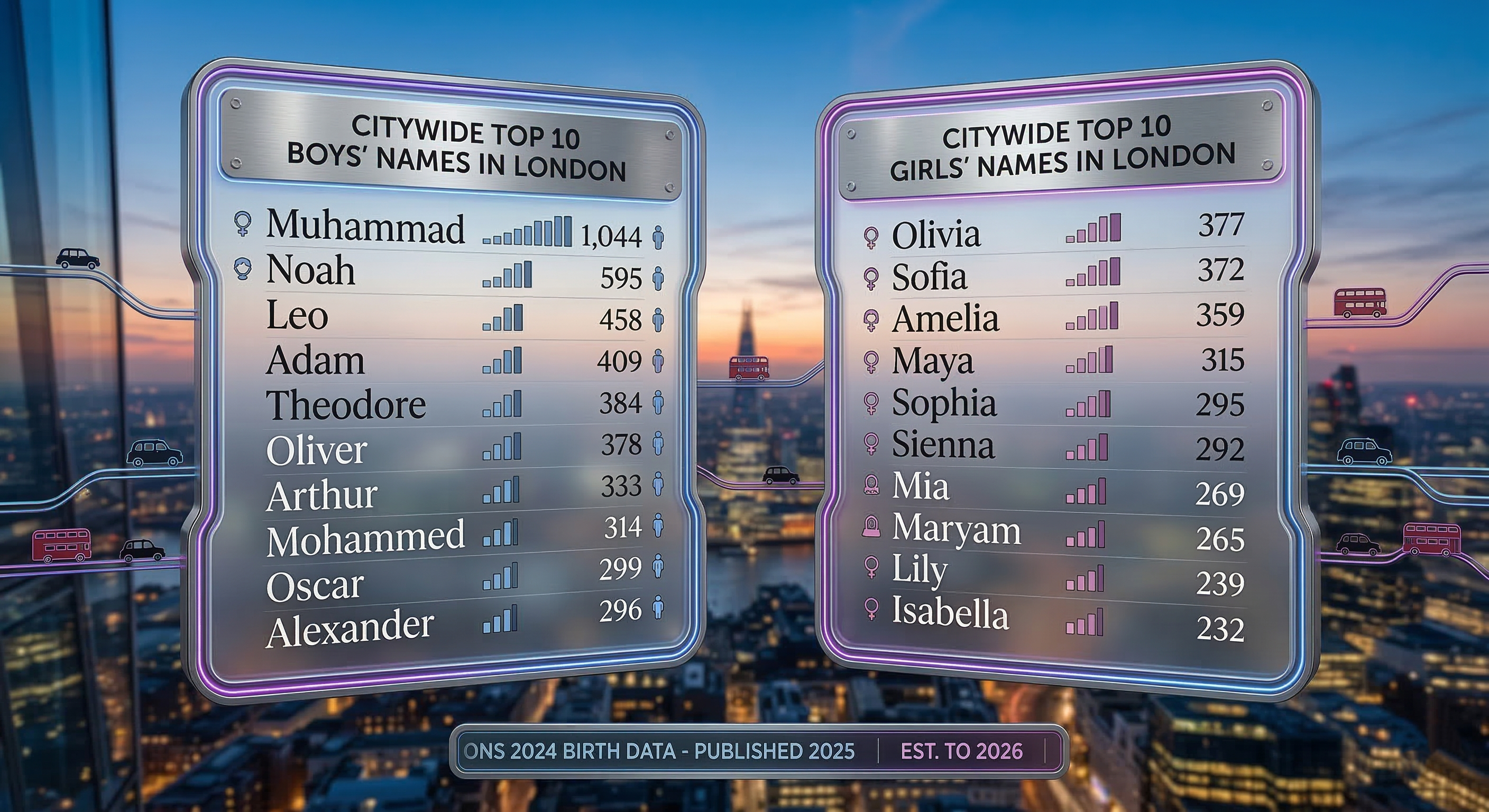
This is the core ranking section. It moves from the single winners to the fuller top 10, because parents and curious readers rarely stop at first place; they want to know what sits just beneath the headline and how tightly packed the rankings really are.
Top 10 Boys’ Names In London
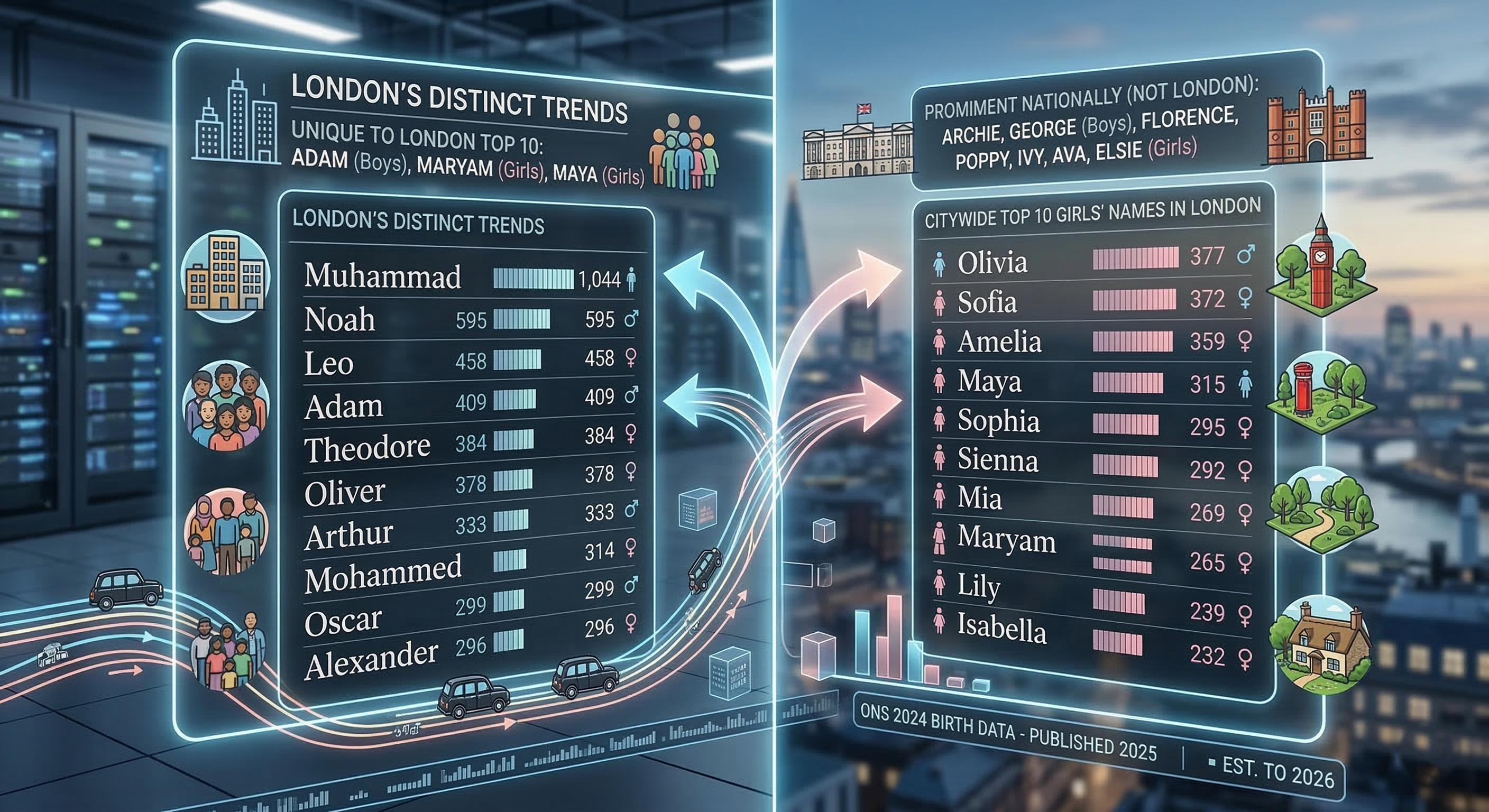
The boys’ list is striking for the size of Muhammad’s lead and for how recognisably London-specific some of the top 10 feel. Londonist’s summary of the latest ONS London data gives the London-wide boys’ ranking as follows:
- Muhammad (1,044)
- Noah (595)
- Leo (458)
- Adam (409)
- Theodore (384)
- Oliver (378)
- Arthur (333)
- Mohammed (314)
- Oscar (299)
- Alexander (296)
What jumps out is not only the top slot. It is the shape of the whole list. Adam and Mohammed feel more prominent here than in many casual national conversations about baby names, while Archie and George, both familiar in England and Wales reporting, do not make the London top 10 at all in Londonist’s citywide roll-up.
Top 10 Girls’ Names In London
The girls’ chart is tighter and more competitive at the top. The latest citywide London ranking reported from the 2024 ONS data is:
- Olivia (377)
- Sofia (372)
- Amelia (359)
- Maya (315)
- Sophia (295)
- Sienna (292)
- Mia (269)
- Maryam (265)
- Lily (239)
- Isabella (232)
That close spread helps explain why borough results become so interesting. Olivia leads London overall, but by a very small margin over Sofia and Amelia.
In practical terms, that means local concentration can easily reshape the top spot from one borough to the next.
Borough-by-Borough Patterns Tell A Different Story
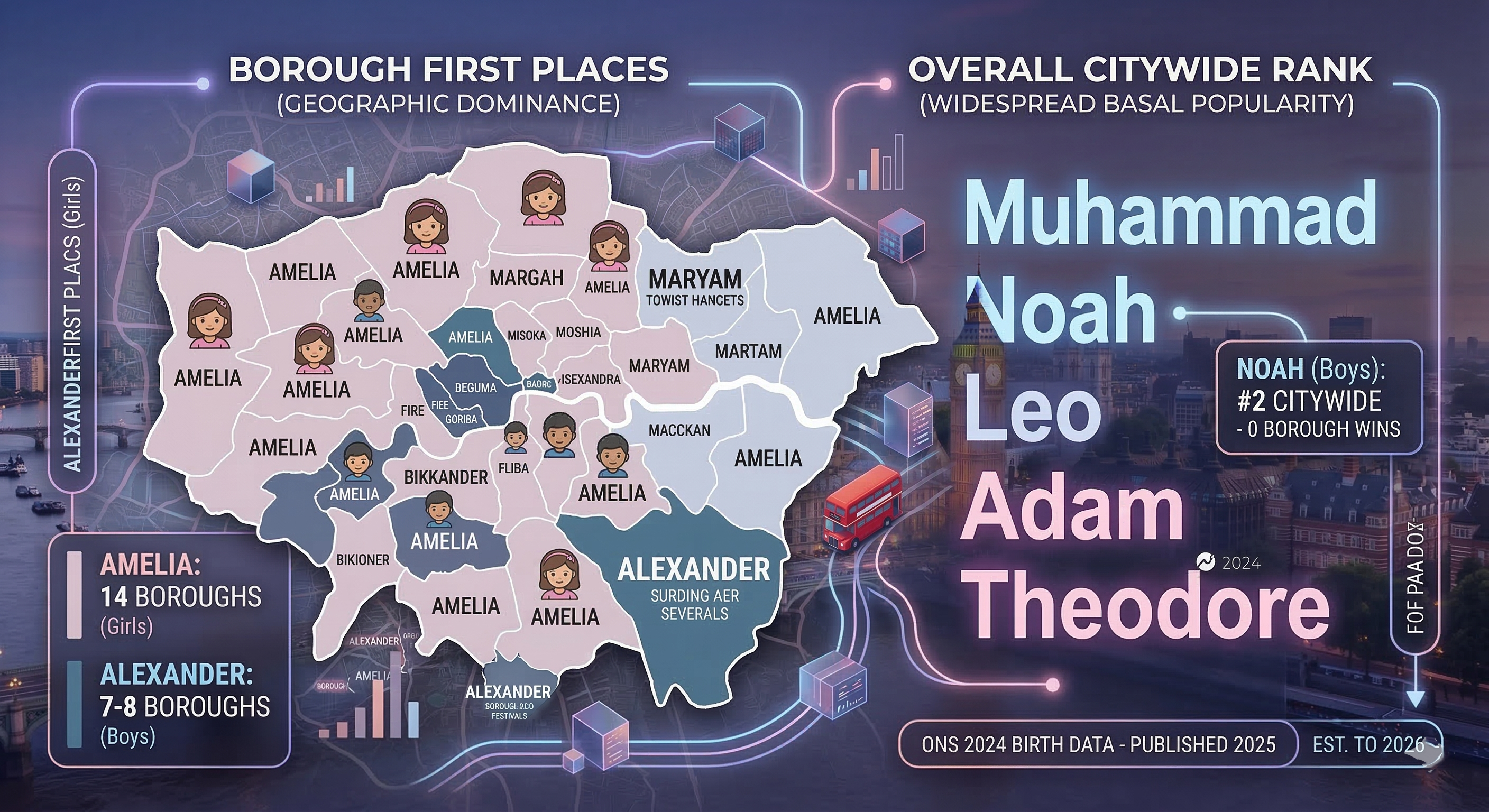
This section is where the article stops being a list and becomes a London analysis. Borough charts reveal the city’s local texture, and they explain why the answer to What is most popular in London? changes depending on whether you mean the whole capital or the neighbourhood-level map.
Which Names Topped The Most Boroughs
For girls, the borough story is unmistakable. Londonist says Amelia topped 14 London boroughs in 2024, up from seven a year earlier, while Olivia topped seven.
Time Out’s August 2025 borough roundup echoes that pattern, describing Amelia as the leading girls’ name in fourteen boroughs.
For boys, the picture is more fragmented. Time Out reports that Muhammad took first place in Barking & Dagenham, Croydon, Ealing, Hounslow, Newham, Redbridge and Waltham Forest, while Alexander climbed from leading one borough in 2023 to eight in 2024.
Londonist also describes Alexander as the big borough-level riser, though it counts seven borough wins rather than eight.
That small discrepancy between secondary summaries is worth noting rather than hiding.
It does not change the main reading of the data:Alexander surged dramatically at the borough level, and Noah’s borough-level dominance disappeared even while Noah stayed very high London-wide.
Borough Outliers Worth Noticing
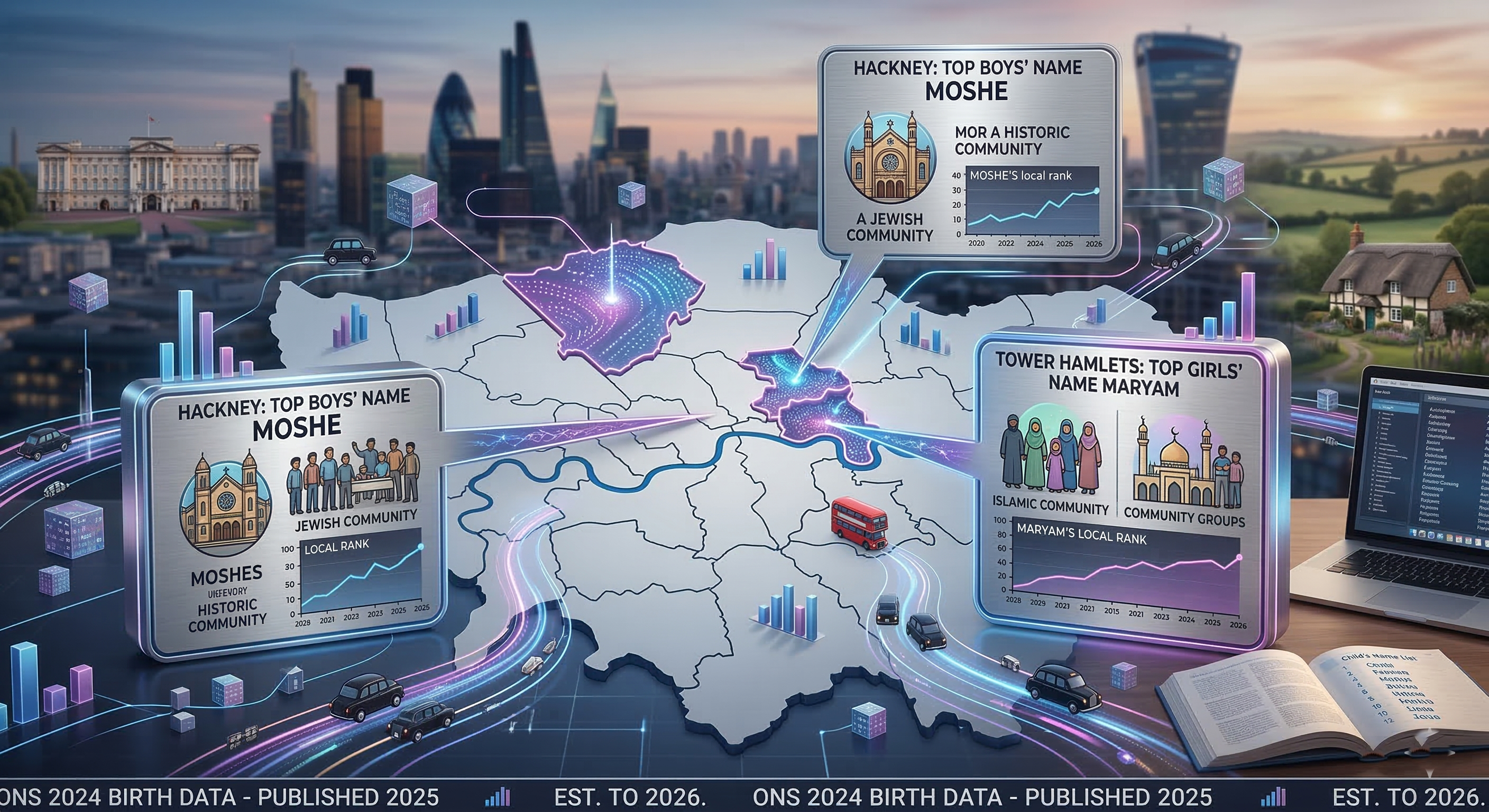
Local outliers are what make London’s map feel like London rather than a generic England-and-Wales recap.
Time Out highlights Moshe as Hackney’s top boys’ name, Maryam as Tower Hamlets’ top girls’ name, Maya as Barnet’s leading girls’ name, and Leo as the top boys’ name in Camden.
Those names are not oddities for the sake of being odd. They point to the cultural geography of the city: neighbourhood histories, family traditions, faith communities, and demographic concentration all shape local naming in ways that a single London-wide ranking cannot show.
Why Borough Winners And London-wide Winners Are Not The Same Thing
A London-wide ranking adds all borough totals together. A borough chart only asks which name finished first within a local authority.
That sounds like a small technical difference, but it changes the meaning of the data completely.
Imagine two names. One is moderately strong almost everywhere. The other is overwhelmingly strong in a handful of boroughs but much weaker elsewhere. The first can rank higher London-wide; the second can still appear on more borough first-place lists.
That is exactly why Amelia and Alexander tell a different story from Olivia and Muhammad, and why Noah can be second across London without topping a single borough.
What Small Borough Counts Can And Cannot Tell You
Londonist makes an important caution explicit: borough top names are often separated by only a few dozen registrations, and second place may be only one or two registrations behind.
That makes borough rankings brilliant for seeing local flavour, but weaker as a blunt measure of how overwhelmingly common a name really is.
That is the right way to use the map. Treat borough winners as a clue to local feel, not a complete measure of popularity.
Once that distinction is clear, the comparison with England and Wales becomes much easier to read.
London Compared With England And Wales
This section places London inside the wider official naming picture. The goal is not to bury the city in national data, but to show where London follows the broader trend and where it starts to look distinctively like itself.
Where London Matches The National Picture
The ONS 2024 release covers England and Wales as a whole and was published on 31 July 2025, so the national and London views come from the same official statistical framework. That makes comparison cleaner than it often is in trend pieces built from mismatched sources.
At the broadest level, London still overlaps with the national picture. ONS describes the release as the most popular first names for baby girls and boys in 2024 using birth registration data, and Londonist’s London-wide results show the same headline leaders Muhammad and Olivia at the top of the capital’s list as well.
That shared ONS framework matters because it means the London and national rankings are directly comparable, rather than being stitched together from different sources.
Where London Diverges
The divergence appears once you move beyond first place. London’s citywide top 10 includes names such as Adam, Mohammed and Maryam, while Londonist notes that some names prominent across the rest of England and Wales, including Archie and George for boys, and Florence, Poppy, Ivy, Ava and Elsie for girls, do not feature in London’s top 10.
That is a useful London insight, not a curiosity. It shows that the capital is not simply the same but bigger. It follows the national structure of the ONS dataset, yet its rank order reflects the city’s own social and cultural patterning.
Spelling Variants And Why They Matter In London

This is one of the most important interpretive points in the article. ONS states that rankings are based on the exact spelling recorded at birth registration and that grouping similar names with different spellings would change the rankings.
In London, that matters immediately because Muhammad ranks first, and Mohammed also appears in the top 10.
If a reader casually groups those variants together, the cultural weight of the name looks even stronger than the official single-entry ranking suggests.
The official list should still be respected as published, but readers should understand what exact-spelling rules do to the picture.
The clean takeaway is that London mirrors England and Wales at the top, then becomes more distinct the deeper you go into the rankings, and the more carefully you read spellings and borough variation.
In practical terms, that means a name can feel even more dominant in everyday life than the official single-spelling ranking suggests.
How To Use Popularity Data When Choosing A Name
This is the practical section. Plenty of readers are not only curious; they are trying to decide whether a name feels too common, reassuringly classic, or pleasantly less expected. Popularity data can help with that, but only if it is read properly.
If You Want A Classic Name, A Less Expected Name, Or Something In Between
A useful first step is to decide which kind of popularity matters to you. If you want a name that already feels firmly established across London, the citywide top 10 is the better guide.
If you care more about local feel, borough rankings matter more. And if you want something familiar without choosing a name that feels unavoidable in your area, you need both layers at once.
That is why the same name can look very different depending on the chart you read. Amelia is a good example: third London-wide, yet dominant in borough charts.
Noah is the mirror image:second London-wide, yet absent from the borough's first places. Those are not contradictions. They are two different kinds of popularity.
What To Check Before Relying On A Borough Trend
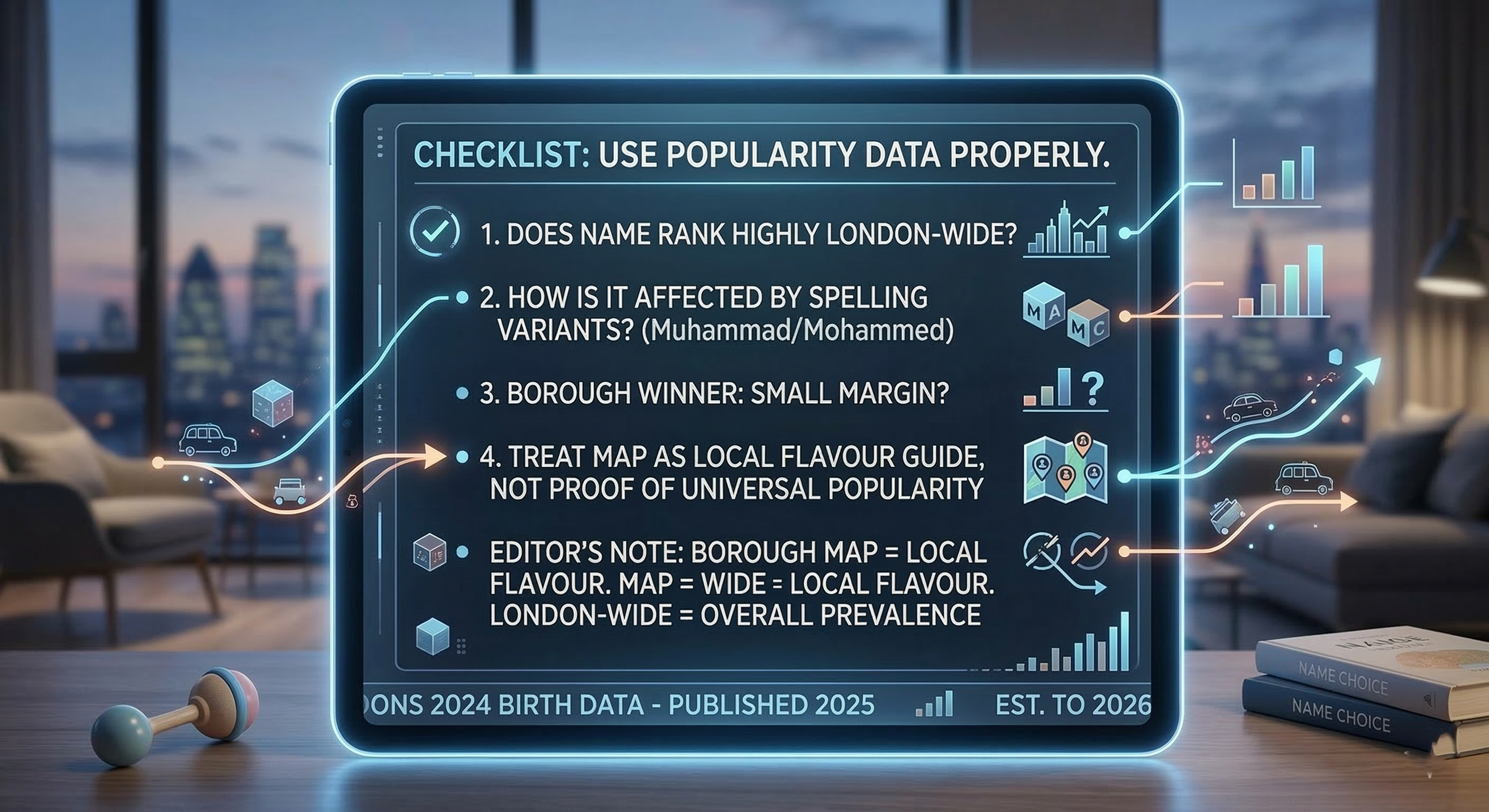
Use this short checklist before deciding a borough winner tells you everything you need to know:
- Check whether the name also ranks highly across London overall.
- Check whether the ranking is affected by spelling variants.
- Remember that the borough's first place can be decided by a very small margin.
- Treat borough maps as a guide to local texture, not as proof that a name is overwhelming everywhere.
Editor’s Note:The most common mistake in local-data stories is asking one chart to do two jobs. A borough map is best for local flavour; a London-wide ranking is best for judging overall prevalence.
Illustrative Scenario: Two Parents Reading The Same Chart Differently
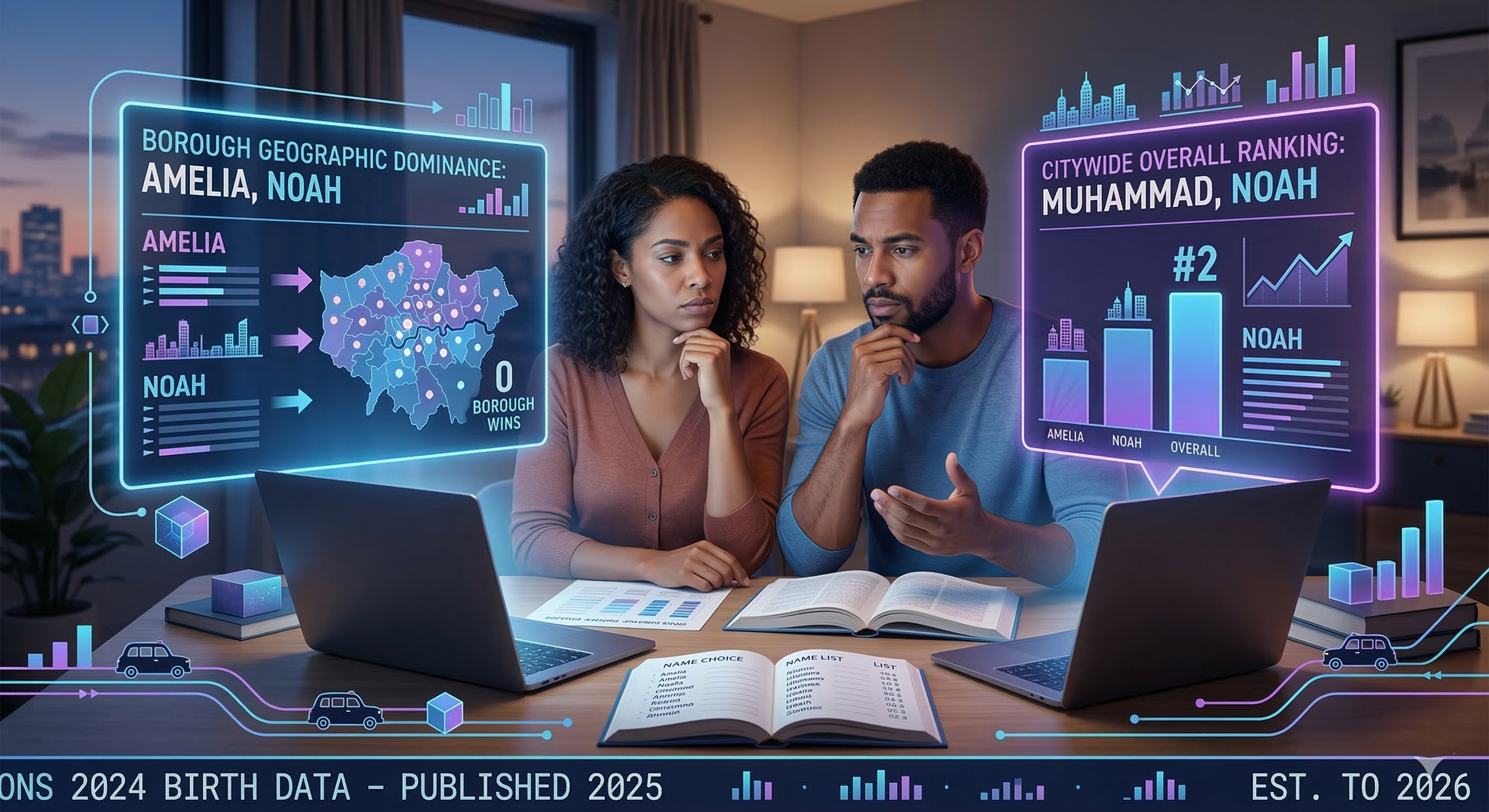
Imagine two parents in south-east London narrowing a shortlist. One sees Amelia scattered across borough first places and assumes it is too common to consider.
The other checks the London-wide table, notices Olivia still leads overall, sees how tight the girls’ counts are near the top, and realises Amelia’s dominance is local and patchy rather than universal.
The same thing works in reverse for Noah. A parent scanning only the borough map might think it has faded badly.
A parent who checks the London-wide ranking sees it is still second across the capital. The lesson is not that one parent is right and the other wrong; it is that one has asked a broader question.
That is the real practical value of the statistics. They do not choose a name for you, but they do stop you from misreading what popular actually means.
Frequently Asked Questions
What Is The Most Popular Baby Name In London?
As of March 2026, the latest official London data available shows Muhammad as the top boys’ name and Olivia as the top girls’ name. That ranking comes from the 2024 ONS release published in July 2025. Data as of March 2026.
Is Muhammad The Most Common Baby Name In London?
Yes, for boys in the latest London-wide official figures available. It ranks first on its own, and ONS’s exact-spelling method means the separate Mohammed ranking is not merged into Muhammad’s official total.
What Are The Top 10 Girls’ Names In London?
Olivia, Sofia, Amelia, Maya, Sophia, Sienna, Mia, Maryam, Lily and Isabella were the top 10 girls’ names in the latest London-wide figures available.
What Are The Top 3 Male Names?
For the latest officially available London-wide totals, the top three boys’ names are Muhammad, Noah and Leo. Data as of March 2026, using 2024 births published in 2025.
Which Name Topped The Most London Boroughs?
For girls, Amelia clearly dominated the latest borough map. For boys, Alexander was the standout borough riser, although current secondary summaries differ slightly on whether it topped seven or eight boroughs.
Why Does Noah Rank Highly Overall But Top No Boroughs?
Because citywide rankings total all borough counts together, while borough charts only show local first place. Noah remained broadly popular across London without finishing first in any single borough.
Are Borough Results Based On Where The Baby Was Born?
No. ONS notes that local authority figures are based on the mother’s usual area of residence, not the hospital where the birth happened.
Are Muhammad And Mohammed Counted Separately?
Yes. ONS says rankings are based on the exact spelling recorded at birth registration, and similar names with different spellings are counted separately.
What The London Baby Name Lists Really Tell You
This final section brings the whole argument together. The value of the latest London baby-name data is not simply that it tells you who came first.
It shows that popularity in London operates on at least two levels at once: the citywide total and the borough-level map.
Read carelessly, those levels can look inconsistent. Read properly, they tell a richer story. Muhammad and Olivia lead London overall; Amelia shapes much of the girls’ borough map; Alexander rises sharply in boys’ borough charts; Noah stays near the top citywide while disappearing from borough first place.
Each fact is true because each one describes a different scale of the same city.
That is also why this topic suits London so well. The city is unified enough to produce clear overall leaders, yet varied enough that local rankings still feel genuinely local.
For anyone choosing a name, or simply curious about the capital’s cultural mood, the most useful question is not What is the most popular baby name in London?
It is What does popularity look like across London once I stop pretending the whole city behaves like one neighbourhood?
Jump to
Popular Baby Names In London: What The Latest ONS Data Shows
Most Popular Baby Names In London At A Glance
London’s Top 10 Baby Names In London
Borough-by-Borough Patterns Tell A Different Story
London Compared With England And Wales
How To Use Popularity Data When Choosing A Name
Frequently Asked Questions
What The London Baby Name Lists Really Tell You

James Rowley
Author
James Rowley is a London-based writer and researcher covering London life, cultural geography, London travel, live London webcam pages and selected public figures across entertainment, sport, business and public life.
For over 15 years, he has focused on verified sources, first-hand local context and clear explanations that help readers understand both places and people more deeply. His work combines street-level London knowledge with careful research into career credits, media work, business interests and, where relevant, transparently explained net worth estimates.
He writes and reviews articles published on LondonWebcam.
Latest Articles
Popular Articles