Why London Is So Expensive: The Real Cost Drivers
Why London Is So Expensive for tourists, students and renters. Learn what pushes prices up and where London still offers value.
Author:James RowleyApr 07, 2026
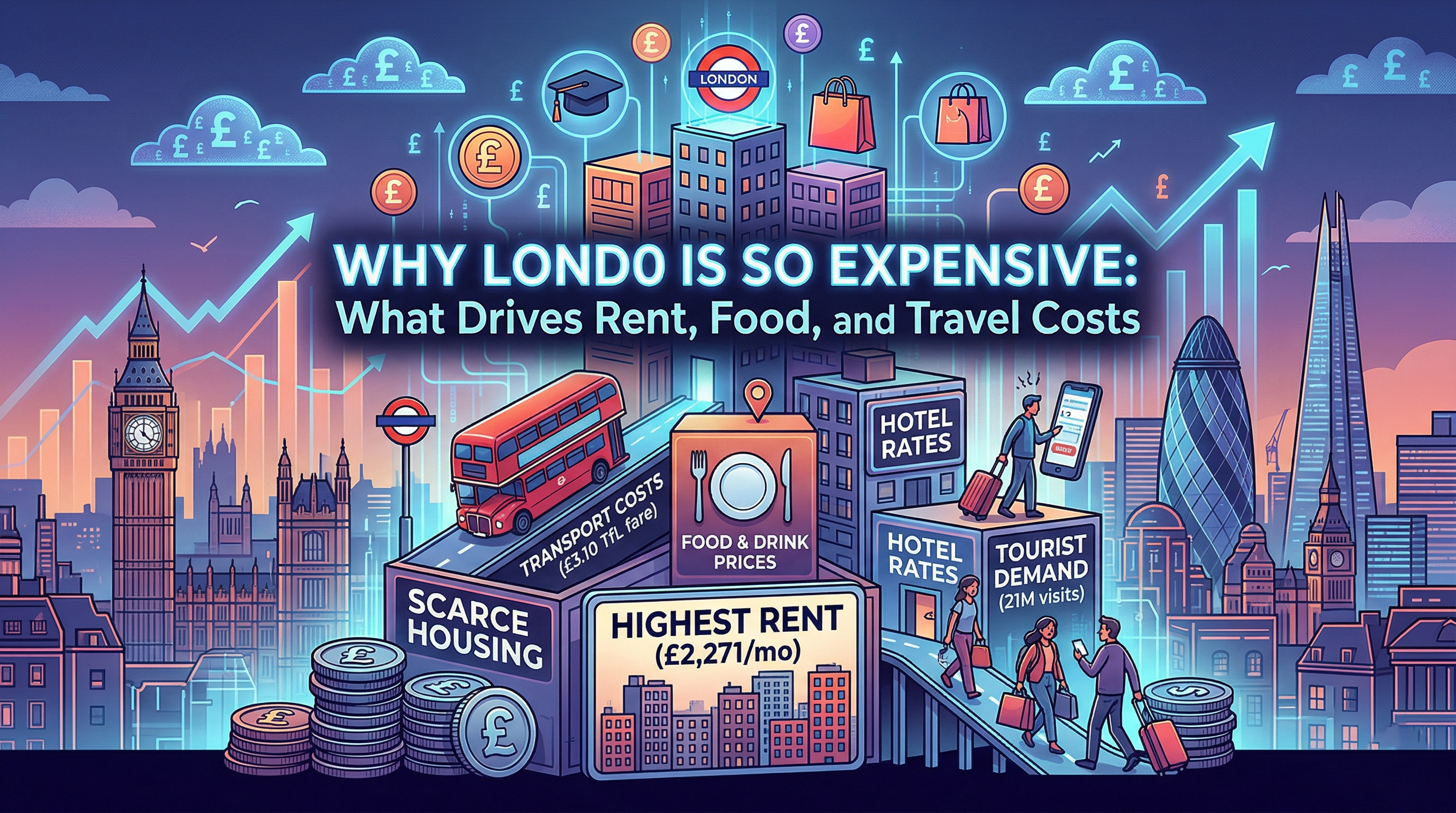
Why London Is So Expensive: What Drives Rent, Food, And Travel Costs
You do not need to spend long in Londonto feel the price tag. A hotel search can sting before you book, a flat listing can feel detached from reality, and even an ordinary dinner can leave you wondering whether the city has quietly stopped making sense.
That reaction is understandable. London is expensive, but not for one simple reason.
The city’s costs come from a stack of structural pressures: scarce housing, intense global demand, high business overhead, and a tourism economy large enough to keep central prices elevated year-round.
Official data also shows that housing is not just one cost among many. It is the force that shapes nearly everything else.
What follows is a practical explanation built for travellers, prospective renters, and students alike.
The goal is not to throw scary averages at you. It is to show why London feels so expensive, which costs are structural, which are optional, and where the city still gives you far more value than its reputation suggests.
Key Takeaways
- London is expensive mainly because housing is scarce and demand is unusually strong. London needed about 88,000 new homes a year under the government’s stated housing need, a scale City Hall says is far beyond what the city has historically built.
- That scarcity shows up immediately in rent: average monthly private rent in London reached £2,271 in November 2025, the highest of any English region.
- Housing costs then ripple outward. Businesses pay more for premises and staff, and those costs feed into hotels, restaurants, nightlife, and convenience pricing.
- Tourism amplifies the effect. London attracted roughly 21 million international visitors in 2024 and generated about £17 billion in spending, which helps keep central accommodation and leisure prices high.
- London is not equally expensive in every category. Some of its best museums and galleries remain free, which is one reason the city can still offer strong value to travellers who understand where to spend and where not to.
Who feels London’s prices most depends on why they are there. A weekend visitor usually feels the hit through hotels, dining, and central convenience.
A student feels it through rent and daily budgeting. A full-time renter feels it most steadily, because housing is not a one-off expense but a monthly pressure that shapes almost every other decision
Why London Is So Expensive In One View

Here is the short version most readers want first: London is expensive because an enormous number of people and businesses compete for a limited amount of well-connected urban space.
Once housing and land become that costly, the rest of the city starts pricing around them.
The Short Answer In One Paragraph
If you picture London as a giant economic magnet, the costs make more sense. The city concentrates jobs, universities, tourism, finance, culture, and transport in one place.
Demand keeps clustering there, but housing supply has not kept up.
That gap pushes rent higher, and rent then affects how much workers need, how much shops and restaurants charge, and how much visitors pay to stay near the action.
The Chain Reaction From Housing To Everyday Prices
A useful way to think about London is this: housing is the first domino. When homes are scarce and expensive, households need more income to live near jobs.
Employers then face pressure on wages and recruitment. Businesses in busy districts pay more for space, staffing, utilities, and logistics.
The final bill shows up in hotel rates, menu prices, drinks, childcare, student rents, and longer commutes from cheaper areas.
London’s poverty figures make that distortion visible:the city rises from 15% poverty before housing costs to 26% after housing costs.
The big takeaway is simple:if you want to understand London’s price tag, start with housing, not with brunch.
Housing Is The Engine Behind London’s Prices
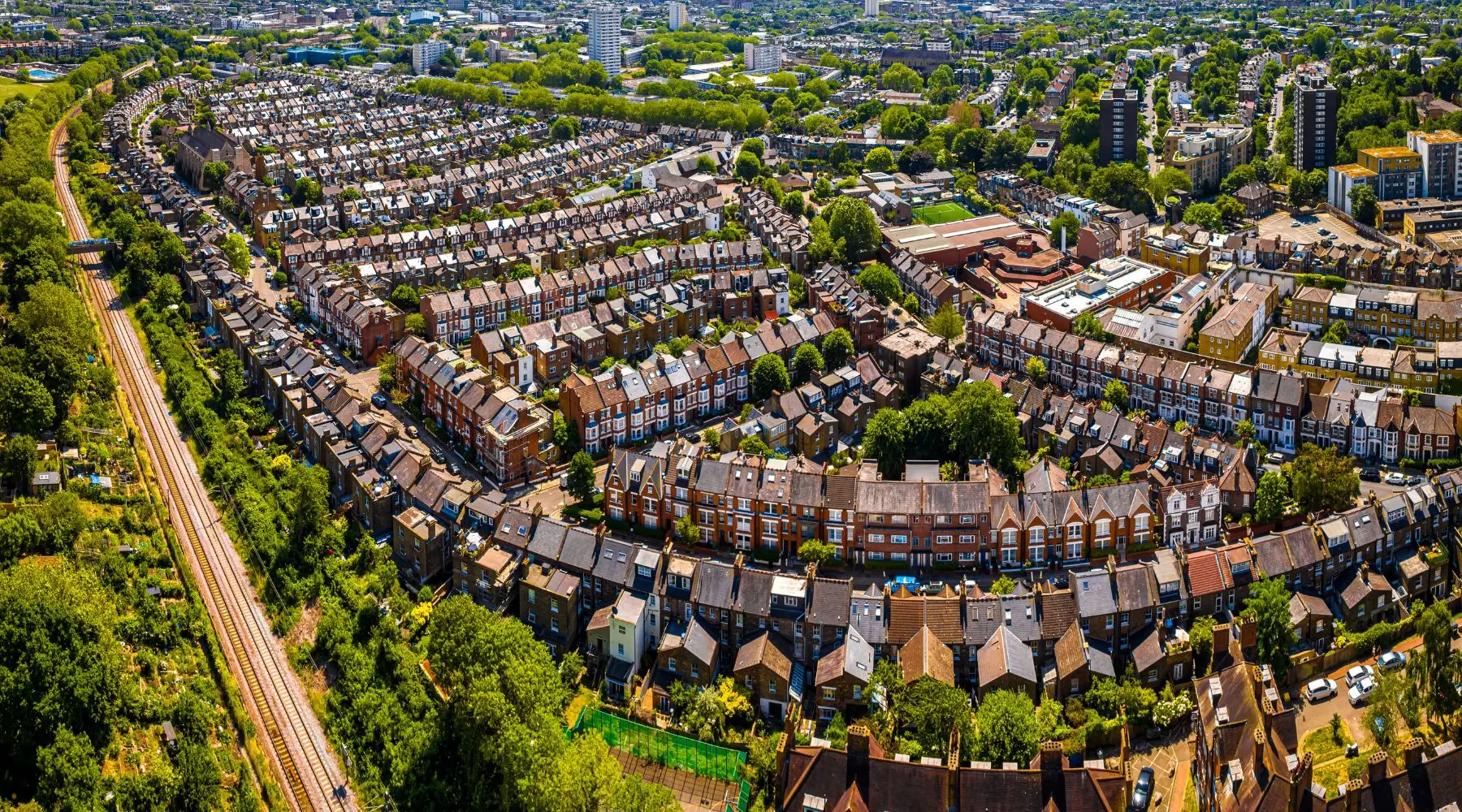
This is the section that makes the rest of the article click. London is expensive partly because it is popular, but popularity alone does not explain the magnitude.
The real engine is the mismatch between how much London is asked to absorb and how much housing it actually adds.
Demand Clusters Where Jobs, Transport, And Amenities Meet
People do not just want a home in Britain. They want access to London’s jobs, universities, hospitals, airports, entertainment, and transport web.
That concentrates demand into a city where being near a Tube station or an employment hub can reshape an entire budget.
London’s role as a high-wage, high-opportunity labour market helps keep that pressure persistent rather than temporary.
A graduate living in Zone 2, for example, is not only paying for a bedroom.
She is paying for commute time saved, job access multiplied, and social life compressed into a smaller geographic area. In London, location is not a luxury add-on. It is part of the economic product.
Supply Has Not Kept Pace With What London Needs
City Hall says the government’s current assessment means London needs 88,000 new homes per year, a number it explicitly describes as far beyond what the capital has historically built.
That does not mean every missing home becomes one extra unaffordable listing, but it does mean competition stays fierce across tenures.
The city’s own data describes housing affordability as one of London’s biggest structural problems and notes that supply has not kept pace with demand.
As of early 2025, the average house price in London was about £556,000, or 107% above the UK average, while average private-sector rents were £2,163 per month, or 63% above the UK average.
Why Rents Matter More Than Headline House Prices For Most Readers
House prices matter for long-term wealth and access, but rent is what most people feel first. ONS data shows London’s average monthly private rent reached £2,271 in November 2025, the highest in England.
November 2025. That figure explains far more about daily affordability than a headline about annual house-price growth.
That is also why London can feel brutally expensive even when house-price inflation cools. In the same official release, London had the lowest annual private-rent inflation among English regions, yet it still had the highest actual rent level. Slower growth does not make a very high baseline cheap.
How Wide The Gap Gets In The Most Expensive Boroughs
The borough picture makes the gap feel real. ONS says Kensington and Chelsea had the highest average monthly private rent in England and Wales at £3,634 in November 2025.
That is not just a premium neighbourhood story. It shows how wide London’s internal affordability spread can become once scarce prime locations meet global demand.
The takeaway is that rent is not merely one expensive category in London. It is the category that teaches every other category how high it can go.
Why Tourists Feel London’s Prices So Fast

Travelers often assume London is expensive because it is famous. Fame matters, but it is not enough.
Tourists feel London’s prices quickly because they buy exactly the parts of the city where land is priciest, demand is most concentrated, and convenience carries the biggest premium.
Timing matters too. London often feels even more expensive during summer travel, school holidays, long weekends, and major event periods, when more visitors are chasing the same rooms and the same central locations.
That does not change the city’s underlying cost problem, but it does make the tourist version of London feel sharper at certain times of year.
Hotels Absorb Land Scarcity And Visitor Demand
A visitor does not rent a long-term flat in outer London. They usually buy short-term access to centrality: somewhere safe-feeling, well-connected, and close to the sights.
That means hotels and short-stay accommodation sit right at the collision point between valuable land and heavy demand.
London drew roughly 21 million international visits in 2024 and generated around £17 billion in spending.
At that scale, accommodation pricing is not only about local wages or utility bills. It is also about a city that keeps attracting visitors from all over the world who want broadly the same districts at broadly the same times.
Attractions, Theatre, And Nightlife Price To Global Demand
Central leisure businesses in London are not pricing only for local residents on local salaries. Many are priced for business travellers, international tourists, special-occasion spending, and weekend demand.
That does not automatically mean they are overcharging. It means they operate in a market where someone is often willing to pay the premium.
Imagine two travellers. One stays near Covent Garden, sees a West End show, books cocktails in Soho, and uses taxis late at night.
The other stays farther out, leans on the Tube, and builds days around free museums. They are in the same city, but they are buying completely different versions of London.
Central London also carries a strong convenience premium. The closer you stay to major stations, famous sights, and the West End, the more you are paying not just for distance, but for saved time and easier access.
That is why two people can visit London in the same week and come away with completely different ideas about what the city costs.
The Hidden Exception - Where London Still Offers Strong Value
This is where many of the expensive articles go flat. They act as if every category is equally punishing. It is not. London’s free-entry cultural offer is genuinely one of its biggest affordability advantages.
The British Museum advertises free entry, the Natural History Museum says visiting is free, and the Tate Modern says the gallery is free to visit.
That does not make London cheap overall, but it does mean the city can be a better value than its hotel prices suggest.
If you already know accommodation is the hardest hit, you can design the rest of the trip more intelligently.
The key takeaway is that London punishes convenience hard, but it still rewards cultural curiosity unusually well.
Why Everyday Costs Stay High Even Beyond Rent

Once readers understand housing, the next question is obvious: why does ordinary life still feel expensive even after rent is set aside?
The answer is that businesses and households are both operating inside a high-cost urban machine.
Commercial Rents, Business Rates, And Utilities Get Passed Through
Restaurants, shops, bars, and service businesses do not float above the housing market. They rent premises in the same city, compete for staff in the same city, and absorb high energy and operating costs in the same city.
That does not mean every menu price is justified, but it does explain why London’s everyday services rarely feel cheap in central areas.
Why Food And Eating Out Cost More Than Many Visitors Expect
Food prices in London combine several layers at once: labour, property, business overhead, and convenience.
A sandwich bought near a major station includes far more location premium than the same lunch assembled from a supermarket a few streets away.
This is why many travellers come away saying even the basics felt expensive. In London, you often pay not just for food, but for access, speed, and footfall-heavy locations.
Transport Costs And The Price Of Moving Around A Huge City
Transport is not the largest line item for most renters, but it becomes highly visible because London is so large and so zone-dependent.
TfL’s current fare structure still separates peak and off-peak pricing, and from 1 March 2026, an adult peak pay-as-you-go fare for a Zone 1 journey is £3.10, while the off-peak fare is £3.00. The Zone 1–2 daily cap is £8.90.
That matters because cheaper housing often sits farther from the centre. A renter may save on location only to spend more time and more money crossing the city.
In London, distance has a cost, and the city makes you feel it.
The takeaway here is that even everyday London prices are not random. They reflect the cost of running ordinary life in an extraordinary urban market.
Why London Feels Especially Expensive To Students
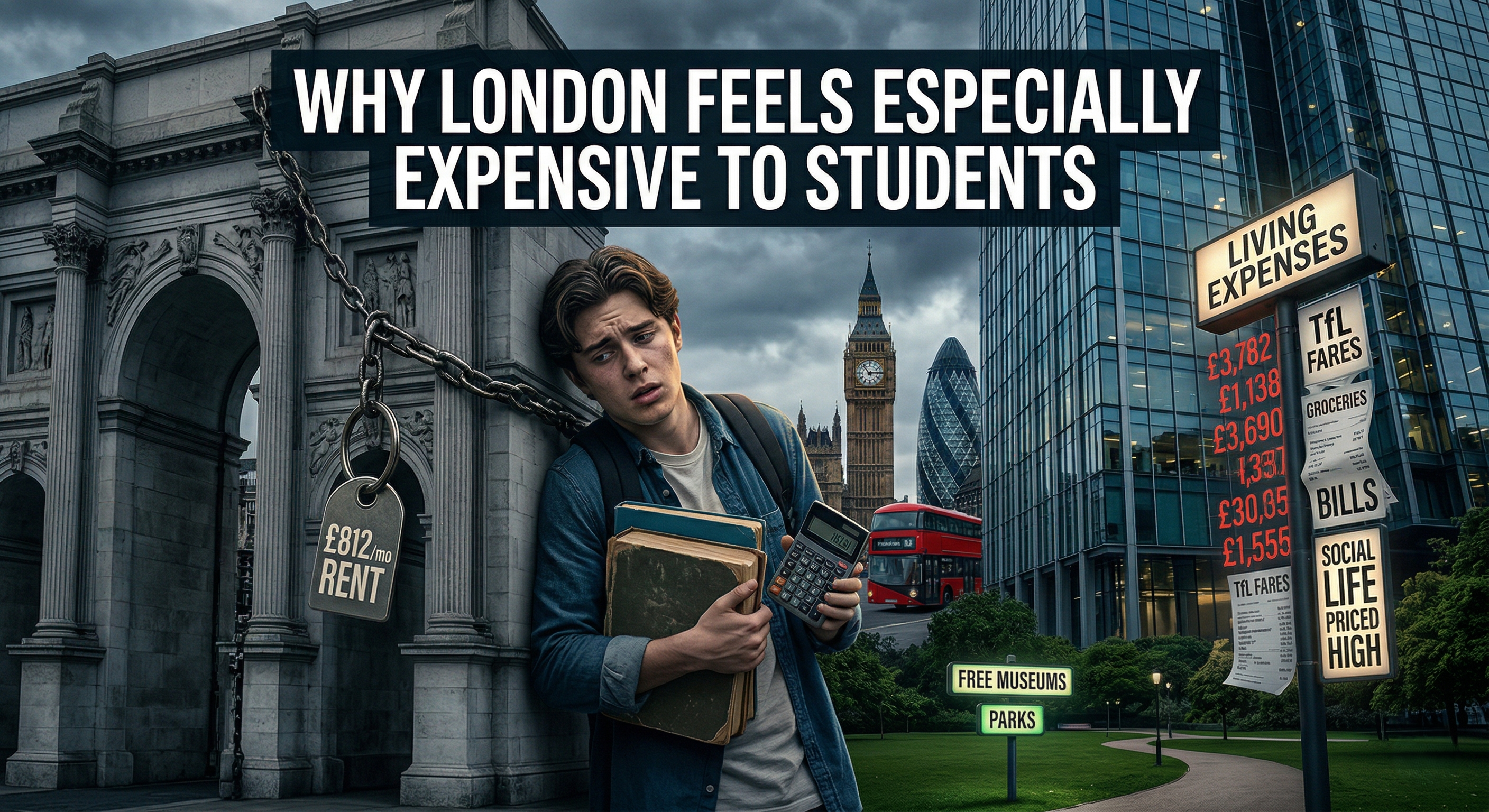
Students do not experience London as mini-tourists or mini-professionals. They often live in the city with the least financial flexibility and the least room for surprise expenses.
That is why the same housing pressure can feel harsher at student scale than at almost any other life stage.
Accommodation Is The Dominant Student Cost
Save the Student’s 2025 survey says students in London reported the highest monthly living costs in the UK at £1,269, while its accommodation survey found London to be the most expensive region for surveyed student rent at £812 per month.
That pressure is not only about rent. For many students, the squeeze comes from how rent combines with groceries, transport, bills, and a social life priced for a much wealthier city.
In London, even ordinary daily spending can feel heavier because it lands on top of an unusually high housing bill.
That means a student in London is rarely choosing between cheap city life and expensive city life. More often, they are choosing between different versions of pressure: hall fees, shared private rent, longer commutes, or reduced social spending.
Bigger London Loans Still Do Not Guarantee Affordability
The government does recognize London’s higher costs. For the 2025/26 academic year, the maximum maintenance loan for a full-time undergraduate living away from home and studying in London was £13,762, compared with £10,544 outside London.
For 2026/27, those maxima rose to £14,135 in London and £10,830 outside London. 2025/26 and 2026/27.
Even so, larger official support does not erase the problem. Save the Student says the average Maintenance Loanstill falls short of living costs by £502 per month across surveyed students.
Where Students Can Still Find Genuine Value In The City
A London student can still squeeze real value from the city, but usually by leaning into its free and low-cost strengths rather than trying to mimic a high-spend social life.
Free museum access, parks, walking-heavy days, and careful zone planning matter more in London than they do in many smaller university cities.
The main point is that students do not find London expensive because they are bad at budgeting.
They find it expensive because the city’s structural costs arrive before they have much income to cushion them.
Is London Actually The Most Expensive City?
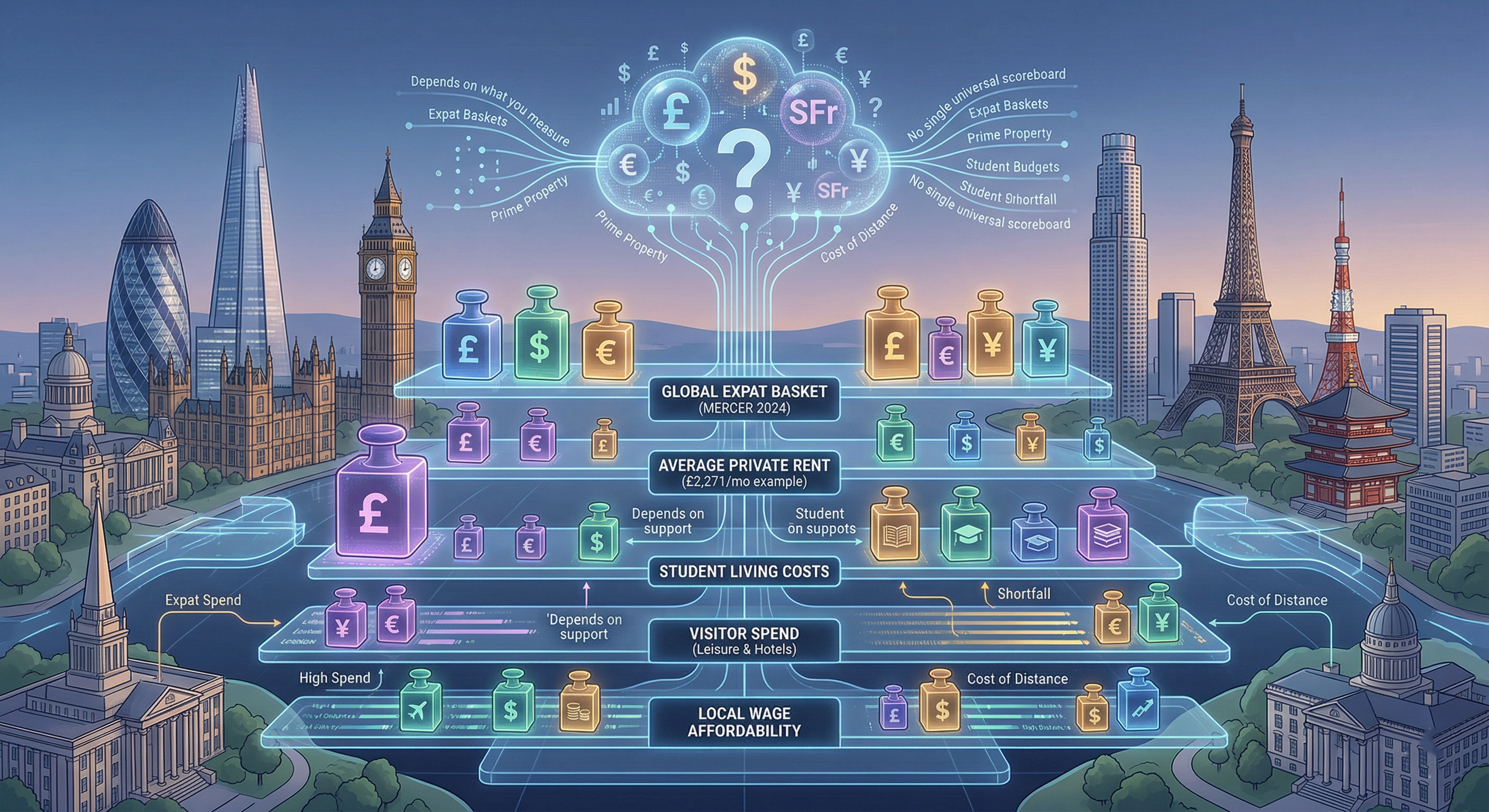
This is where headline claims need calming down. Most expensive sounds clean, but it depends entirely on what you measure: expat baskets, rent, prime property, student budgets, local wages, or visitor spend.
London ranks very high on several measures, but there is no single universal scoreboard that settles it once and for all.
Why Most Expensive Depends On The Ranking
Mercer’s 2024 Cost of Living City Ranking, which tracks more than 200 items for international assignees, puts London 8th and Los Angeles 10th among the world’s most expensive cities for that specific population and basket.
That is useful, but it is not the same thing as saying London is the most expensive city in the world for every resident, traveller, or student.
London Vs Los Angeles
On Mercer’s expatriate ranking, London edges Los Angeles. That suggests London is at least not obviously cheaper in a global-city comparison, especially once housing and central living are factored in.
But city-to-city comparisons shift with exchange rates, transport habits, healthcare assumptions, and whether you compare central districts or whole metro areas.
London Vs Paris
London and Paris are both expensive capitals, but they are expensive in slightly different ways. London’s price story is especially dominated by rent pressure, a massive commuter geography, and a tourism market that keeps central accommodation and leisure highly bid up.
Broader or richer? Comparisons also depend on whether you mean private wealth, metro economy, or household income.
What £1000 Or $1000 Realistically Buys
For a traveller, £1000 can still cover a short London trip if accommodation is modest and the itinerary is built around free attractions.
For a renter or student, £1000 a month is usually not enough for independent living once accommodation is included. London’s average monthly private rent alone was £2,271 in November 2025.
The key takeaway is that London belongs in the elite-cost conversation, but the honest answer depends on whose basket you are measuring.
What People Commonly Get Wrong About London’s Cost
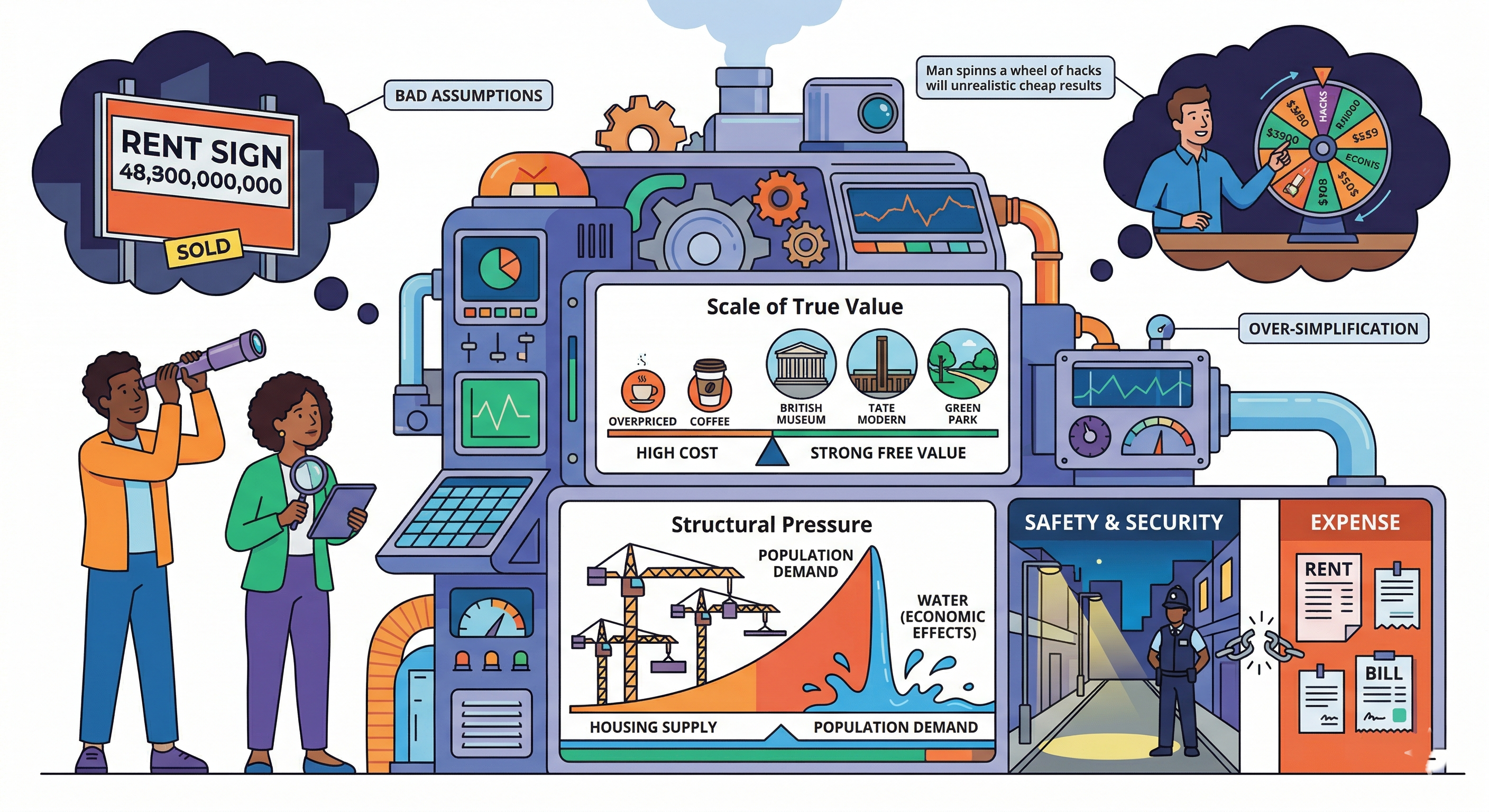
This part matters because bad assumptions lead to bad budgeting. People often flatten London into a cartoon: either impossibly expensive in every respect or somehow manageable if you know the hacks. Neither view is quite right.
Expensive Does Not Mean Every Category Is Bad Value
The strongest misconception is that high cost equals low value. London can absolutely be bad value if you spend carelessly on the wrong categories.
But it can also be an exceptional value if you care about museums, galleries, parks, walks, architecture, and public culture. A city can be expensive and still contain unusual concentrations of free or low-cost quality.
The Problem Is Structural, Not Just Greedy Pricing
It is tempting to explain London with one moral judgment: greedy landlords, overpriced restaurants, or rip-off Britain.
Those labels can capture parts of the mood, but they miss the broader truth. The city’s affordability problem is structural. Housing need has outpaced supply, and the knock-on effects reach well beyond the property market.
Safety And Expense Are Separate Questions
Another common detour is to mix up price with safety. They are different questions. A costly city is not automatically dangerous, and a safety judgment does not explain why rent, hotels, and food are expensive.
For this topic, treating them as one issue usually muddies the answer rather than improving it.
The takeaway is that London becomes easier to judge once you stop asking whether it is worth it in the abstract and start asking which parts are structurally expensive and which still offer strong value.
What this does not mean is that London is always poor value, or that every part of the city is priced the same way.
It means the city becomes harder faster when your budget depends heavily on housing or central convenience. Once you separate those pressures from the rest, London becomes easier to judge fairly.
How To Judge London For Your Own Budget
"London Travel Guide: Budget vs. Luxury - How to Experience the British Capital on Any Budget!"
Now the question becomes personal. Once you understand the forces behind London’s prices, you can judge the city more rationally. The trick is to stop using one scary headline number and start thinking by category.
A Quick Decision Table For Tourists, Renters, And Students
This table turns the theory into something usable.
| Main cost driver | What it makes expensive |
| Housing scarcity | Rent, flatshares, student accommodation, hotel rates |
| High-value central land | Restaurants, drinks, convenience shopping, short stays |
| Global demand | Prime neighbourhoods, leisure, theatre, central experiences |
| Big-city geography | Commutes, zone-based travel, time lost to distance |
| High operating costs | Everyday services, hospitality, staffing-heavy businesses |
The table is simple on purpose: if housing is your hardest constraint, London will likely feel expensive no matter how disciplined you are elsewhere.
If accommodation is already handled, the city becomes much easier to manage.
Worked Example With Numbers: Who Feels The Pressure Most
Consider three people. A three-day tourist can sometimes contain costs if they find simpler accommodation and build around free attractions, because their biggest pressure is short-term and adjustable.
A student paying around £812 a month in accommodation is already starting from a fixed cost before groceries, transport, and bills are even counted.
A private renter feels the sharpest ongoing pressure of all in a city where the average monthly rent reached £2,271, because that cost returns every month, whether spending elsewhere is careful or not.
- A three-day tourist can still control costs if they accept a simpler hotel, use fare caps, and build around free museums.
- A student may get a larger London maintenance loan, but survey data still suggests living costs can outrun support.
- A single renter feels the most relentless pressure because the city’s core cost driver, rent, is waiting every month.
That is why London often feels harsher to residents than to visitors. A tourist can swap restaurants for museums. A renter cannot swap rent for a free gallery.
Travel Editor’s Take
I would judge London in layers, not in slogans. If someone tells me the city is absurdly expensive, I want to know whether they mean a weekend hotel, a one-bed flat, nightly drinks in Zone 1, or a student budget stretched across a full academic year.
Those are all real London experiences, but they are not the same problem.
The practical takeaway is this:treat accommodation as the main decision, then build the rest of the city around it.
Also Check Out: Top 10 Most Spoken Languages In London Explained
Frequently Asked Questions
Why Is London So Expensive?
London is expensive because scarce housing, strong global demand, high business costs, and heavy tourism all compound one another. Rent is the clearest signal: average monthly private rent in London reached £2,271 in November 2025.
Why Is Rent So Expensive In London?
Rent is high because too many households and businesses compete for limited well-connected urban space, while housing supply has lagged what London is assessed to need. City Hall says London needs 88,000 homes a year under the current government assessment.
Why Is London Expensive To Visit?
Visitors buy the most competitive parts of the city: central accommodation, convenient transport, famous districts, and high-demand leisure. London also attracted roughly 21 million international visitors in 2024, which helps keep hotel and visitor pricing firm. .
Why Are Hotels In London So Expensive?
Hotels price into scarce central land, strong visitor demand, and high operating costs. In a city with huge tourism volumes and expensive property, central convenience carries a premium.
Why Is Food In London So Expensive?
Food prices reflect rent, labour, utilities, logistics, and the premium people will pay for convenience in busy districts. A meal near a major station often includes more location cost than food cost.
Is London The Most Expensive City In The World?
Not by every measure. Mercer’s 2024 ranking for international assignees placed London 8th, not 1st, and different methodologies produce different answers.
Is London Or Los Angeles Cheaper?
It depends on the basket, but Mercer’s 2024 expatriate ranking placed London 8th and Los Angeles 10th, which means London ranked as more expensive in that framework.
Who Is Richer, Paris Or London?
That depends on the metric. On private-wealth rankings, London remains one of the world’s leading wealth centres, but richer changes if you mean private wealth, GDP, public wealth, or income.
Is £1000 Enough To Live In London?
Usually not for independent full-month living if accommodation is included. London’s average monthly private rent alone was £2,271 in November 2025.
Is London Expensive For Students?
Yes. Save the Student’s 2025 survey says students in London reported the highest monthly living costs in the UK at £1,269, and London also had the highest surveyed student rent regionally.
Why Are Tube Fares So High?
TfL runs a huge network with peak and off-peak pricing, zone-based costs, and daily caps. From 1 March 2026, a Zone 1 peak pay-as-you-go Tube fare is £3.10 and the Zone 1–2 daily cap is £8.90.
Is Everything In London Expensive?
No. Housing, hotels, and nights out are costly, but some of London’s best museums and galleries still offer free general entry, which can make the city better value than its reputation suggests.
Why Does Housing Matter More In London Than Elsewhere?
Because housing shapes not only rent but commute choices, labour costs, poverty after housing costs, and what businesses must charge. In London, poverty rises from 15% before housing costs to 26% after housing costs.
What Part Of London Is Most Expensive To Rent?
ONS says Kensington and Chelsea had the highest average monthly private rent in England and Wales at £3,634 in November 2025.
Can You Still Do London On A Budget?
Yes, but usually only if you control accommodation, use public transport strategically, and build your itinerary around London’s unusually strong free cultural offer.
Why Is Nightlife In London So Expensive?
Nightlife venues absorb high rents, staffing costs, transport realities, and strong demand in central entertainment districts. Late-night convenience is part of what you are paying for.
Why Do Students Get Bigger Loans For London?
Because official student-finance rules recognize London’s higher living costs. For 2025/26, the maximum maintenance loan for living away from home and studying in London was £13,762, above the rate outside London.
Why Does Tourism Make London Pricier For Everyone Else?
Large visitor volumes support higher prices for central hotels, restaurants, and leisure businesses, especially in peak districts. London’s roughly 21 million international visits in 2024 show the scale of that demand.
Final Thoughts On London’s Price Tag
London is expensive for reasons that are easier to respect than to enjoy. It is not simply a city that charges too much.
It is a city where scarce housing, valuable land, intense demand, and global importance keep reinforcing one another.
That does not mean you should shrug and accept every price. It means you should read the city correctly. If accommodation is your weakest point, London will feel hard.
If that part is solved, London can open up quickly through free culture, walkable neighbourhoods, and better trade-offs than its reputation suggests.
The clearest way to say it is this:London is so expensive because housing scarcity sets the tone, and the rest of the city prices around it.
Don't Miss: Quietest Time To Travel On London Buses
Jump to
Why London Is So Expensive: What Drives Rent, Food, And Travel Costs
Why London Is So Expensive In One View
Housing Is The Engine Behind London’s Prices
Why Tourists Feel London’s Prices So Fast
Why Everyday Costs Stay High Even Beyond Rent
Why London Feels Especially Expensive To Students
Is London Actually The Most Expensive City?
What People Commonly Get Wrong About London’s Cost
How To Judge London For Your Own Budget
Frequently Asked Questions
Final Thoughts On London’s Price Tag

James Rowley
Author
James Rowley is a London-based writer and researcher covering London life, cultural geography, London travel, live London webcam pages and selected public figures across entertainment, sport, business and public life.
For over 15 years, he has focused on verified sources, first-hand local context and clear explanations that help readers understand both places and people more deeply. His work combines street-level London knowledge with careful research into career credits, media work, business interests and, where relevant, transparently explained net worth estimates.
He writes and reviews articles published on LondonWebcam.
Latest Articles
Popular Articles