Quietest Time To Travel On London Buses: TfL's Quiet Hours
The quietest time to travel on London buses is 08:30-15:00 or after 18:00 on weekdays, and before 12:00 or after 17:30 at weekends. Check live before you go.
Author:James RowleySep 26, 2026
Quietest Time To Travel On London Buses: What TfL Advises, And What Still Makes A Route Busy
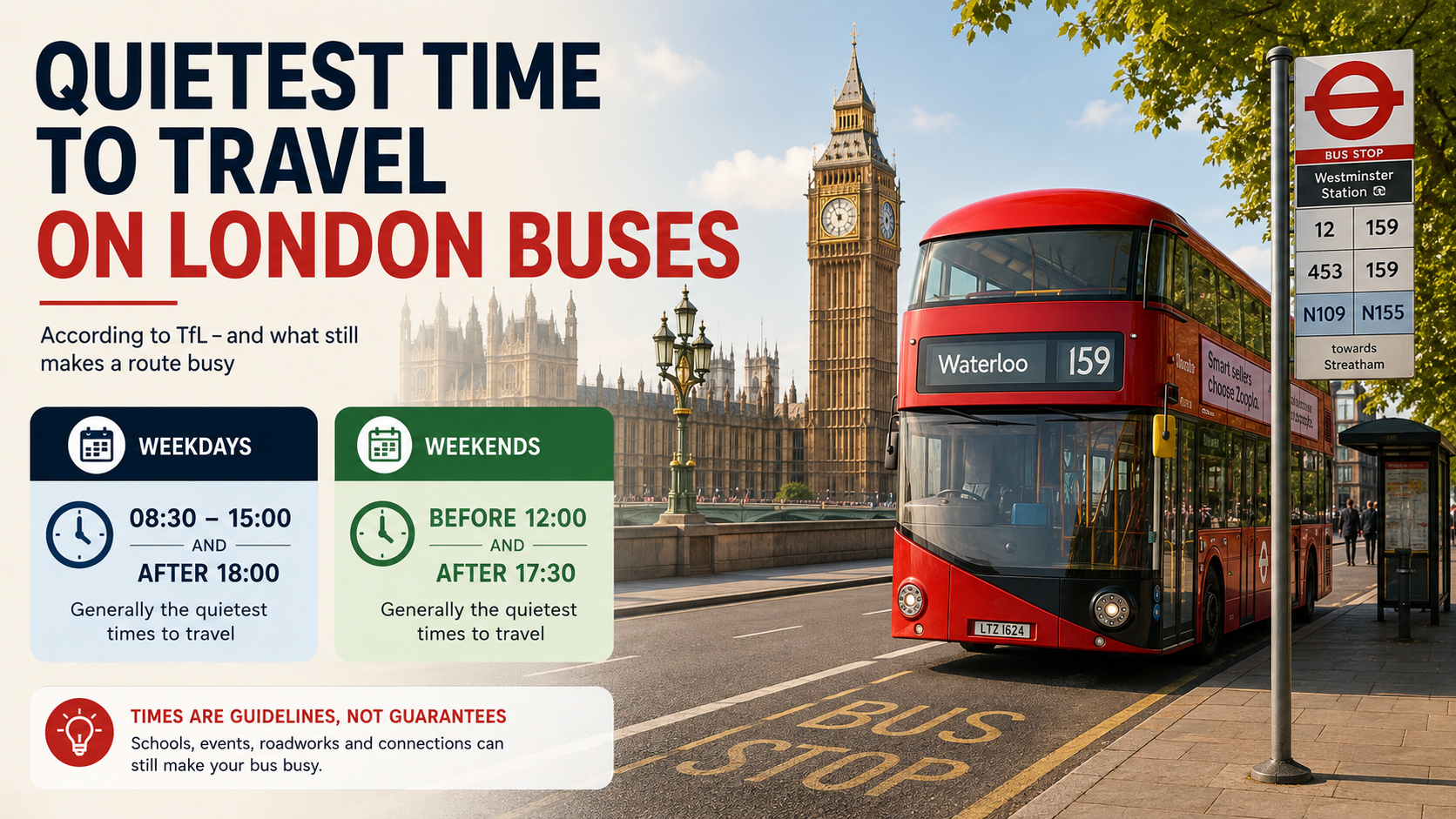
The quietest time to travel on London busesis generally between 08:30 and 15:00 and after 18:00 on weekdays, and before 12:00 and after 17:30 at weekends, according to Transport for London(TfL). These are network-wide guidelines rather than guarantees, so your exact route can still be busy because of schools, stations, shopping areas, events, roadworks or service disruption.
| When | Timing |
| Weekday quiet window | 08:30-15:00 |
| Weekday evening quiet window | After 18:00 |
| Weekend quiet window | Before 12:00 |
| Weekend evening quiet window | After 17:30 |
| Standard Hopper fare | Unlimited bus and tram journeys within one hour for £1.75 |
| Weekend Hopper trial | Unlimited bus and tram journeys for £1.75 per day on eligible weekends through 31 August 2026 |
| Sightseeing/daytime visitor | Weekdays around 09:30-15:00 |
| Flexible commuter | After 08:30 or after 18:00 on weekdays |
The timings above are the best starting point if you want a calmer journey, but the most useful approach is to combine them with a quick live check before boarding.
Quietest Time To Travel On London Buses: TfL’s Best Hours To Avoid Crowds
If you want a calmer bus ride in London, the difficult part is not finding one universal quiet hour. It is separating TfL’s general network guidance from what will actually feel quieter on your route, from your stop, on that particular day.
TfL publishes bus-specific quieter-time guidance, which gives a stronger starting point than guessing. On weekdays, buses are generally quieter between 08:30 and 15:00 and after 18:00. At weekends, the quieter periods are before 12:00 and after 17:30. TfL also warns that these conditions can change because of works, events and other circumstances.
Key Takeaways
- On weekdays, start with 08:30-15:00 or after 18:00 if your priority is avoiding the busiest periods.
- At weekends, aim for before 12:00 or after 17:30.
- These are general London-wide windows, not promises that every route or stop will be quiet.
- London buses do not have a standard peak and off-peak adult pay-as-you-go fare. The normal adult bus and tram fare is currently £1.75, with a standard daily cap of £5.25.
- The standard Hopper fare gives unlimited bus and tram journeys within one hour of first touching in for £1.75 when the same card or device is used.
- A temporary Weekend Hopper is running from 25 July to 31 August 2026. On eligible Saturdays and Sundays, £1.75 covers unlimited bus and tram journeys for that day. The August Bank Holiday Monday is also included.
- Before leaving, check live arrivals, route status, planned works and events using TfL’s journey tools.
The Quick Answer
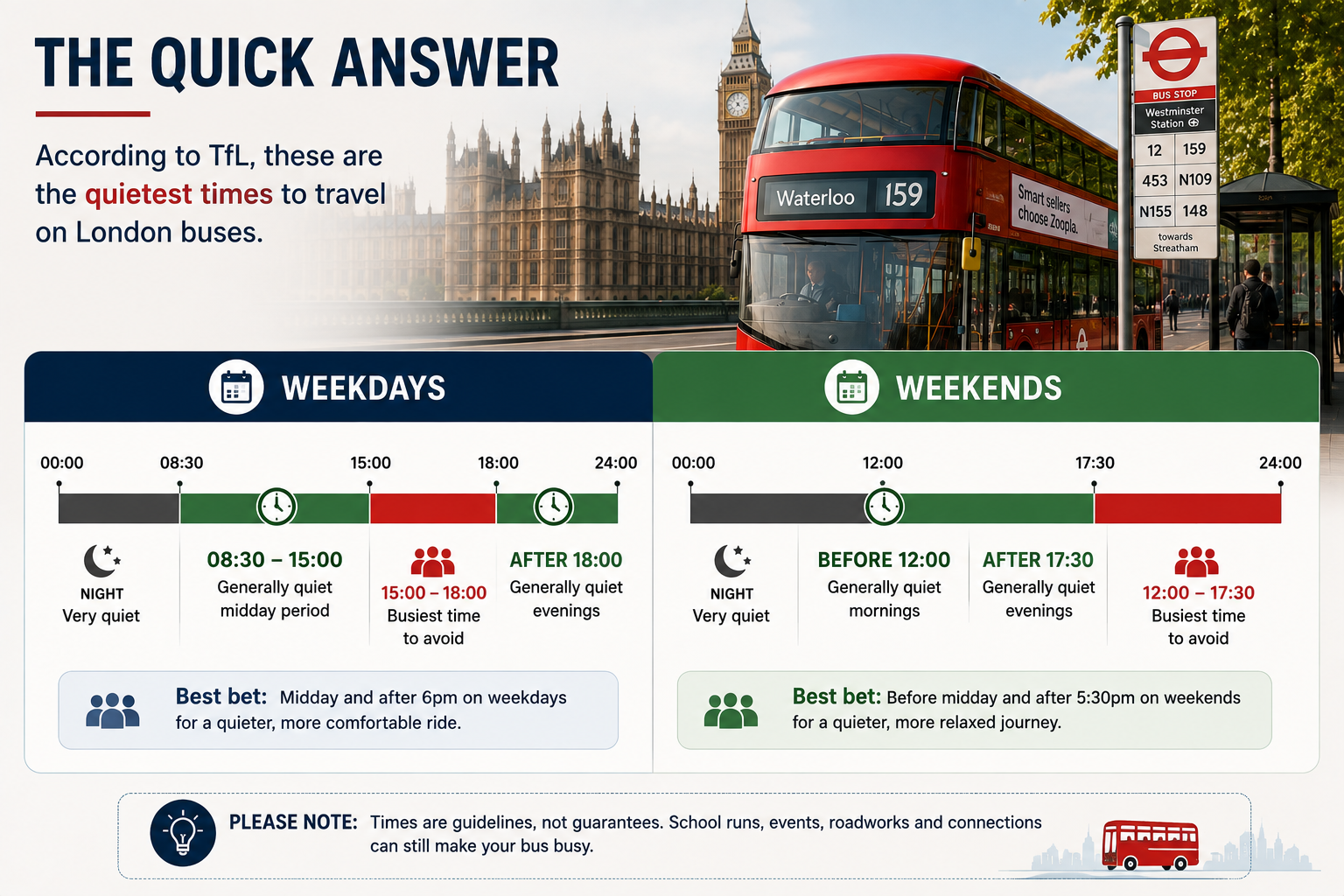
For most travellers, the simplest method is to start with TfL’s published quieter periods and then check whether your exact route is likely to follow them.
A weekday journey at 10:00 is generally a better bet for lighter crowding than one at 08:10. Likewise, travelling after 18:00 gives you a better starting point than leaving during the late-afternoon commuter period. At weekends, travelling before noon usually gives you a stronger chance of avoiding the busiest daytime leisure traffic.
A common mistake is treating “off-peak” on London buses as mainly a fare question. It is more useful as a crowding description, because the standard adult bus fare does not become more expensive during conventional rush hours.
It is also important not to import Tube rules directly onto buses. TfL gives separate quieter-time guidance for Tube and rail travel, with different time bands. If you are deciding between the two for the same journey, see the guide to the quietest time to travel on the Tube.
Weekday Quiet Windows: 08:30-15:00 And After 18:00
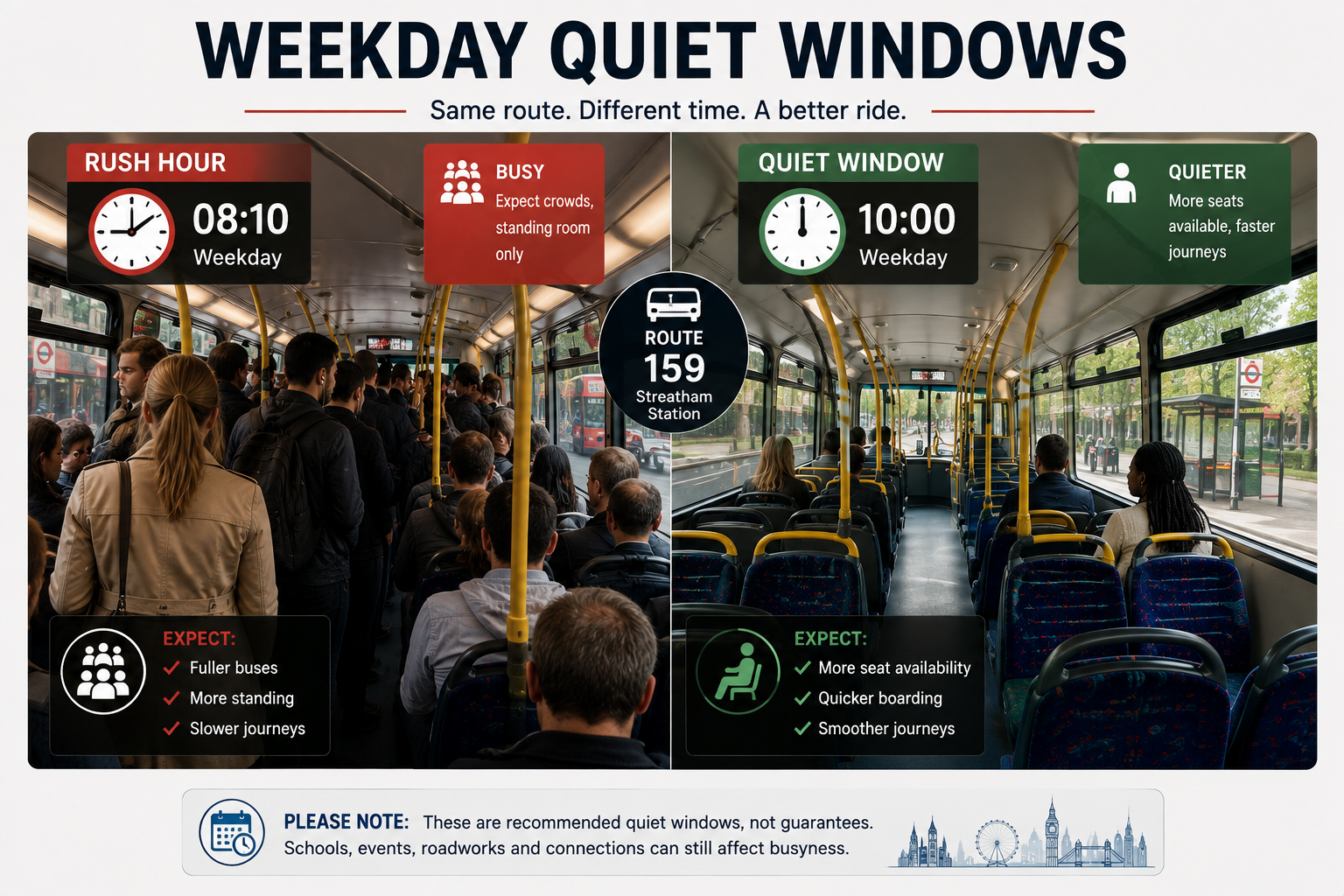
TfL’s weekday guidance gives two clear quieter periods for buses: 08:30 to 15:00, followed by another quieter period after 18:00.
For flexible travellers, the long mid-morning to mid-afternoon window is the easiest one to use. It begins after the main morning commuter build-up and runs until the afternoon becomes busier again.
In practical terms, that means a visitor heading out at 10:00 generally has a better starting point for a calmer journey than someone boarding shortly before 08:30.
The same logic applies in the evening. If your schedule allows you to leave after 18:00 instead of during the late-afternoon rush, you are moving into TfL’s published quieter period.
None of these boundaries acts like a switch. A bus at 18:05 is not guaranteed to be quiet, just as one at 17:55 is not guaranteed to be packed. The times are best treated as useful planning boundaries rather than minute-by-minute predictions.
Weekend Quiet Windows: Before 12:00 And After 17:30
Weekend bus patterns are different. TfL says buses are generally quieter before 12:00 and after 17:30 on Saturdays and Sundays.
For sightseeing and leisure trips, that makes an earlier start especially useful. Travelling before noon gives you a better starting point than waiting until the middle of the day, when shopping, tourism, sport and other leisure activity can increase demand.
The evening becomes a better option again after 17:30, although nightlife, concerts, football matches and major events can still produce very busy individual routes.
“Avoid rush hour” is therefore not enough advice for a weekend. Weekend demand is often driven by city activity rather than the conventional office commute.
When London Buses Are Usually Busiest Instead
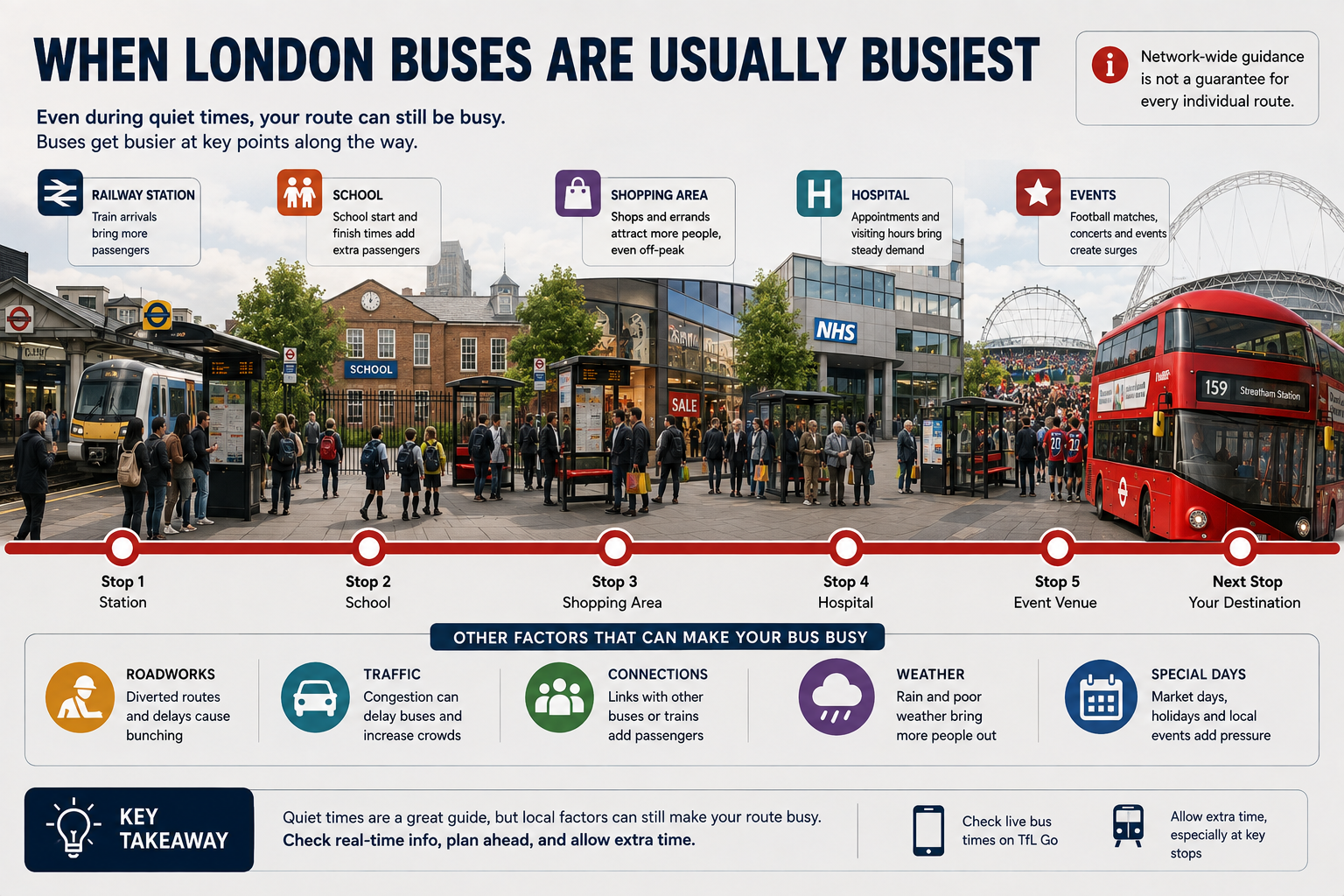
Knowing the quiet windows is useful, but understanding what sits outside them makes the advice much easier to apply.
Morning Commuter Peak
The bus network generally becomes busier before TfL’s weekday quieter window begins at 08:30. That makes the earlier morning period the first time to treat cautiously if crowding matters.
The effect can be especially noticeable around rail interchanges, town centres, schools, hospitals and large employment areas, where buses are carrying both local passengers and people connecting with other transport.
Late-Afternoon And Early-Evening Crowding
The second obvious pressure period comes before the quieter evening window begins after 18:00.
Several types of demand can overlap during this part of the day, including commuters travelling home, school and college journeys, shopping trips and event traffic.
TfL’s guidance returns to a quieter weekday period after 18:00, although it also warns that local conditions, planned works and events can change how busy individual stops become.
Why School Routes, Shopping Corridors And Interchanges Can Still Feel Busy
A quiet-time rule is a network-level guide, not a promise for every bus stop.
Different route types can behave very differently:
- Station-feeder routes can fill quickly after train arrivals.
- School-heavy routes can become crowded around school start and finish times.
- Shopping and leisure corridors can stay busy through the middle of the day, particularly at weekends.
- Event-area routes can fill before and after concerts, matches and other large events.
- Routes affected by reduced frequency or disruption can accumulate more waiting passengers between buses.
That is why your exact stop and route matter almost as much as the general time window.
Quietest Does Not Mean Cheapest: London Bus Fares Explained Simply
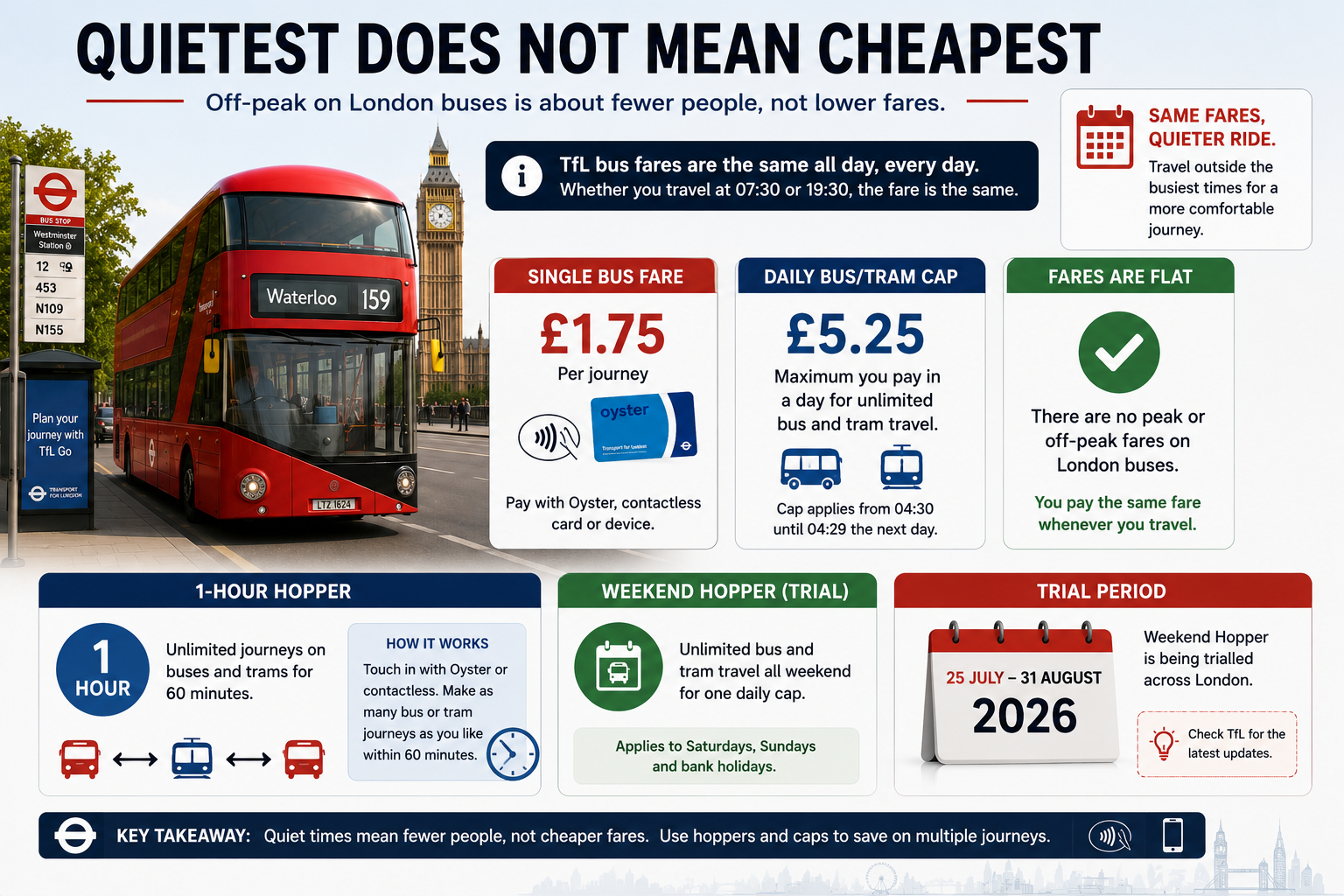
On London buses, “off-peak” is mainly a crowding idea rather than a pricing rule.
For adult Oyster or contactless pay as you go, the standard bus and tram fare is currently £1.75, regardless of whether you travel during a conventional commuter peak or during one of TfL’s quieter periods. The standard daily bus-and-tram cap is £5.25.
Do London Buses Have Peak And Off-Peak Fares?
No standard peak-versus-off-peak adult bus fare applies.
This is different from parts of London’s rail network, where time of travel can affect some fares. For buses, moving your journey from 08:00 to 10:00 is primarily a crowd-avoidance decision rather than a way to obtain a lower standard single fare.
Current Bus Fare, Hopper Fare And Weekend Hopper
| Journey scenario | What applies |
| Adult pay-as-you-go bus or tram journey | £1.75 |
| Standard Hopper | Unlimited bus and tram journeys within one hour for £1.75 |
| Standard adult daily bus-and-tram cap | £5.25 |
| Weekend Hopper trial | £1.75 for unlimited bus and tram journeys during an eligible Saturday or Sunday |
| From 04:30 on 1 November 2026 | Adult single £1.85; standard daily cap £5.55 |
The standardTfL Hopper fareallows unlimited bus and tram journeys within one hour of first touching in for £1.75. You need to use the same payment card or device for the journeys.
There is also an important temporary exception during summer 2026. The Weekend Hopper trial runs from 25 July through 31 August 2026. On Saturdays and Sundays during the trial, passengers can make unlimited TfL bus and tram journeys during that day for the price of one £1.75 fare. The August Bank Holiday Monday is included in the trial.
That makes weekend bus travel temporarily cheaper than the normal £5.25 daily-cap calculation for eligible pay-as-you-go journeys.
What Changes On 1 November 2026?
Bus and tram fares are currently frozen until 04:30 on 1 November 2026.
From that point, the adult pay-as-you-go single bus and tram fare is scheduled to increase from £1.75 to £1.85, while the standard daily bus-and-tram cap will rise from £5.25 to £5.55. The standard Hopper arrangement will continue to allow unlimited transfers within an hour of the first paid bus or tram journey.
Why Your Route May Not Match The “General” Quietest Time
TfL’s quieter periods are useful, but they are network-level guidance rather than route-by-route occupancy guarantees.
Busy Stops Vs Quiet Stops
The same route can feel completely different depending on where you board.
A bus may have plenty of room earlier in its journey and become much busier when it reaches a railway station, hospital, shopping district or major interchange.
If you know a route tends to fill at one large interchange, boarding one or two stops earlier may sometimes help, provided doing so is practical and safe.
Route Changes, Slower Traffic And Service Reductions
Current service conditions can also change how crowded a bus feels.
Reduced frequencies, diversions, roadworks and disruption elsewhere on the transport network can leave more passengers waiting between buses. TfL advises passengers to plan ahead and check current travel information because quieter conditions can change.
Bus bunching can have a similar effect. If one vehicle is delayed and another catches it, a longer gap may open behind them. The next bus can then be much fuller than the general time of day would suggest.
Busy road corridors can add another layer of uncertainty. If road traffic is part of your concern, the guide to London’s busiest intersectionsexplains where road conditions can become especially difficult.
Works, Events And Weekend Closures
Major works and events can temporarily override normal crowding patterns.
A concert, football match, rail closure or large public event can push additional passengers onto nearby buses and create queues that do not resemble the normal quiet-time pattern.
TfL specifically warns that stations and stops may become temporarily busier because of planned works and events.
The most reliable habit is therefore not memorising one supposedly perfect time. Use the published quiet windows as your baseline, then check what is happening on the network before travelling.
How To Find The Quietest Bus For Your Exact Journey Today
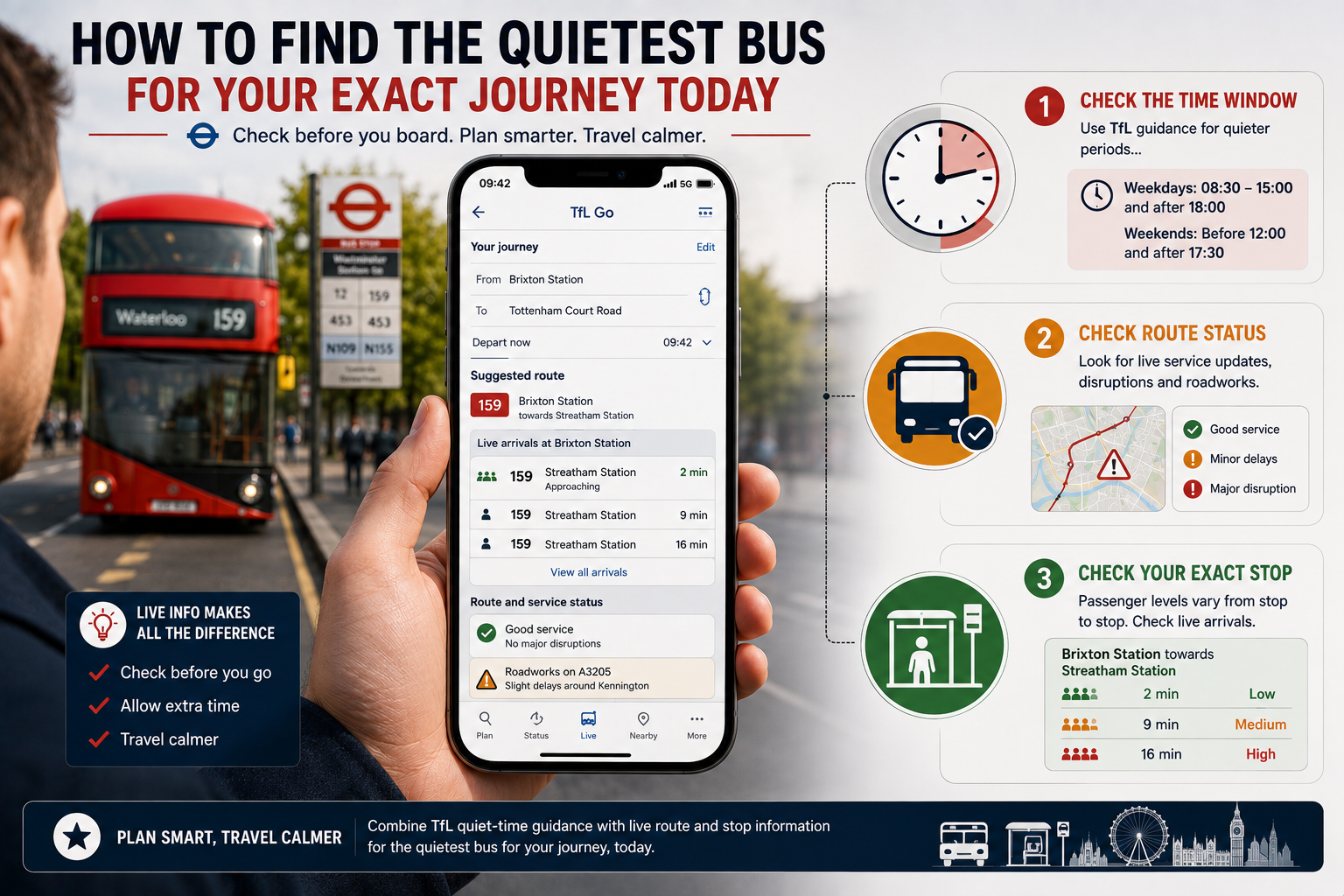
A general timing guide gives you the starting point. Live information helps you make the final decision.
Check TfL Go And Journey Planner First
TheTfL Go appprovides route planning and live transport information, while TfL also offers an online Journey Planner.
TfL recommends planning journeys in advance and checking current conditions when trying to travel at quieter times.
If your schedule is flexible, compare two nearby departure times rather than assuming your first option is best.
For example, on a weekday, choosing 09:10 instead of 08:10 puts you inside TfL’s general quieter period. In the evening, moving a journey from 17:20 to after 18:00 does the same.
Use Live Arrivals And Route-Status Updates
TfL provides live bus information and disruption tools that can help you check whether your route is operating normally before you leave.
Look at your exact stop, not just the route number.
A stop beside a railway station, hospital, shopping centre or event venue can behave differently from another stop on the same route.
If two nearby stops serve your journey, compare them. A short walk can sometimes help you board before the largest queue develops.
A 3-Step Pre-Boarding Check
Use this short checklist when avoiding crowds matters more than leaving at the earliest possible moment:
- Check the time window. Are you inside one of TfL’s generally quieter bus periods?
- Check the route status. Look for diversions, reduced services, roadworks or other disruption.
- Check the exact stop. Compare live arrivals and, where practical, nearby alternatives.
This turns a broad London-wide guideline into a practical decision for the journey you are actually making.
Best London Bus Times By Journey Type
The official quiet windows are broad, so it helps to match them to the kind of trip you are taking.
| Journey type | Best starting point |
| Sightseeing and daytime visitors | Weekdays around 09:30-15:00 |
| Commuters with flexible hours | After 08:30 or after 18:00 |
| Weekend travellers | Before 12:00 or after 17:30 |
| Late-evening and night-bus riders | After the evening peak, but check frequency and eventsAfter the evening peak, but check frequency and events |
| Rail or airport arrivals connecting to buses | Check the exact station stop and live arrivals |
Sightseeing And Daytime Visitors
For sightseeing, mid-morning through mid-afternoon on weekdays is usually the easiest window to work with.
If sightseeing is the main reason for your journey, London bus ride videos and live streamscan also help you preview the experience before choosing when and where to travel.
It falls inside TfL’s 08:30-15:00 quieter period while still giving you most of the day for attractions, museums and neighbourhoods.
At weekends, starting before noon gives you a better baseline than beginning in the busiest part of the afternoon.
Commuters With Flexible Hours
If you can shift your working day, even a relatively small change can place your journey inside TfL’s quieter guidance.
Travelling after 08:30 rather than in the earlier morning period, or after 18:00 rather than during the afternoon commute, is the clearest starting point.
Weekend Travellers
Weekend demand is less dominated by the office commute and more affected by shopping, sightseeing, sport, entertainment and events.
TfL’s broad recommendation remains simple: before 12:00 or after 17:30.
Late-Evening And Night-Bus Riders
Late evening can be calmer than the main commuter period, but it is not automatically quiet.
Service frequency can be lower and nightlife or major events can create sudden queues. Checking live arrivals becomes particularly useful when fewer buses are running or when large venues are emptying.
Rail Or Airport Arrivals Connecting To Buses
Connecting passengers can lose some of the benefit of travelling inside a general quiet window if they arrive at a busy station at the same time as a large trainload of other passengers.
A bus serving a railway or coach interchange can become crowded even when the wider network is relatively calm.
Check the exact stop and live arrivals before joining the first queue you see.
FAQs About The Quietest Time To Travel On London Buses
Is Sunday Quieter Than Saturday?
TfL does not give a bus-wide rule saying that Sunday is always quieter than Saturday.
Its public weekend guidance is based on time of day, with buses generally quieter before 12:00 and after 17:30. Local events, shopping areas, stations and service changes can make either day busier on a particular route.
What Time Is Off-Peak On London Buses?
For buses, “off-peak” is most useful as a crowding description rather than a separate standard adult fare category.
TfL says buses are generally quieter between 08:30 and 15:00 and after 18:00 on weekdays, and before 12:00 and after 17:30 at weekends.
What Is The Maximum Bus Fare In London Per Day?
The standard adult pay-as-you-go bus-and-tram daily cap is currently £5.25. The standard adult single fare is £1.75.
There is a temporary exception during the 2026 Weekend Hopper trial. On eligible Saturdays and Sundays from 25 July through 31 August, £1.75 covers unlimited bus and tram journeys for the day, with the August Bank Holiday Monday also included.
From 04:30 on 1 November 2026, the standard adult single fare is scheduled to become £1.85 and the standard daily cap £5.55.
Are Buses Or The Tube Quieter At Off-Peak Times?
There is no single answer for every journey.
TfL publishes separate quieter-time guidance for buses and for Tube and rail services. Bus guidance uses the 08:30-15:00 and after-18:00 weekday windows, while Tube and rail have different timings. Your better option depends on the exact route, station, stop and any disruption taking place.
Quick Recap
For the quietest time to travel on London buses, start with 08:30-15:00 and after 18:00 on weekdays, or before 12:00 and after 17:30 at weekends. Those are TfL’s current general quieter periods.
Then check your exact route before travelling. Schools, stations, shopping areas, events, roadworks, diversions and service changes can all make an individual bus much busier than the general timing suggests.
The practical method is simple: choose the quieter window, check live arrivals and route status, then check your exact boarding stop. That gives you a much better chance of finding a calmer London bus without overcomplicating the journey.
Jump to
Quietest Time To Travel On London Buses: What TfL Advises, And What Still Makes A Route Busy
Quietest Time To Travel On London Buses: TfL’s Best Hours To Avoid Crowds
The Quick Answer
Weekday Quiet Windows: 08:30-15:00 And After 18:00
Weekend Quiet Windows: Before 12:00 And After 17:30
When London Buses Are Usually Busiest Instead
Quietest Does Not Mean Cheapest: London Bus Fares Explained Simply
Why Your Route May Not Match The “General” Quietest Time
How To Find The Quietest Bus For Your Exact Journey Today
Best London Bus Times By Journey Type
FAQs About The Quietest Time To Travel On London Buses
Quick Recap

James Rowley
Author
James Rowley is a London-based writer and researcher covering London life, cultural geography, London travel, live London webcam pages and selected public figures across entertainment, sport, business and public life.
For over 15 years, he has focused on verified sources, first-hand local context and clear explanations that help readers understand both places and people more deeply. His work combines street-level London knowledge with careful research into career credits, media work, business interests and, where relevant, transparently explained net worth estimates.
He writes and reviews articles published on LondonWebcam.
Latest Articles
Popular Articles