

What remains readable when the light changes?
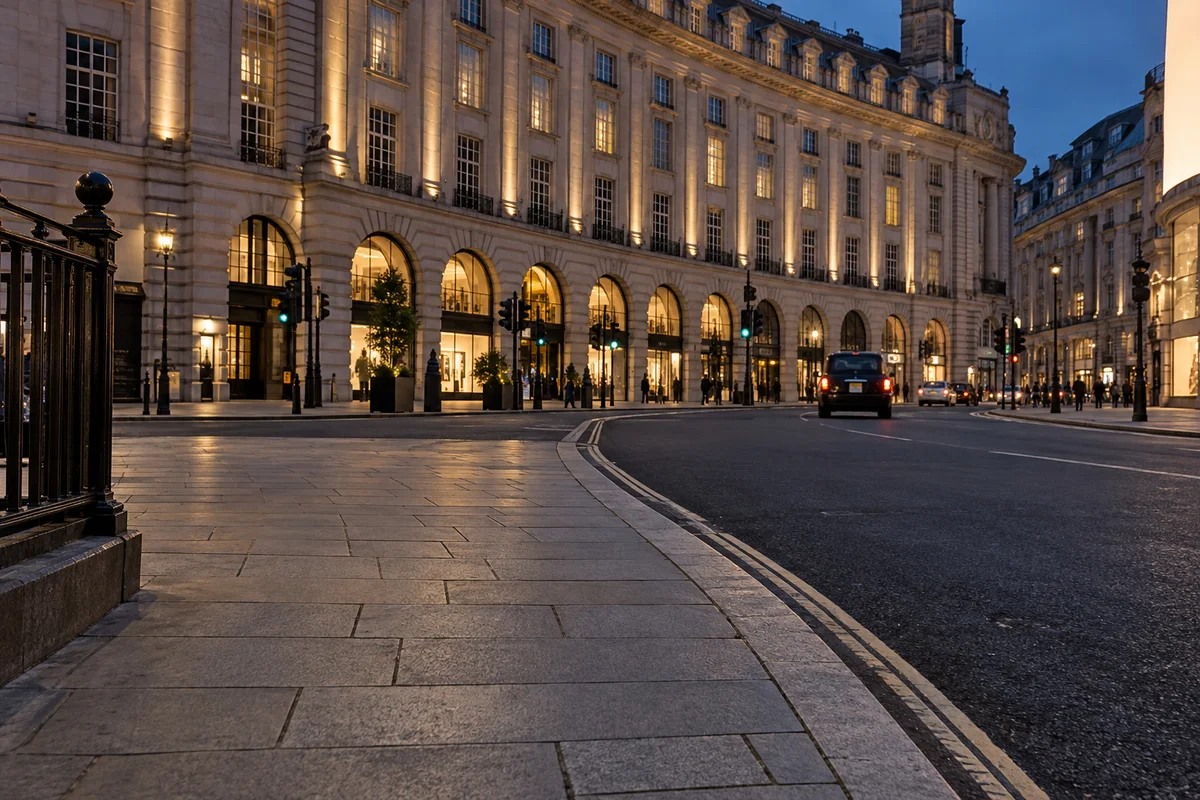
Trace the pavement edge and the repeated windows before looking at the illuminated openings. A bright patch can draw the eye away from a useful boundary. This composed night study supplies a practice scene, not evidence of current lighting.
Begin with the frame
Begin at a junction, where lit surfaces and road movement share one picture. Piccadilly Circus will do, or either Albert Bridge camera if you prefer a single crossing to a meeting of streets. Historic England records lamp standards in the bridge listing alongside the structure itself, which is a useful reminder that lighting on a bridge is part of the architecture rather than decoration applied to a photograph. Whether those lamps are lit in the media you receive is a question for the frame. The listing describes metalwork; it cannot tell you what a camera is showing tonight.
Inspect the still image before you request a clip. A photographic exposure integrates light over a finite interval; a still frame does not provide a sequence or time base. It can show that something is bright without showing how long it stayed that way or what happened next. Ask two plain questions of the picture. Can you separate pavement from carriageway? Can you follow a building edge outside the brightest patch? A familiar location can still produce a dark, cropped or obscured image, and a reputation for illumination is no help when the frame is mostly shadow.
If both answers are no, the view is telling you something about the view. It may be worth changing camera rather than arguing with the picture. A night frame is not a measurement of darkness; it is a report on what one exposure captured. Naming that limit early keeps the rest of the reading honest.
Read around the brightest patch
Bright signs, vehicle lamps and reflective surfaces can take command of a night image. The most luminous object in the frame is rarely the most informative one. Where a bright patch has lost its detail, avoid using it to describe a building’s shape or the road’s condition; the glare has removed the evidence you would need. Examine the darker edges instead. A silhouette, a parapet or a steady line of lamps may give a clearer account of the street’s geometry than the brightest object on the screen.
Brightness can hide the very thing it falls on. That is a practical point rather than a paradox. A shopfront lit from within may read as a flat rectangle while the floor above it keeps its cornice and window rhythm. A wet carriageway may throw a column of light that hides the lane markings beneath. Move your attention to the part of the frame that still has edges, and describe what those edges do.
This is also where a still image is at its most useful. Shape survives a single exposure, so the outline of a bridge, the turn of a kerb and the regular spacing of lamp standards remain available even when colour and surface detail do not. Read the shape first, and treat the brightness as something to be navigated rather than a subject to be described.
Fixed light and moving light
In a requested clip, follow one visible change rather than the whole scene. This is where fixed and moving light separate. A line of lamp standards holds its position across the sequence, while headlights travel through the frame and the reflections beneath them shift. That difference is more useful than any attempt to identify a vehicle from its glare. The fixed light gives you the structure; the moving light gives you a direction of travel, and little more.
Movement blur is the smear a thing leaves during the exposure, and it is evidence of motion rather than a measurement of it. Leave ambiguous motion ambiguous. A blur need not be rain, and a streak of light need not establish speed. If you want to know how fast something moved, or whether a surface is wet, the picture is the wrong instrument. Record the change you saw and stop where the evidence stops.
For services and journeys, use the transport guide rather than reading them from a night picture. A camera can show a vehicle passing a frontage; it cannot show where that vehicle is going, when the next one leaves, or whether the road is behaving normally. Keeping those questions apart is what makes the visual observation worth having.
The two-caption test
A night image can simplify a complicated place. At Piccadilly Circus a lit surface may stand forward while a building edge retreats; at Albert Bridge a line of light may make the crossing easier to follow than the individual ornaments. Write two short captions for any readable frame. The first names the brightest feature. The second names the structure that contains it.
The pair tests whether the light has left you any geography. If the second caption is impossible, the frame is giving spectacle without much place, and the honest response is to change views or to record the limit and stop. There is no shame in a picture that shows a glow and nothing else; there is a problem when the caption pretends to more.
Keep the two captions in the same order every time. Brightest feature first, containing structure second, and any uncertainty written plainly underneath. The habit turns a night view from an atmosphere into an observation.
Choosing a night subject
Choose a subject the light reveals rather than the most brightly lit thing on offer. A bridge rewards a steady line of lamps along its deck; a junction rewards the contrast between fixed standards and travelling lamps; a shopping street rewards the edges between lit windows and darker masonry. None of these needs a claim about the weather, the traffic or the time.
The site’s observation notebook asks for a feature, an uncertainty and a second look, which suits night work well. Pick one edge, one fixed light and one question you cannot answer from the frame. Then write the two captions and compare them with what the next view gives you.
A night camera is at its best when it is asked about shape. Ask it about speed, weather or mood and it will flatter you with an answer it cannot support.
Sort the light sources
Four kinds of light do most of the work in a night frame: the street lamp, the shop window, the vehicle lamp and an apparent reflection on the carriageway. Sort each claim below by whether a single still frame can establish it. Work through all six, and read the note that follows each choice.
Street lamp
A steady line of lamp standards marks the edge of the street or the line of the bridge deck.
Choose a label for this claim.
Shop window
The number of storeys above the brightest shop window can be counted from the glare itself.
Choose a label for this claim.
Vehicle lamp
A streak of headlight shows how fast a vehicle was travelling.
Choose a label for this claim.
Apparent reflection on the carriageway
A bright patch appears beneath a fixed lamp standard; the still does not establish whether the surface is wet.
Choose a label for this claim.
Vehicle lamp
The vehicle behind the near headlights is waiting at the junction.
Choose a label for this claim.
Shop window
A pavement edge runs on beyond the brightest window.
Choose a label for this claim.
No claim labelled yet. Sort the six visible-light claims as you read.
- Street lamp: A steady line of lamp standards marks the edge of the street or the line of the bridge deck. A still frame can establish this. Fixed light gives geometry. A line of lamps that holds its place against the dark is one of the few night features a still frame can describe with confidence.
- Shop window: The number of storeys above the brightest shop window can be counted from the glare itself. A still frame cannot establish this. Glare swallows detail. Where a bright patch has lost its edges, read the darker face beside it or leave the storey count out altogether.
- Vehicle lamp: A streak of headlight shows how fast a vehicle was travelling. A still frame cannot establish this. A streak is evidence that something moved during the exposure, not a measurement of how quickly. Leave speed to a source that has a time base.
- Apparent reflection on the carriageway: A bright patch appears beneath a fixed lamp standard; the still does not establish whether the surface is wet. A still frame can establish this. The position of the bright patch can be described relative to the lamp. That appearance alone does not establish a reflection or prove the surface is wet.
- Vehicle lamp: The vehicle behind the near headlights is waiting at the junction. A still frame cannot establish this. Waiting implies a duration and a reason. A still frame shows a position, not how long the vehicle has held it or what it is waiting for.
- Shop window: A pavement edge runs on beyond the brightest window. A still frame can establish this. The darker edge is often the more legible part of a night image. Follow it past the lit surface and describe where it goes.
Sources & further reading
Official references inform this guide. Check the responsible organisation for current access, opening times and travel advice.