
Two windows onto London.
A crossing, a gathering place, a shopping street. Choose a short study below, or make your own comparison with two full camera images. Start with the shape of the street.
Two ends of a crossing
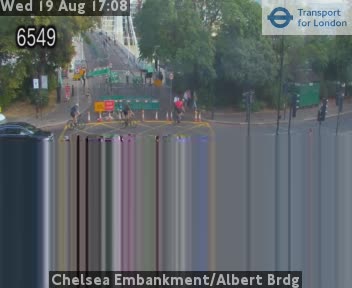
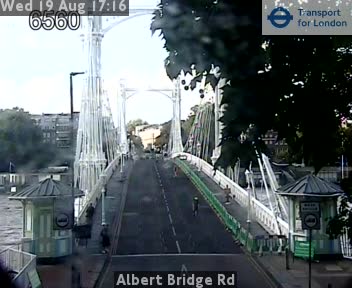
Find the road approach in each available frame. Describe how its width, position or apparent depth differs between the two views. Compare the perspective without following a vehicle between images or assuming a shared capture time.
Separate provider images, without a verified shared capture time. Compare the framing; these views cannot measure a change in traffic between two moments.
Back to the camera collection ↑
Start with a small study.
Two ends of a crossing
A road approach gives a bridge its first shape: a line narrowing into the distance, or a broad foreground leading towards a crossing. Begin with that line in these two views, labelled for the Chelsea and Battersea ends of Albert Bridge.
Notice how much space the approach occupies and where it meets the edge of the frame. A difference in perspective is enough to describe. The companion guide explains the crossing and its two settings; the images need not reveal every part of the bridge.
Try thisFind the road approach in each available frame. Describe how its width, position or apparent depth differs between the two views. Compare the perspective without following a vehicle between images or assuming a shared capture time.
Approach and gathering place
A bridge leads somewhere; a square gives a place an edge. Westminster Bridge and Parliament Square offer a useful starting point for looking at these two ways of organising a city, without treating a camera frame as a complete plan.
Look for the shape rather than the amount of activity. A road may carry the eye through a view, while a pavement, railing or building edge may enclose part of it. The guide supplies the wider setting when an image leaves the relationship unclear.
Try thisIf visible, notice a line that carries movement through one frame and a boundary that holds a space in the other. Describe the shapes you can identify; if either is outside the frame, leave that part of the comparison open.
Two retail streets
A shopfront gives a street one edge; the pavement gives it room for everyday use. Compare the Oxford Street view labelled for Selfridges with the Harrods view, looking for the relationship between frontage, pavement and roadway wherever the frame allows.
Start with broad proportions: an unbroken edge, an opening, a strip of pavement. Small camera images cannot settle questions of stone, ornament or workmanship. Follow the companion guide and its heritage sources for that material detail, then return to the street's shape.
Try thisWhere visible, compare how much of each frame is given to frontage and pavement, and how those edges meet the road. Describe the proportions you can see; use the guide's heritage sources for details the camera cannot resolve.