

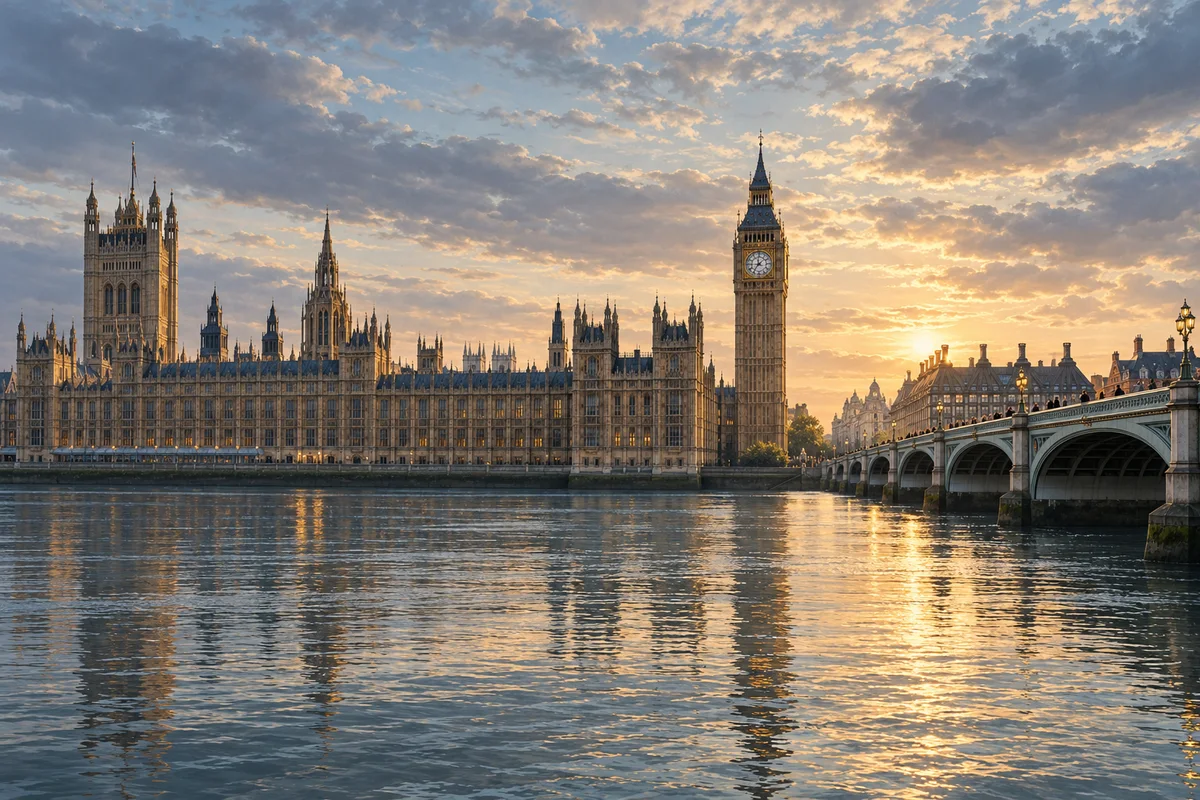
Two documented views
The two Westminster cameras are often treated as rival attempts at the same picture, which is the fastest way to make both disappointing. The catalogue separates them clearly. The bridge camera is described as a view of Westminster Bridge, looking towards Big Ben and the Houses of Parliament, and those buildings appear on the left-hand side. The Parliament Square camera is described as looking south. One is a crossing with a destination ahead; the other is a view across a civic space from one side.
The distinction between Elizabeth Tower and Big Ben is worth fixing before you look. The Palace of Westminster places Elizabeth Tower at its north-eastern end, and Big Ben is the name of the tower’s main bell. Parliament’s own architecture account uses those names precisely, and the precision helps when a frame gives you a tower but not a clock face, or a bell tower you cannot identify. Naming a landmark accurately is a small skill that prevents a great deal of confident nonsense.
Keep a second distinction in view as well: between a landmark being nearby and a camera showing it. A camera described as looking towards a building may include it, partly include it or miss it altogether, depending on the crop and on what has parked in the way. The descriptions establish a direction and a relationship. They do not establish the contents of any particular frame.
Reading the approach
An approach towards a building is a different composition from an architectural portrait. The road supplies momentum, and the destination sits at the end of the movement rather than filling the frame. Follow the kerbs, the lane markings and the parapet as they converge, and note how much of the picture the carriageway claims. A road that occupies the lower half and narrows towards a distant point gives the scene its direction; a heavy foreground of vehicles interrupts it.
The bridge camera is described as having Parliament on the left, which gives you a left-and-right reference rather than a centre of attention. That is useful when a tall vertical or a pointed detail appears, because you can ask whether it sits where the description leads you to expect. It is not proof of a particular facade. A small pointed window is not a Gothic building, and a pale silhouette is not necessarily the Palace.
Even when the expected skyline is indistinct, the approach still says something worth recording about the bridge’s road space and its relation to the buildings beyond. Write what the road does, then leave the architecture as a question to check against Parliament’s account rather than a name to guess from the camera title.
The square as its own setting
Parliament Square asks for a different reading. A civic space is an arrangement of open ground, road, frontage and sometimes planting, and a camera described as looking south will show you one edge of that arrangement rather than the whole design. Look for the boundary between road and open space, the pavement corners, and the building faces that enclose the area. Then say how much of the space the crop actually gives you.
The name of the camera is not a contents list. Parliament Square is a large place, and the view may not include the Abbey, the Palace or the square’s central ground. Before you identify a building, check the crop. A pale stone frontage in a Westminster frame might be any number of things, and Parliament’s architecture account, which explains the Palace’s Gothic form, is grounds for reading an identifiable portion of the Palace correctly rather than for calling every classical or Gothic elevation Parliament.
Give the square its own subject and its usefulness becomes obvious. Where the bridge view gives you a journey towards a building, the square view gives you the edges around a civic setting: road, pavement, frontage and open ground held together. That is a composition in its own right, not a failed attempt at a Big Ben picture.
One feature at a time
The way to compare two dissimilar views is to fix a single feature and hold it steady. Choose the road’s direction, a pavement corner or an identifiable building edge, and look for that same kind of feature in both frames. Do not compare traffic volumes, which depend on unverified capture times, and do not compare “how close” the cameras feel to Big Ben, which is a question about framing rather than proximity.
With the feature fixed, the two views become complementary rather than competitive. The bridge frame will generally give a strong directional line and a destination; the square frame will generally give a boundary between movement and open space. If a feature appears in only one frame, that is a result to record, not a reason to prefer that camera permanently. The pair improves orientation precisely because it refuses to show the same slice twice.
The dedicated Westminster comparison study on the comparison page sets the two views side by side with a paired prompt, which suits this one-feature method. For a virtual visit, write down something visible and something missing from each frame, and keep the two lists separate. A pair that shows you its own limits is doing better work than any single frame asked to be definitive.
Where the pair cannot settle it
Some questions have no better answer among these two. If you need to identify a particular building, neither view guarantees it: the bridge camera’s description names a direction and a left-hand relationship, and the square camera’s description gives only a compass direction. If you need to know about rooms, opening times or access, neither camera can help, because an image records a surface and not a service. If you want a plan of the junction and the square together, the pair is the wrong instrument.
It is worth saying this plainly, because the temptation with two named Westminster cameras is to force them into a contest and declare a winner. They are different kinds of space. The bridge view is a route with somewhere to go; the square view is an edge of a gathering place. A decision between them is a decision about what you want to study, not a judgement about which camera is superior.
Where the choice is genuinely open, the honest move is to open both and record a difference and a gap from each. That is a complete piece of observation. A single confident sentence about a landmark you cannot quite see is not a substitute for that record.
Bridge versus square decision tool
Answer three short either/or questions about what you want to study. The tool returns the better starting view with a reason, and says when neither view settles the question.
Answer all three questions to reach a recommendation. 0 of 3 answered.
- Bridge approach: the catalogue describes Westminster Bridge looking towards Big Ben and the Houses of Parliament, which appear on the left-hand side.
- Civic setting: the Parliament Square camera is described as looking south; the name does not mean the Abbey or the Palace is included.
- Use Elizabeth Tower for the tower and Big Ben for its main bell. Where neither view settles your question, leave it open rather than inferring a building from a pale stone frontage.
Sources & further reading
Official references inform this guide. Check the responsible organisation for current access, opening times and travel advice.