

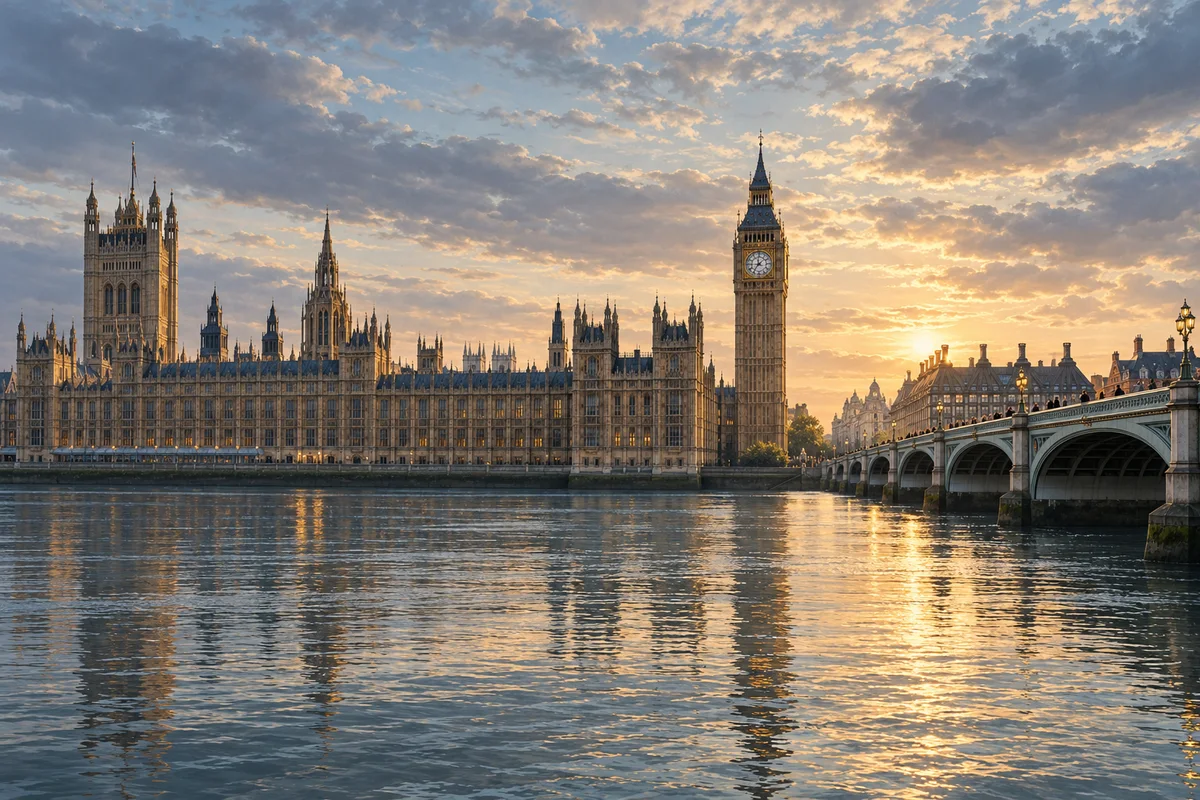
A bridge designed as a neighbour
Westminster Bridge is usually treated as a platform for a photograph of Parliament. Its own design rewards a second look. Historic England dates the present bridge to 1862, credits Thomas Page, and describes seven segmental cast-iron arches carried on grey granite piers and abutments. The Gothic detailing was chosen to accompany the new Palace across the road. This was an engineering work made to converse with a conspicuous civic building, not a neutral strip of road placed in front of it.
What the road conceals
A camera near deck level may show a parapet, a lamp or the run of traffic while the arches remain below the line of sight. The bridge is present even when its most explanatory engineering is absent. That is not a failure of the camera; it is a fact about the position. For the seven-arch form, the heritage listing and a side-on image can do what this crop cannot, and knowing which part you are missing is the first step to reading the scene well.
An arch is not only a curve
A cast-iron arch carries the deck’s load towards its piers, while the granite below meets the water. Historic England also names pierced, panelled spandrels: the panels between the curve of an arch and the flat roadway above it. Those openings lighten the visual mass and give the bridge detail at a scale between structure and ornament. A side elevation makes their position obvious; from the roadway you may see none of it. Knowing what lies below the traffic corrects the common picture of Westminster Bridge as merely a decorated parapet with a view.
Lamps in conversation with stone
Historic England records Tudor-Gothic cast-iron lamp standards, some carrying twin bracketed octagonal lanterns with gilded finials. If one is clear enough to inspect, compare its pointed, historicising forms with the larger Palace silhouette. The affinity is deliberate, though the two work at very different scales. A lamp is useful precisely because it can be visible when the iron arches are not. Do not force an identification from a few pixels; the repeated uprights, their spacing and their relationship to the parapet may be more legible than the individual ornament.
Separate three bands
Read an available frame from the bottom upward: road surface, any river or embankment visible beyond it, then the buildings against the sky. Find the line where one band ends before naming a landmark. Perspective may stack the bridge approach against Elizabeth Tower, which stands at the north-eastern end of the Palace. The tower gives an anchor, but the road and river explain why the scene looks as it does. A bus may interrupt the view; the geometry of the place is still the subject.
Choose a viewpoint
The same bridge yields different amounts of itself depending on where the camera stands. Switch between the three positions below to see how many arches a given sightline can actually reveal.
From the roadway. A deck-level crop may contain parapet and traffic while leaving the arches below the line of sight. The bridge is present, but its most explanatory engineering is not visible. Historic England's listing and a side-on image must supply the seven segmental cast-iron arches.
The seven arches come from the listing. Viewpoint drawings are illustrative, without measured sightlines or a predicted visible arch count. They make no claim about a current camera crop.
A useful comparison
Use Westminster Bridge for the crossing and Parliament Square for the streets on its northern side. They offer different fragments of the same district rather than two synchronised views of one event. Compare fixed elements: the line of the approach, the scale of the buildings, and whether greenery or water enters either crop. That small exercise tells you more about Westminster’s layout than watching for a coincidental match between vehicles whose capture times are unknown.
Sources & further reading
Official references inform this guide. Check the responsible organisation for current access, opening times and travel advice.