

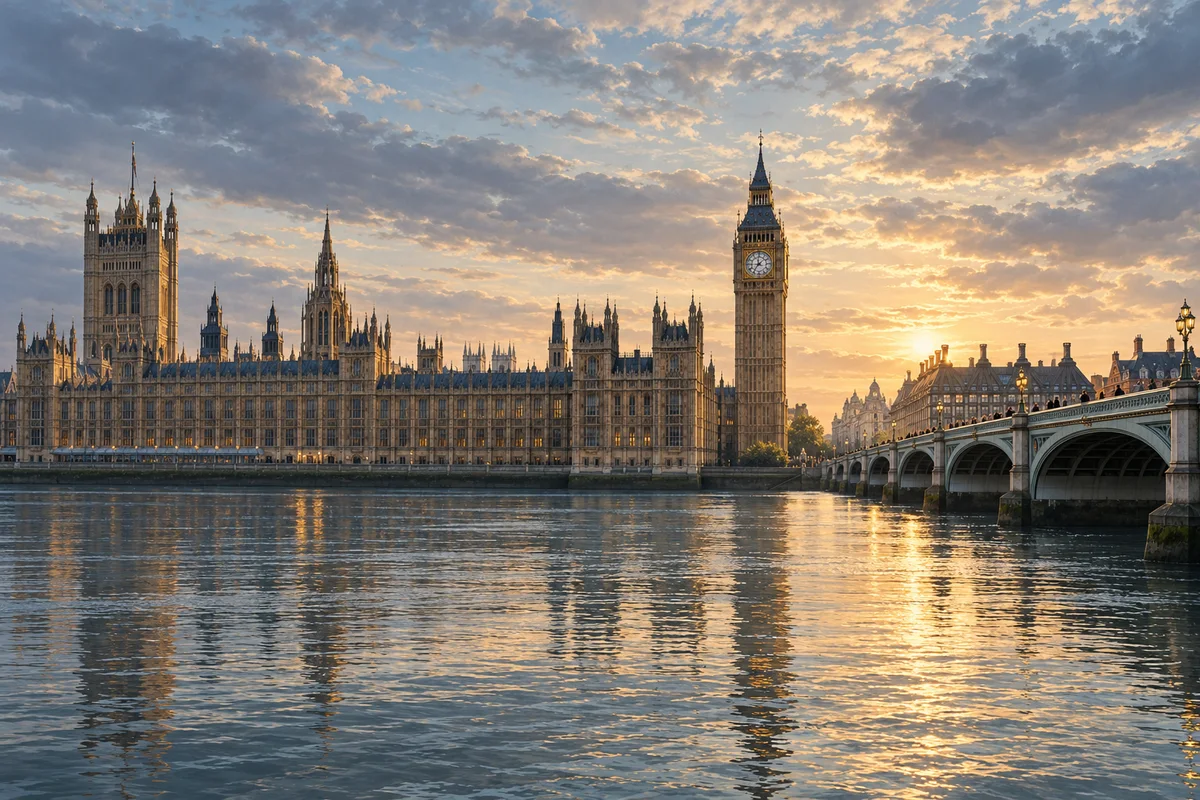
The long building behind the famous clock
The Palace of Westminster is a horizontal story with conspicuous punctuation. Elizabeth Tower stands at one end, Victoria Tower at the other, and a long rhythm of roofline and windows connects them. If you look only for the clock, much of the building’s architectural argument disappears. Follow the repeated divisions for as far as the crop allows. They make the riverfront read as a civic whole, even when perspective compresses its actual length.
That distinction between a single famous feature and a long composition is the first thing a camera can test. Ask how much unbroken façade the frame actually contains. A view that gives you a tower and a few bays is still informative, provided you do not mistake the fragment for the whole elevation.
A fire and deliberate continuity
The fire of 1834 destroyed much of the old Palace. Parliament’s architectural account traces the rebuilding associated with Charles Barry, while Westminster Hall survives from older fabric. That is why “Gothic” here describes a form rather than a date. The later rebuilding adopted an architectural language that could suggest continuity with the institution’s past. The resulting silhouette is coherent; its history is layered.
An exterior frame can reveal the coherence much more readily than the layers. The stone is nineteenth-century Gothic in medieval clothing, and knowing that keeps you from reading the whole riverfront as a single medieval survival. The visible building is a Victorian design made to look rooted, and the effect is deliberate.
Three towers with distinct roles
Victoria Tower, at the south-western end, was designed as a royal entrance and a repository for the records of Parliament. The Sovereign’s Entrance at its base is the Monarch’s way into the Palace, and the gateways were made wide enough for the royal coach at State Openings. The archive collections formerly held there have moved: Parliament’s current archives page states that the Parliamentary Archives is closed and its collections have moved to The National Archives at Kew.
The Central Tower rises over the Central Lobby. It is octagonal and carries a spire, unlike the other two, and it was designed as a ventilating chimney to draw stale air and smoke from the building. Its vault is octagonal and stands without a central supporting pillar. Elizabeth Tower, at the north-eastern end, holds the clock and the Great Bell. A single camera may show only one of the three, so identify the tower in frame and let the other two explain the building’s length.
The riverfront as an elevation
An elevation is the face of a building viewed from one side. A riverside photograph can reveal the Palace’s length and repeated bays; a road-level image might show an end or an approach instead. Ask which face the available picture actually offers. If the river is absent, do not assume the whole riverfront is visible merely because the camera is near Westminster Bridge. A plan or Parliament’s architectural material is the right companion when the missing length matters to your question.
The riverfront is also a study in repetition. Bays of windows, vertical divisions and a continuing roofline do the work that a single ornament cannot: they make a very long building legible as one composition. When you find the repeated unit, count how many times the crop shows it before the frame cuts the building off. That count is a rough guide to how much of the elevation you are actually seeing, and it is more honest than estimating the Palace’s length from a compressed perspective. An end view and a river view of the same building can look almost unrelated, which is why naming the face matters.
Choose a tower
Each tower has a different job, and only one of them is likely to fit in a street photograph. Select a tower to see its role and where it sits in the riverfront.
Elizabeth Tower, north-eastern end. Holds the Great Clock and the Great Bell. It received its present name in 2012, for Queen Elizabeth II's Diamond Jubilee. A single camera may show only this tower, so the other two are what explain the length of the building.
The elevation is illustrative. Parliament’s own architectural account is the authority for the fabric and the towers.
A five-minute looking exercise
Open Westminster Bridge, identify one large tower and trace every continuous piece of Palace roofline visible beside it. Then open Parliament Square and locate the Palace relative to the road and garden. The two fragments need not join like a panorama to teach you something about scale. They cannot tell you what is happening in a chamber or whether a tour is available; use Parliament’s current visitor information for access, and let the images do the work of exterior orientation.
Sources & further reading
Official references inform this guide. Check the responsible organisation for current access, opening times and travel advice.