




Three names, three jobs
A clock dial gives an answer without showing the work behind it, and Big Ben is the most consequential example of that in London. The name belongs to the Great Bell. The Great Clock is the mechanism and its four dials. Elizabeth Tower is the stone and iron casing that contains both. Three names, three jobs: the bell announces, the clock measures, and the tower turns a working machine into a public landmark. Everyday usage gathers all three under the shortest of the names, which is fine in conversation and misleading in a photograph.
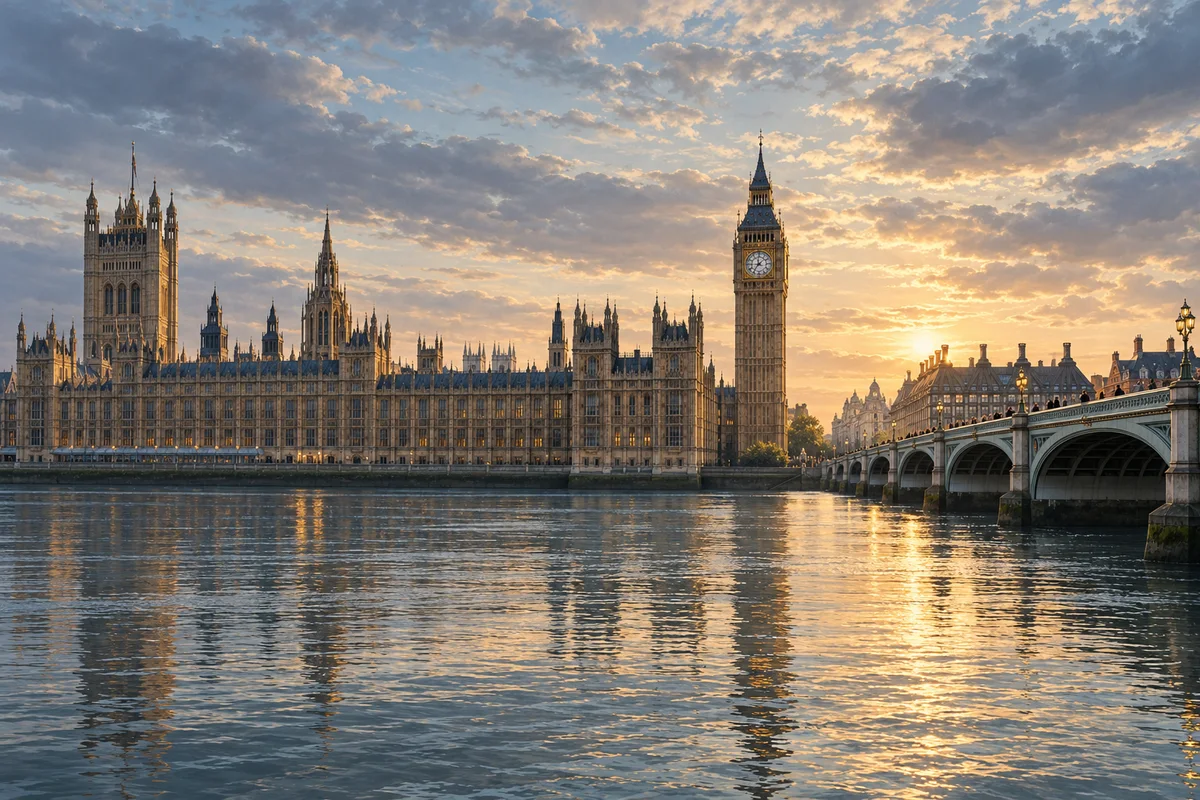
Parliament’s current facts-and-figures page gives the casing a scale worth holding on to: 96 metres and eleven floors, with 281 steps to the clock faces, 334 to the belfry where the Great Bell hangs, and another 65 to the Ayrton Light. That lantern above the dials is lit when either House of Parliament is sitting. It is the one part of the tower that answers a question about Parliament rather than about time. In a bridge frame, identify the enclosing structure first, then a dial if the resolution allows. The bell sits behind masonry; the dial is the public face, not a window onto the mechanism.
A penny against five tonnes
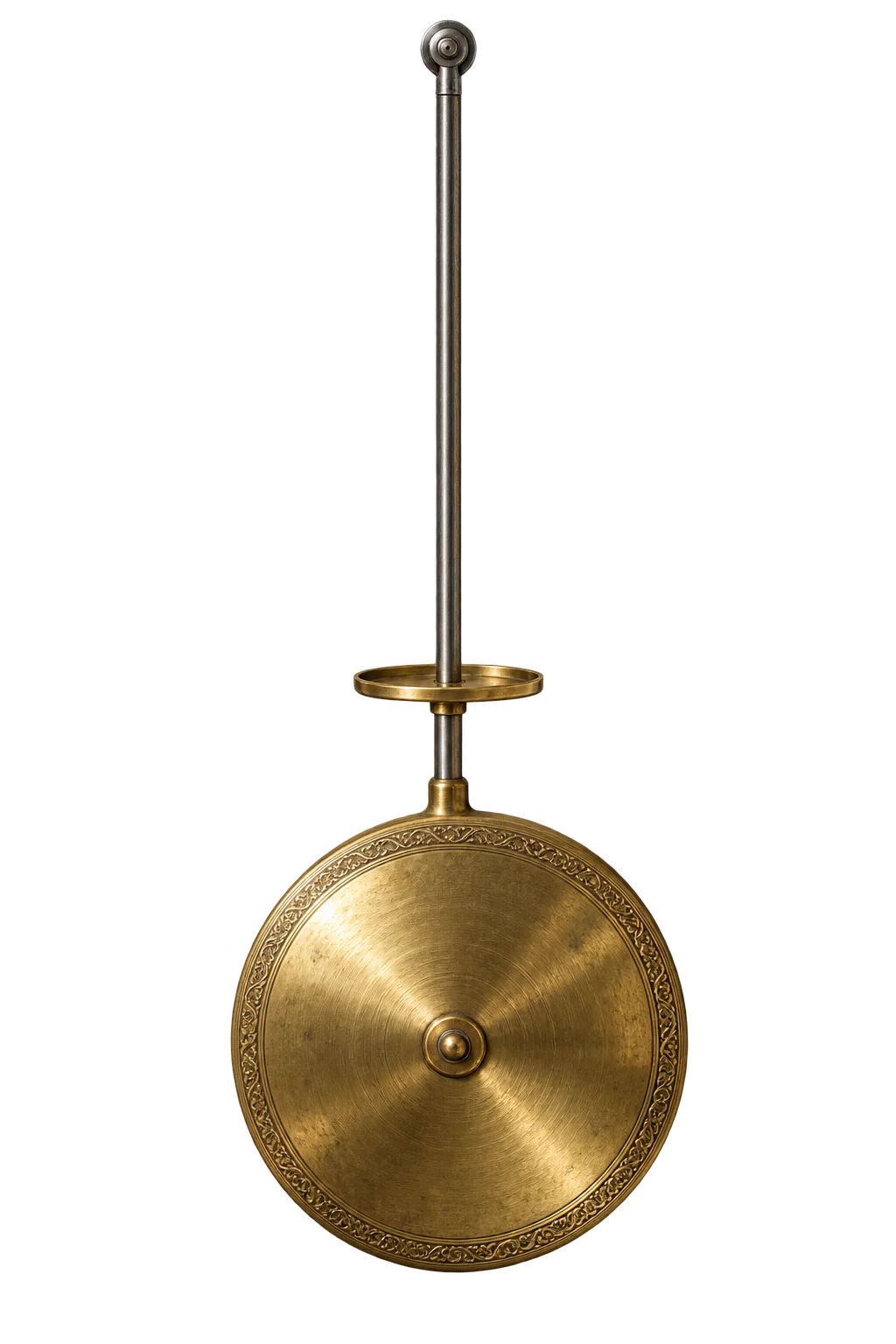
The Great Clock is a weight-driven machine, and Parliament describes its mechanism as five tonnes of cast iron measuring 4.7 metres by 1.4 metres. The pendulum is 4.4 metres long and weighs 310 kilograms; its bob alone is 203 kilograms of concentric steel and zinc tubes. Each beat of that pendulum lasts two seconds.
Such a machine still needs fine correction. Adding a single pre-decimal penny to the pendulum makes the clock gain two-fifths of a second over twenty-four hours: a small mass in exactly the right place. Parliament records that Edmund Beckett Denison designed the Double Three-legged Gravity Escapement to keep the rate steady when wind pushed on the exposed hands. An escapement releases the mechanism’s energy in controlled steps; the pendulum remains the timekeeper. The achievement is less about moving heavy hands than about stopping their exposure from dictating the clock’s rate.
A bell that does not swing
A swinging bell is struck from inside by a clapper. Big Ben works the other way round: the Great Bell and the four quarter bells are fixed and struck from outside by hammers. Parliament gives the weights: Big Ben is 13.7 tonnes with a 200 kilogram hammer, while the quarter bells run from 1.1 tonnes to 4 tonnes and sound G, F sharp, E and B. Nothing in the bell chamber revolves for the hour; the moving part travels to meet the metal.
Parliament’s key dates separate the two jobs. Construction of the new palace began in 1840 under Charles Barry, with Augustus Pugin supplying the Gothic Revival detail, and the clock tower itself was begun in 1843. The second Great Bell was cast at the Whitechapel Bell Foundry in April 1858. The Great Clock began ticking on 31 May 1859, and the bell was first heard on 11 July that year. It fractured later in 1859 and stayed silent while the largest quarter bell struck the hour; in 1863 it was turned a quarter turn and given a lighter hammer. The tower was renamed Elizabeth Tower in 2012 for the Diamond Jubilee; before that it was usually the Clock Tower.
Reading the dial
The dials are the part a camera can genuinely show, and their construction is worth knowing. Each is 7 metres across and made of 324 separate pieces of pot opal glass set in a cast-iron frame: a mosaic that passes light from behind rather than a single pane. The hour figures are 60 centimetres long. The minute hands are copper sheet, 100 kilograms and 4.2 metres long, travelling the equivalent of 190 kilometres a year; the hour hands are gunmetal and three times heavier at 300 kilograms.
That is a useful discipline for looking. Name the layers you can defend — the stone outline, the dial, the angle of the hands — and then stop. A good reading of the Westminster frame says less and means more when it keeps the visible and the documented in separate sentences.
Read the penny arithmetic
Parliament records that each pre-decimal penny adds about two-fifths of a second to the day. The figures below apply that recorded rate directly.
Show the arithmetic
1 penny = 0.4 s a day4 pennies = 1.6 s a day4 pennies = 11.2 s a week
The clock’s real rate also depends on temperature, air pressure and the escapement’s condition. Those influences are outside this page’s symbolic study.
What the frame withholds
A photograph of Elizabeth Tower from Westminster Bridge shows an outline, a dial, a roofline and, on a lucky day, light on the stone. It cannot show the belfry, the pendulum or the hammers that strike a stationary bell, and a still image freezes the hands at whatever position they held rather than proving the clock is keeping time.
The honest exercise is two sentences. Begin the first with “The frame shows…” and the second with “Parliament explains…”. The first might name the tower, the Ayrton Light and a resolvable dial; the second might give the penny adjustment or the fixed bell. Together they describe more than either alone, without asking a street picture to be an engineering drawing.
Sources & further reading
Official references inform this guide. Check the responsible organisation for current access, opening times and travel advice.