Cheapest Places To Live In London Without Leaving London (2026)
Compare the cheapest places to live in London without leaving the city, including rent, house prices, commute value and practical borough trade-offs.
Author:James RowleyJun 02, 2026
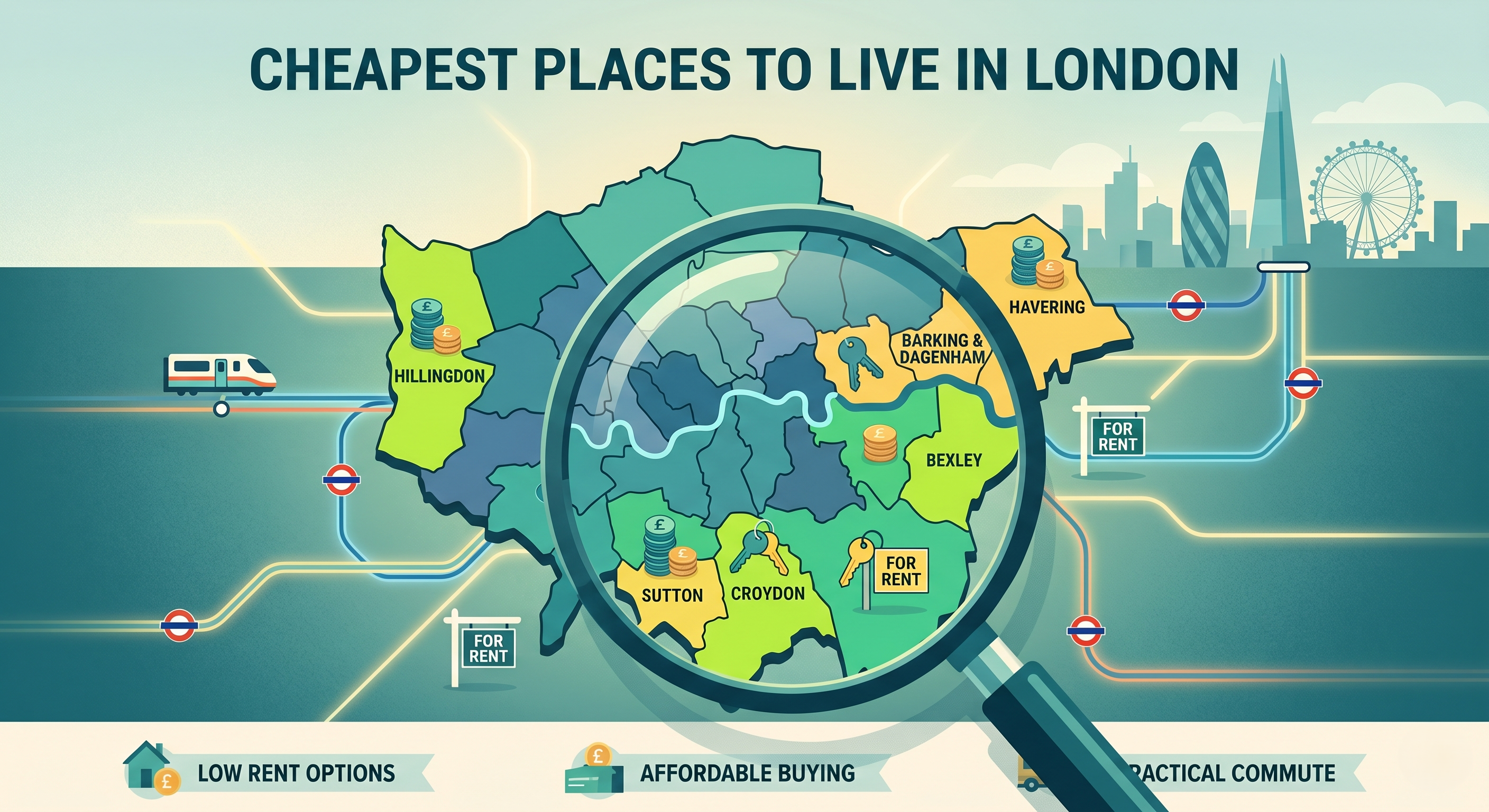
Where Is It Still Affordable to Live in Greater London?
Londonis expensive by almost any UK standard, but that does not mean every corner of the capital is priced the same.
Those numbers explain the pressure, but they also hide something useful: several outer boroughs sit well below both city-wide averages.
The real mistake is treating “cheap” as one simple ranking. Some boroughs are cheaper to rent, some are cheaper to buy, and some are not the absolute cheapest on paper but still offer better everyday value once you factor in commute, housing stock, and the way you actually live.
If you want the bigger context first, start with our cost of living in London, average rent in London by borough, and what salary you need to live in Londonpages before narrowing your shortlist.
Key Takeaways
- The cheapest places to live in London are usually in outer boroughs, not central ones. Trust for London’s affordability measurealso finds that the most affordable boroughs by earnings are on London’s outskirts.
- For renters, Bexley, Sutton, Hillingdon, Croydon, Havering, and Barking and Dagenham are among the strongest budget starting points in current ONS local data.
- For buyers, Barking and Dagenham, Croydon, Bexley, and Newham stand out more than inner London in terms of entry price.
- “Without leaving London” means staying inside Greater London’s borough boundaries, not shifting to commuter towns outside the capital.
- The smartest choice is rarely the single lowest price. It is the borough where rent or buying costs, transport, and daily life balance well enough that you will not regret the move six months later.
How This List Was Judged
This shortlist is not based on one headline price alone. I used five filters to decide which London boroughs and local areas are worth a closer look:
- Borough-level private rent data to spot where monthly costs are lowest.
- Borough-level house price data to separate cheap-to-rent areas from cheap-to-buy areas.
- Affordability relative to earnings to avoid confusing “low price” with “realistically manageable.”
- Practical commute logic so cheaper areas with workable rail or Tube access are not overlooked.
- Every day is fit for different kinds of movers, including renters, buyers, students, young professionals, and families.
The goal is not to crown one universal winner. It is to show which parts of London offer the strongest value for the kind of life you are actually trying to build.
Why “cheap In London” Usually Means Outer Boroughs, Not Commuter Towns
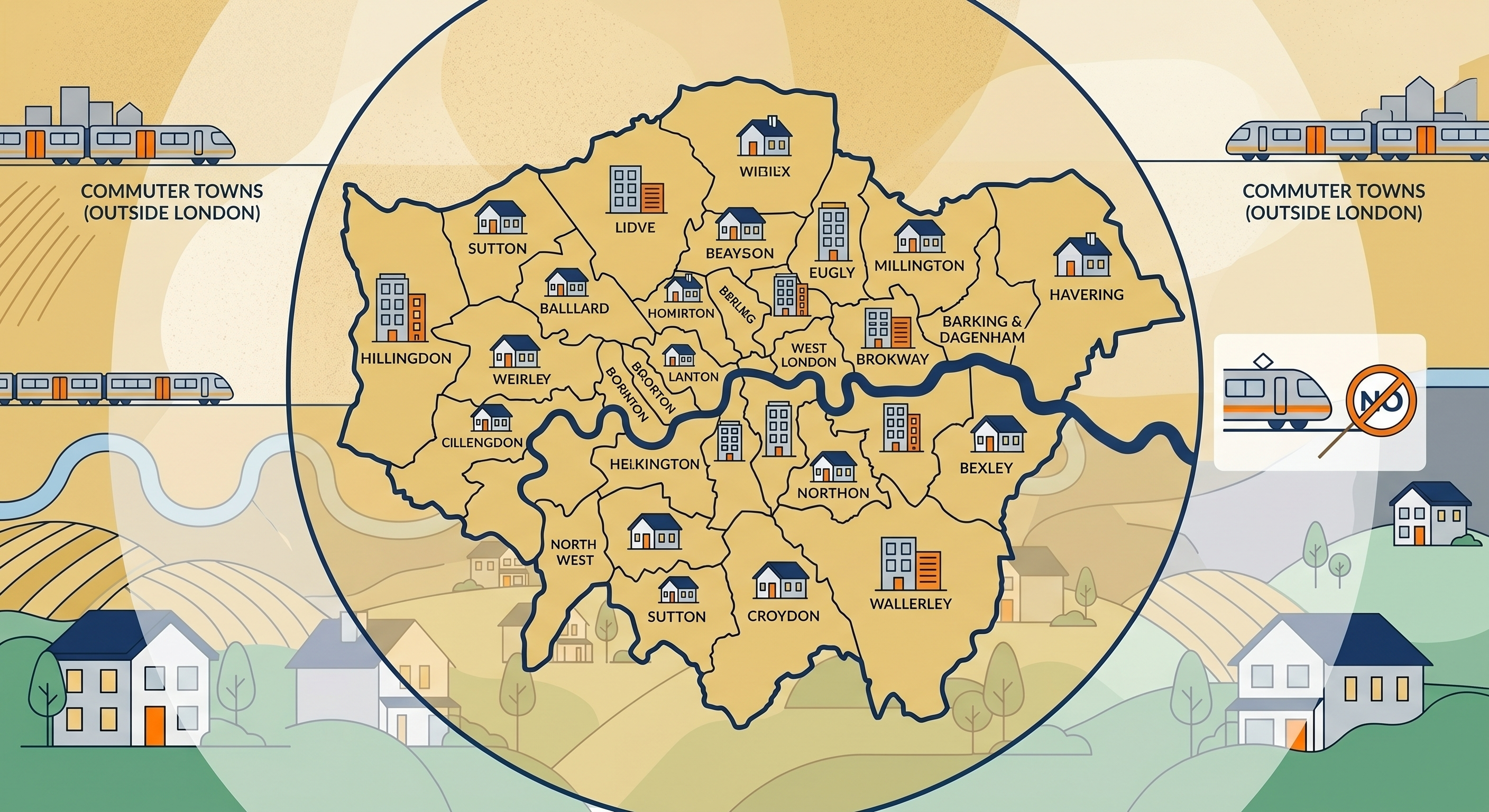
If your goal is to stay in London, the first thing to get right is the boundary. Greater London is made up of 32 boroughs plus the City of London, so “without leaving London” means you are still comparing places inside that system, not towns further out on the rail map.
That matters because many search results drift into “near London” advice. Useful, sometimes, but it is answering a different question.
This page is for the reader who still wants London wages, London transport, London postcodes, and London daily life, just at the lower end of the city’s housing market.
Outer boroughs dominate cheap-London lists for a simple reason: distance from the centre still affects housing values.
Trust for London’s affordability work shows the more affordable boroughs by rent-to-earnings measure are mostly on London’s edge, while the least affordable cluster is in inner west and central London.
That is the frame to keep in mind as we move from the boundary question to the more useful one: cheap for what, exactly?
What “cheap” Actually Means In London
This section matters because most cheap-London articles flatten different problems into one list. You are better served by separating rent, buying, and practical affordability before you compare borough names.
Cheapest To Rent Vs Cheapest To Buy
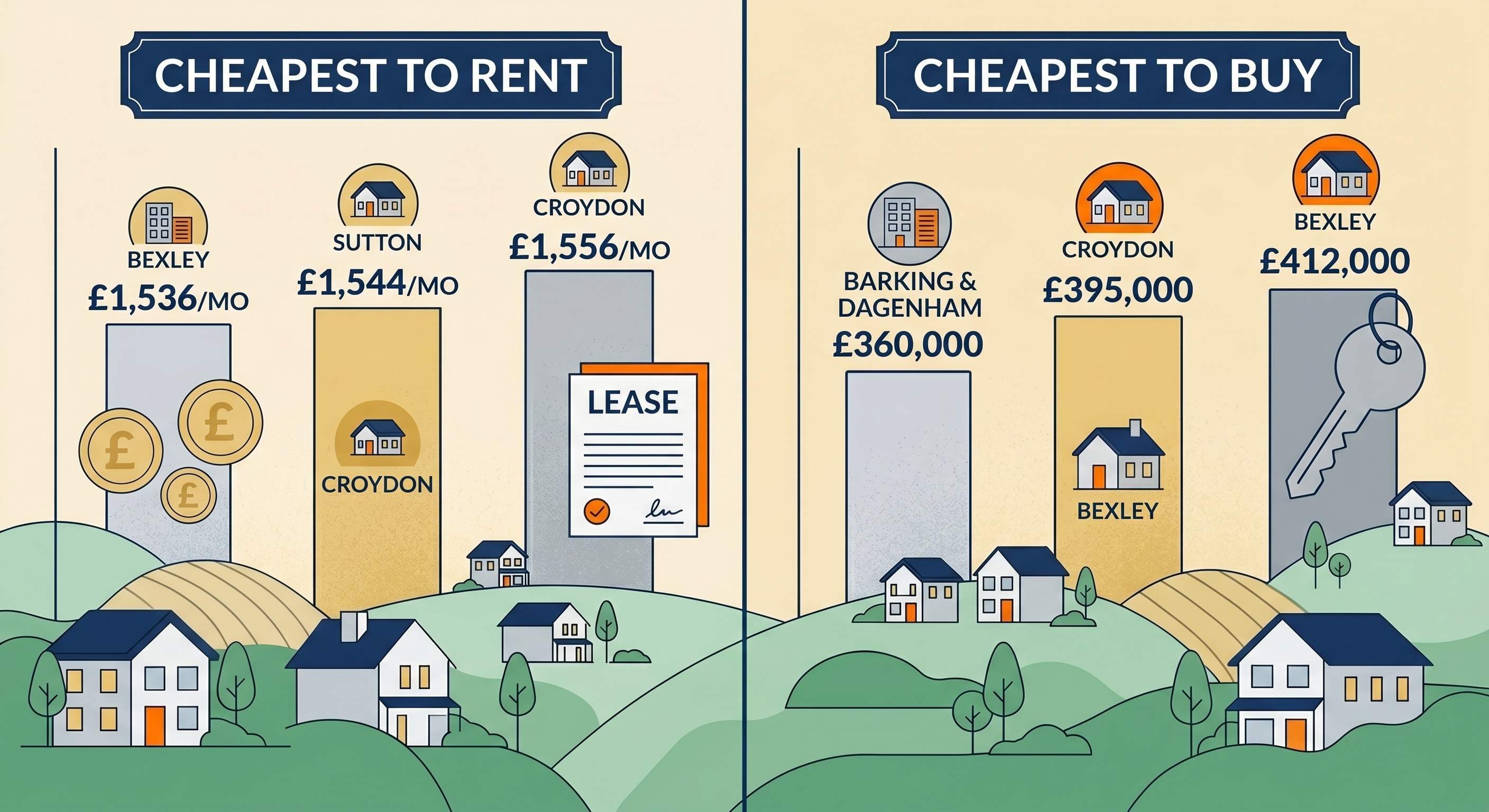
Renting and buying do not behave the same way. Bexley is one of the cheapest boroughs to rent in, according to the current ONS local dataat £1,536 a month, while Barking and Dagenham stands out more strongly in buying costs, with an average house price of £360,000 in January 2026.
Croydon is another classic split case: rents stay relatively low at £1,556 a month, while average house prices sit at £395,000.
That is why a renter and a first-time buyer often need different shortlists. A borough can be cheap enough to rent now but still less attractive to buy in, or the other way round.
Cheap Vs Affordable: Why Earnings And Commute Still Matter
Cheap is a sticker price. Affordable is a life you can sustain. Trust for London estimates that across the capital, the average one-bed rent costs 52% of median pre-tax pay, and even the more affordable boroughs still take about a third of typical earnings. Their most affordable trio by this measure is Bromley, Havering, and Sutton.
That is also why the gap between official rent averages and live listing prices matters. ONS puts London’s average private rent at £2,273 in February 2026, while Rightmove’s average advertised London rent for new listings reached £2,736 in Q1 2026.
One tells you what renters are broadly paying across new and existing tenancies; the other tells you what fresh listings are asking right now.
If you want the wider explanation for that pressure, our Why London is so expensivepiece is the natural next read.
Why Borough Averages Are Useful, But Never The Full Story
Borough-level averages are a starting point, not a verdict. City Hall’s London Rents Mapis useful precisely because it gives borough-level averages for private rents and updates monthly using ONS rent data, but it does not pretend every street or neighbourhood inside a borough feels the same.
A borough can look cheap at the headline level and still contain pockets that are harder to reach, pricier near stations, or simply a poor fit for your routine.
Keep the borough average to build your shortlist; then drill down into actual listings and exact streets. That is the mindset you need for the shortlist below.
The Cheapest London Boroughs At A Glance
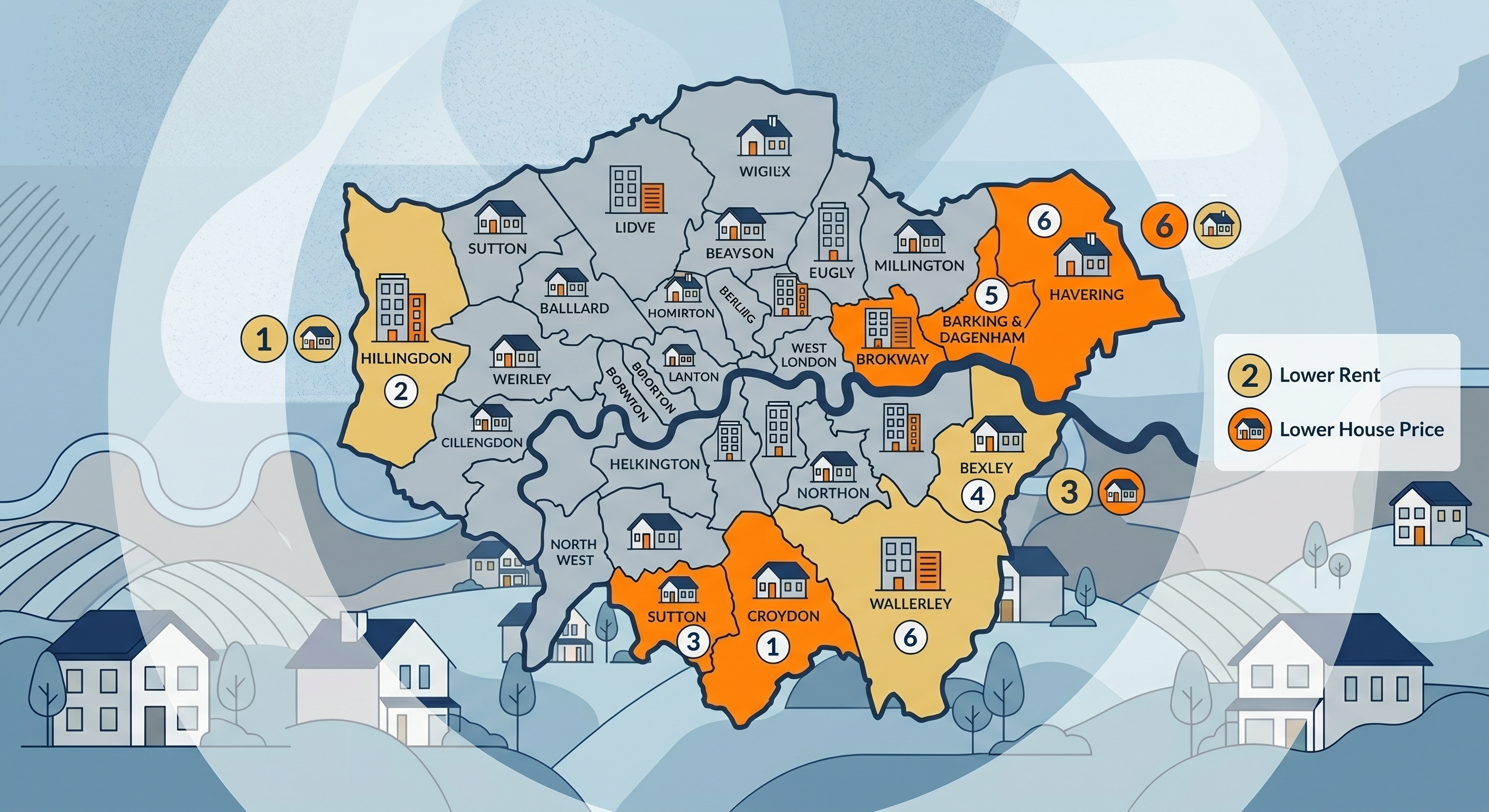
Here is the fast comparison most readers actually need: a borough-level shortlist that separates low rent, low buying cost, and which area each suits best.
Using ONS local housing pages for February 2026 rents and January 2026 house prices, these are the strongest budget starting points inside Greater London.
Quick Comparison Table: Rent, Buying Cost, Best Fit, Main Trade-off
| Borough | Summary |
| Barking and Dagenham | Rent: £1,684 • Buy: £360,000 • Best for lowest-entry buyers • Trade-off: less central feel, so micro-location matters |
| Bexley | Rent: £1,536 • Buy: £412,000 • Best for budget renters and quieter households • Trade-off: longer journeys for many central commutes |
| Sutton | Rent: £1,544 • Buy: £451,000 • Best for families and earnings-based value • Trade-off: less nightlife and inner-London energy |
| Croydon | Rent: £1,556 • Buy: £395,000 • Best for renters seeking value with strong rail links • Trade-off: wide street-level variation |
| Havering | Rent: £1,564 • Buy: £448,000 • Best for space-first households • Trade-off: longer distances affect daily life |
| Enfield | Rent: £1,767 • Buy: £473,000 • Best for North-London value seekers • Trade-off: commute quality depends heavily on exact area |
| Newham | Rent: £1,910 • Buy: £402,000 • Best for East-London buyers and renters needing good links • Trade-off: rent is no longer ultra-cheap |
| Hillingdon | Rent: £1,548 • Buy: £478,000 • Best for West-London renters and airport-side workers • Trade-off: distance from central London |
Best If… Quick Decision Guide
| If your priority is… | Start with… |
| The lowest rent | Bexley, Sutton, Hillingdon |
| Buying on a tighter budget | Barking and Dagenham, Croydon, Bexley, Newham |
| Commute-value balance | Croydon, Lewisham, Newham |
| Family-friendly value | Sutton, Havering, Bexley |
| A quieter suburban feel | Bexley, Havering, Sutton |
| East London values with stronger links | Barking, Newham |
| North-London value | Enfield, Lower Edmonton, as a local search area |
| Room-rent or flatshare value | Manor Park, East Ham, Lower Edmonton |
The Shortlist Most Readers Should Start With
If your priority is lowest rent, start with Bexley, Sutton, Hillingdon, Croydon, and Havering. If your priority is the lowest buying cost, start with Barking and Dagenham, Croydon, Bexley, and Newham.
If your priority is best affordability relative to local earnings, pay closest attention to Sutton and Havering, with Bromley also strong on that narrower measure even though it is not always among the absolute cheapest by headline rent.
The pattern is already clear:the cheapest London answer changes depending on whether you pay monthly or buy once.
Cheap Neighbourhoods And Postcodes Worth Checking Inside These Boroughs
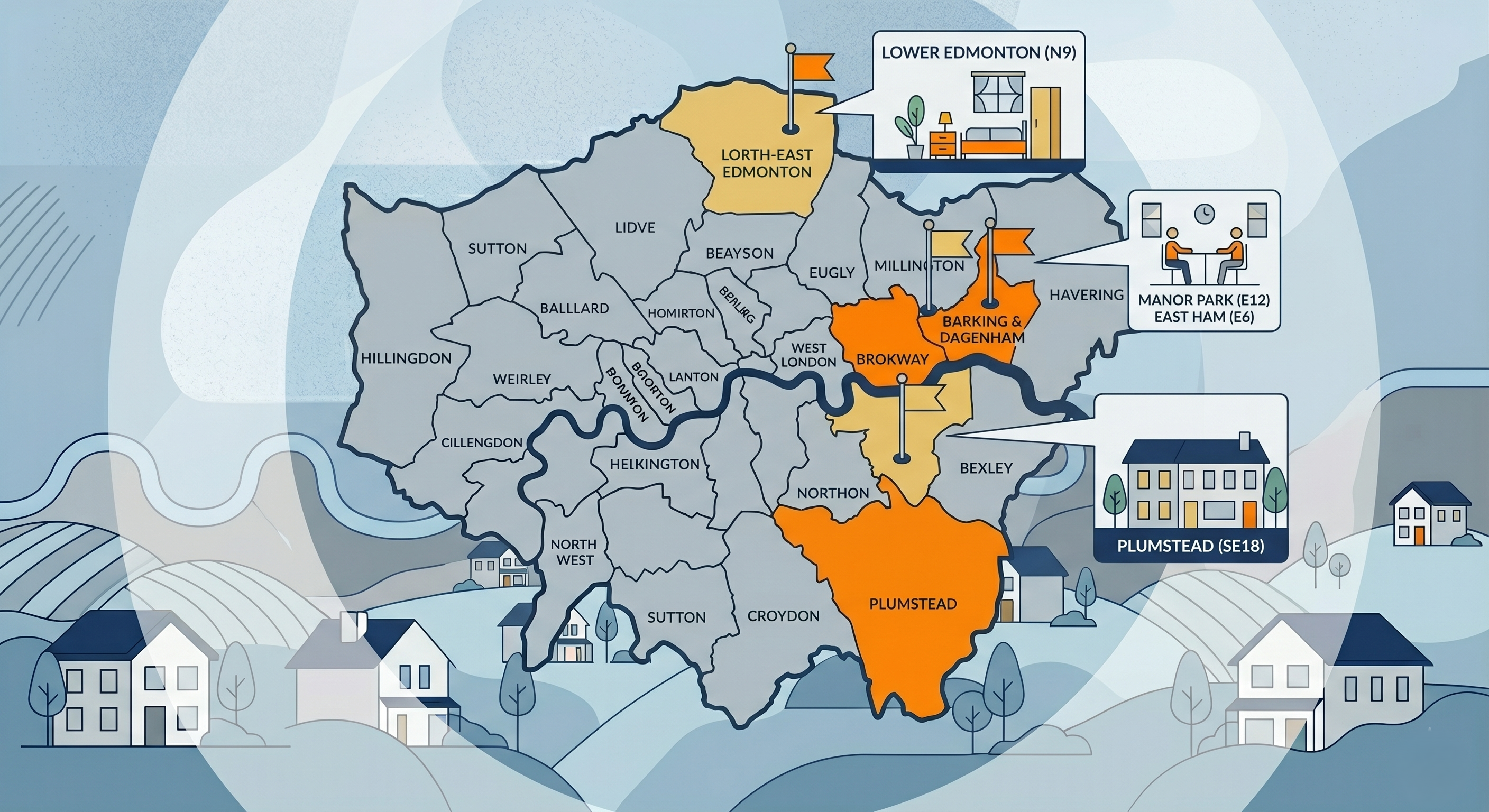
Borough averages are useful, but they are still broad. If you want to turn a shortlist into an actual property search, it helps to start with a few named neighbourhoods and postcode areas that regularly appear in London affordability conversations.
Plumstead (SE18)
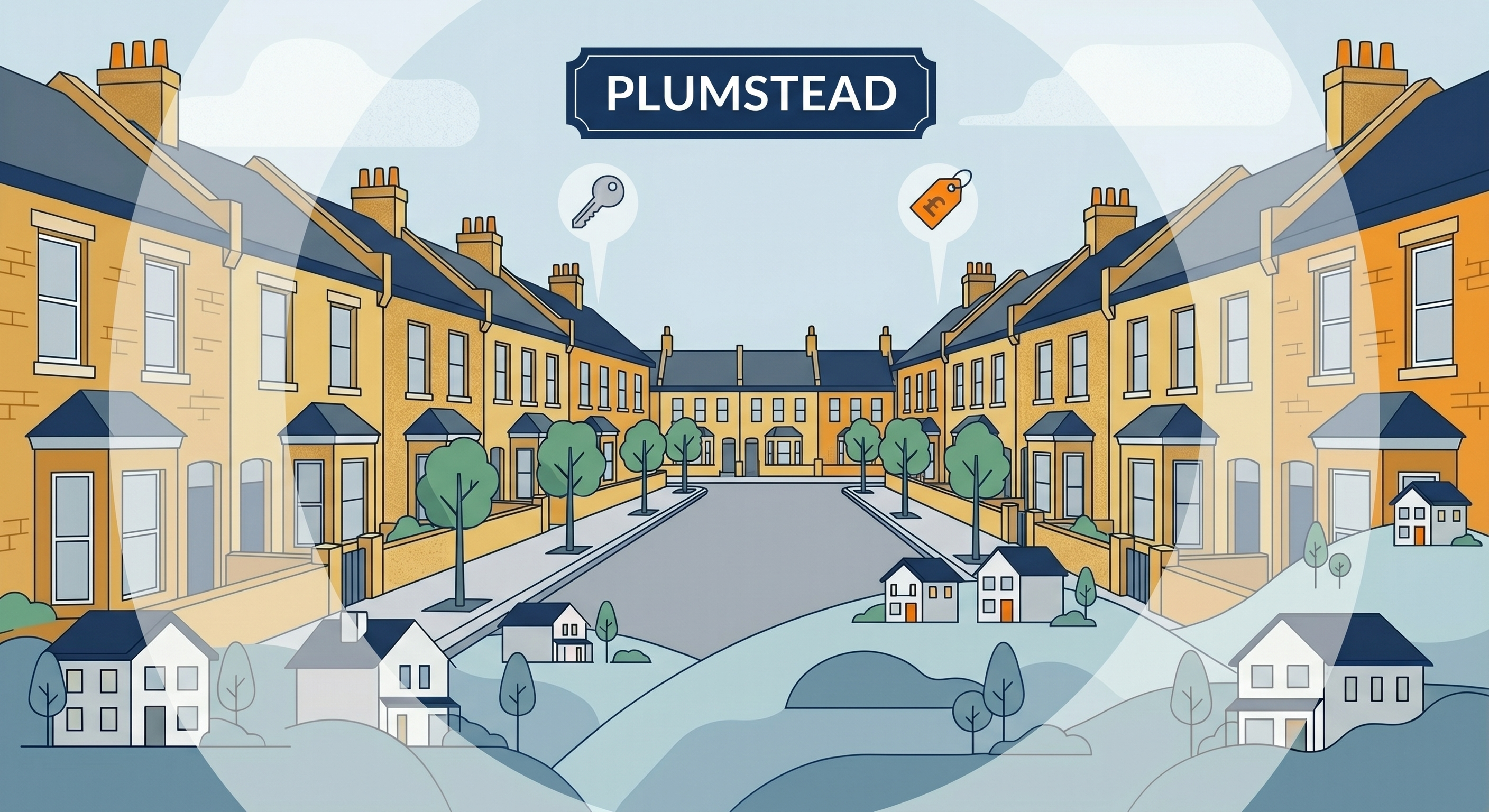
If you are researching cheaper places to buy in southeast London, Plumstead is a smart first check. It often comes up because it can offer lower entry prices than more polished neighbouring areas while still keeping you within reach of Woolwich and the wider rail network.
Manor Park (E12) And East Ham (E6)
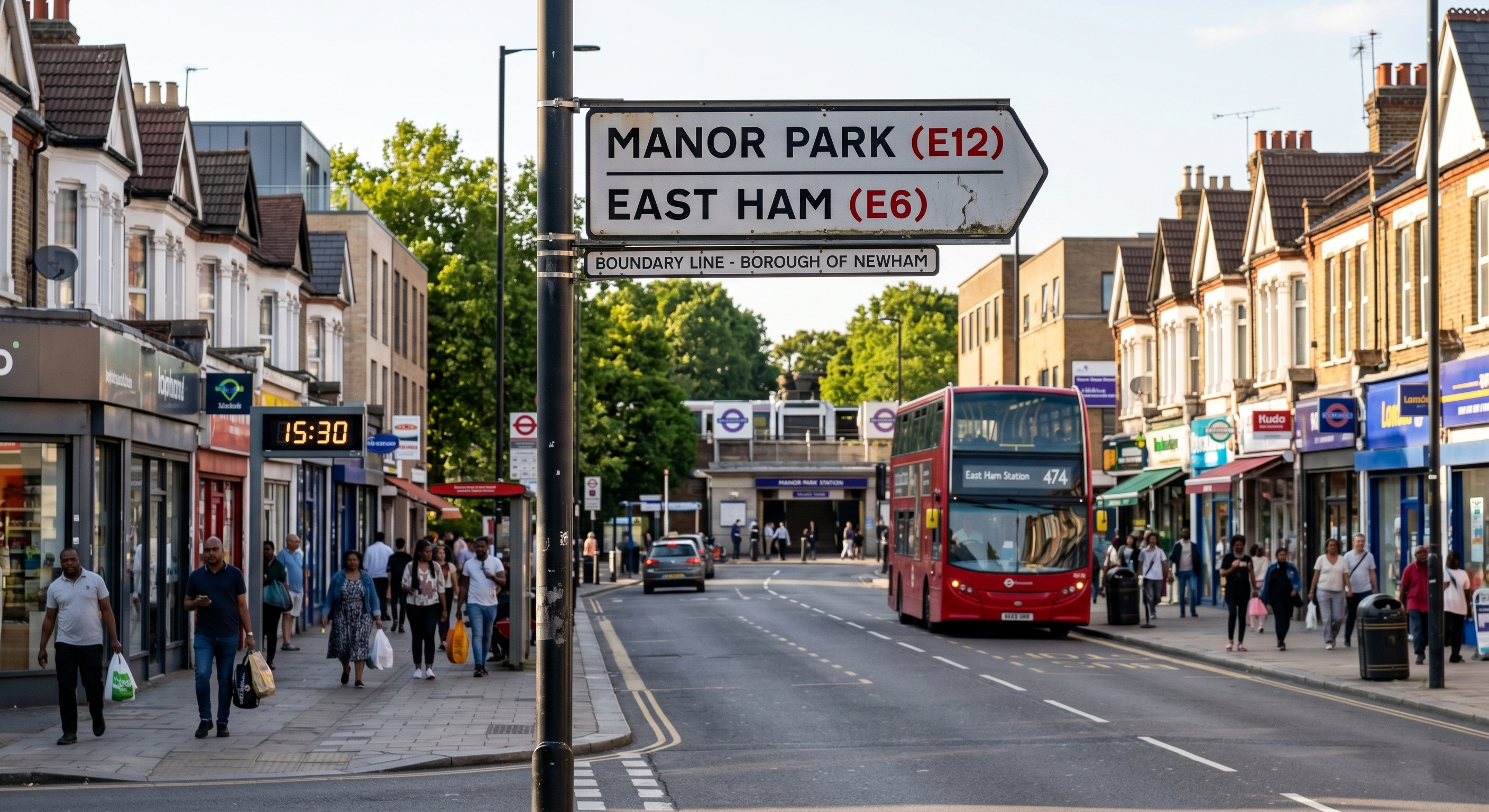
If your budget is tight and you are focused on room rents or flatshares, these are worth watching early. They tend to appear in affordability-led room-rent comparisons more often than many better-known London neighbourhoods.
Lower Edmonton (N9)
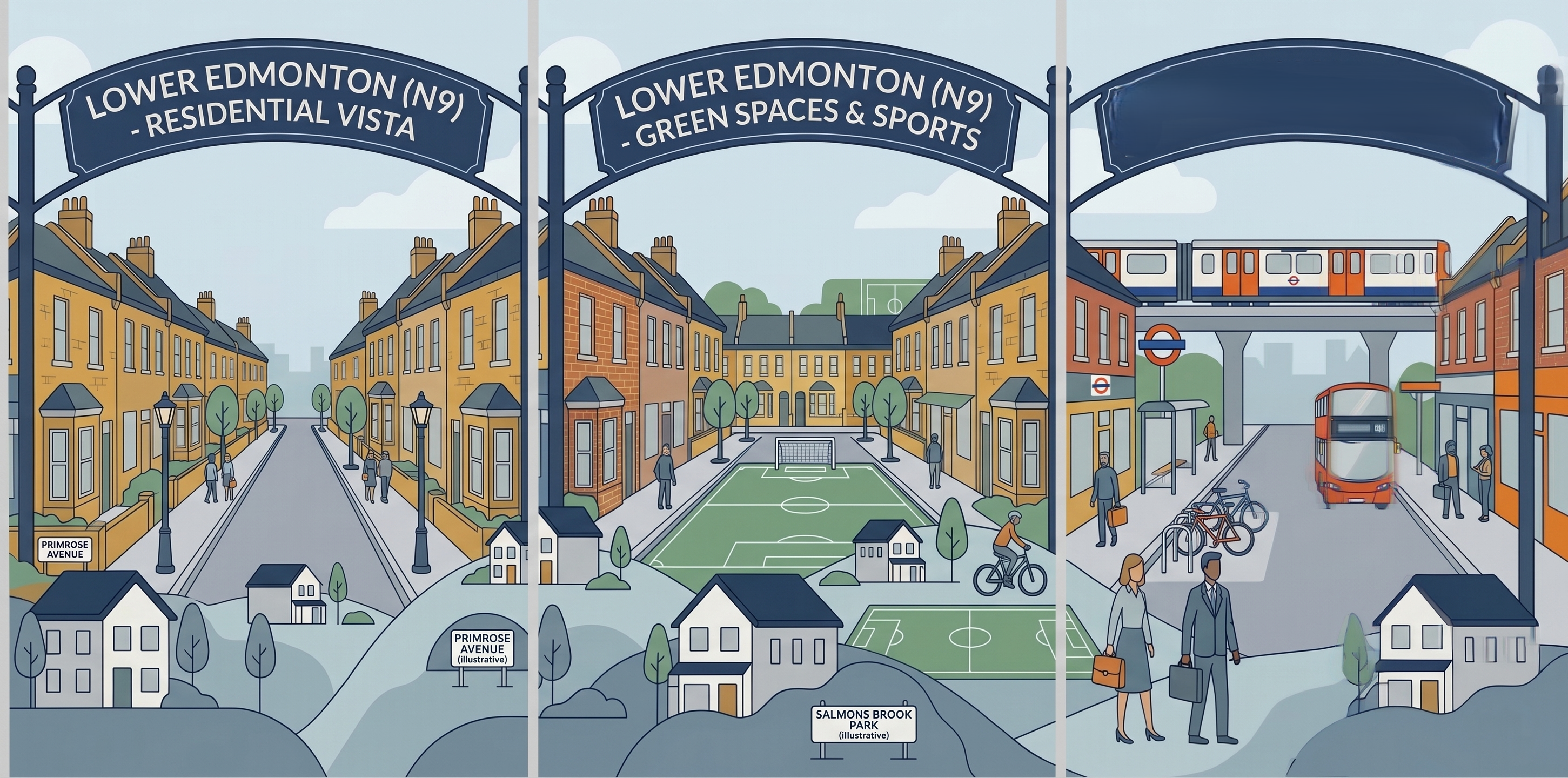
Lower Edmonton is one to keep on your list if you want north-London value, especially for room-rent searches. It is not a prestige pick, but it does show up in cheaper-room rankings often enough to justify a closer look.
Barking (IG11)
For buyers and renters who want East London value without losing London connections altogether, Barking is one of the clearest starting points.
It tends to show up in affordability roundups because it balances lower entry prices with stronger transport logic than some outer-edge alternatives.
Erith (DA8)
Within the wider Bexley conversation, Erith is a practical place to check first. It fits the same broad value logic as the borough itself: lower housing costs, a more suburban feel, and a trade-off in journey time for many central commutes.
Croydon (CR0)
Croydon works well as a postcode-level starting point if your goal is commute-value balance rather than the absolute lowest price.
It often makes more sense for renters and first-time buyers who want cheaper London housing without feeling completely cut off from the city.
These are not the only places worth searching. They are simply useful first pins on the map once you move beyond borough averages and start comparing real listings.
The Best Cheap Places To Live In London For Renters
If rent is the immediate pain point, this is where your shortlist should narrow fast. What matters most is not only the cheapest borough on paper, but how much value you get before transport and daily friction start erasing the savings.
Best Value Boroughs If Monthly Rent Is Your Main Concern
On current ONS data, Bexley (£1,536), Sutton (£1,544), Hillingdon (£1,548), Croydon (£1,556), and Havering (£1,564) form the clearest low-rent band among the boroughs most often considered by budget movers.
Barking and Dagenham is still relatively low at £1,684, but it is no longer automatically the cheapest rental answer once you compare today’s numbers borough by borough.
A simple rule works well here:if you want the lowest monthly outgoings, start in Bexley, Sutton, Hillingdon, Croydon, or Havering before you widen the map.
Where A House Share Changes The Maths
A flatshare can make a borough that looks only “mid-cheap” suddenly workable. Imagine two renters comparing Bexley and Lewisham.
ONS puts Bexley’s average monthly rent at £1,536 and Lewisham’s at £1,806. That is a £270 monthly gap before you have even counted council tax, utilities, or travel. In a house share, the cheaper borough’s savings can start to compound quickly.
But the reverse can also happen. If the pricier borough sharply cuts journey pain and gives you more everyday convenience, the lower headline rent may stop being the better deal. That is why rent alone should narrow the map, not make the final decision.
Which Cheaper Boroughs Still Keep Central London Within Reach
For many renters, Croydon remains attractive because it pairs relatively low rent with a transport profile that often feels more practical than its headline location suggests.
Newham is not among the very cheapest rental boroughs anymore at £1,910, but East London rail connectivity still keeps it in the conversation for renters who want stronger links than some outer-borough alternatives.
TfL’s rail maps help explain why “farther out” and “harder commute” are not always the same thing.
That leads neatly into the buyer question, where the rankings shift again.
The Best Cheap Places To Live In London For Buyers
Buying is where the borough list changes the most. Some places that still feel “cheap enough” to rent become much less compelling when deposit size, mortgage payments, and long-term value enter the picture.
Boroughs That Usually Offer The Lowest Entry Prices
The clearest budget-buying clusters are Barking and Dagenham (£360,000), Croydon (£395,000), Newham (£402,000), and Bexley (£412,000) on current ONS local pages. That puts them well below the London-wide average house price of £554,000.
If you want the blunt answer to “where can I still buy in London without a huge budget?”, those four should be near the front of your research.
Where Lower Buying Prices Still Come With Decent Transport
This is where Croydon and Newham often become more interesting than the raw ranking suggests. Their average prices stay much lower than London’s overall level, but they also avoid the fully edge-of-the-map feeling some households want to escape.
Hillingdon is not quite as cheap to buy, at £478,000, yet its west-London transport options keep it relevant for some buyers who want lower rent now and a broader travel network later.
Why “cheapest To Buy” May Not Be The Same As “best First-home Choice.”
A lower purchase price is powerful, but it is not the full first-time-buyer answer. Bexley looks stronger if you want a quieter suburban trade-off. Croydon can look stronger if you care more about everyday city access.
Barking and Dagenham is the obvious headline bargain, but that does not automatically make it the best personal fit.
That is why the next step is not more numbers. It is understanding how these places feel to live in.
Cheap Does Not Mean Equal: How Each Borough Feels In Real Life
This section is where listicles usually get lazy. A cheap borough is not just a price point. It is a daily pattern: the kind of housing you are likely to find, the rhythm of the commute, and whether the area matches the life you actually live.
Barking And Dagenham: Cheapest Buy Contender With Regeneration Upside
Barking and Dagenham is the budget-buy answer that shows up again and again for a reason. Its average house price of £360,000 is one of the lowest in London, and its average rent of £1,684 still keeps it below the city norm.
It makes the most sense for buyers who want the lowest entry point and can accept a less central, more practical version of London life.
Bexley: Budget Choice For Quieter Suburban Living
Bexley is one of the cleanest “cheap but still sensible” choices. The rent figure is especially strong at £1,536, house prices remain relatively low at £412,000, and the borough tends to appeal to households who would rather trade central buzz for lower housing pressure.
Sutton: Strong Value For Families And Affordability By Local Earnings
Sutton is not the absolute cheapest place to buy on this list, but it is one of the strongest value picks once you bring affordability into the picture.
Trust for London places it among the most affordable boroughs by rent relative to earnings, and ONS shows rent at £1,544 with average house prices at £451,000.
That is why Sutton often makes more sense for families than flashier boroughs that only look attractive on a map.
Croydon: Cheaper With Fast Rail Appeal
Croydon keeps appearing because it answers a very common London problem: “I can accept a less polished postcode if the numbers and commute still work.”
ONS puts average rent at £1,556 and average house price at £395,000, which is a strong combination for both renters and first-time buyers.
Havering: Space And Suburban Feel Over Centrality
Havering works best for the reader who wants space, a more suburban pace, and lower costs than most of London.
Current ONS averages show £1,564 in monthly rent and £448,000 for the average house price. The trade is straightforward: the money goes further, but the city feels farther away, too.
Newham And Lewisham: Better For Some Renters Than Buyers
These two boroughs sit in a different category. Newham is still relatively cheap to buy at £402,000, but rent at £1,910 means it is not really a bottom-end rental bargain anymore.
Lewisham, at £1,806 rent and £499,000 average house price, is usually a stronger pick for renters and young professionals who want a better balance between price and city access than some cheaper but sleepier boroughs offer.
Enfield And Hillingdon: Outer-borough Compromises Worth Understanding
Enfield and Hillingdon are useful because they show how “cheap London” has more than one geography. Enfield gives you North London value at £1,767 rent and £473,000 average house price.
Hillingdon is lower on rent at £1,548, though house prices are higher at £478,000. Both can work well, but both demand that you think carefully about exact station access and daily travel patterns.
The Best Cheap London Areas By Lifestyle
A cheap borough only helps if it fits the life you are trying to build. This is where the shortlist becomes personal.
Best For Young Professionals
For young professionals, the strongest value picks are usually Croydon, Lewisham, and parts of Newham. They are not always the absolute cheapest, but they tend to preserve more city access and momentum than the farthest suburban bargains.
Best For Students
Students usually need lower rent and workable transport more than they need buyer value. That makes Bexley, Croydon, and Newham more plausible than the pure buyer shortlist, depending on where campus days actually happen.
Best For Families
For families, Sutton, Havering, and Bexley make the most sense from this list. The logic is not glamorous. It is lower housing pressure, more suburban housing stock, and stronger affordability than much of inner London.
Best If You Want The Shortest Commute For The Money
This is the category where Croydon, Lewisham, and parts of Newham usually outperform cheaper-looking rivals. A borough that saves you a little on rent but adds heavy daily travel costs can become a more expensive life in practice. TfL’s journey tools are worth checking before you commit.
How To Choose The Cheapest Place In London Without Choosing Badly
This is the point where the article turns from comparison into action. The right borough is the one that still feels sensible after the spreadsheet closes.
A 5-point Checklist Before You Pick A Borough
- Compare the rent and buying costs separately.
- Check your real commute, not just the borough name.
- Look at current listings, not borough averages alone.
- Check crime and safety data by area, not by reputation. City Hall SafeStats, the London Datastore, and the Met dashboard all exist for this reason.
- If you plan to drive, check the London ULEZ boundary mapbefore assuming your cheap outer-borough move stays cheap.
Compare Rent, Rail Time, And Daily Spending Together
A useful way to think about it is this:a borough is only truly cheaper if the rent saving survives the rest of your week. A slightly higher-rent area with a cleaner commute, fewer transport changes, and less daily sprawl can still be the better-value move.
Expert’s Take:When I assess a “cheap London” shortlist, I trust the headline price only after it survives three tests: housing cost, commute friction, and neighbourhood fit. Cheap that breaks on the second and third test is rarely cheap for long.
Check Borough Data, Then Check Live Listings, Then Check The Street
Use borough-level data first. Then compare it with the live listing reality. Then inspect the exact streets, because borough averages flatten too much.
City Hall’s rent map and the ONS local pages are excellent filters. Still, Rightmove’s Q1 2026 London asking-rent average of £2,736 is a reminder that live market conditions can sit well above achieved borough averages.
That is the sequence that prevents a cheap London search from becoming an expensive mistake.
Common Mistakes People Make When Searching For Cheap Places In London
This section is your final quality check. Most bad London moves start with one of these errors.
Confusing Borough Averages With Neighbourhood Reality
A borough average is not a street. It is a filter. Two areas inside the same borough can feel entirely different in transport, housing stock, and day-to-day convenience.
Chasing The Lowest Price While Ignoring Transport Costs
A longer, more complex commute can quietly eat the advantage of a lower rent. Cheap on the lease is not always cheap by Friday night.
Using Outdated Rankings Without Checking Current Market Data
Rental growth has slowed, supply has improved, and live asking rents do not always mirror achieved-rent averages. That makes old “top 10 cheapest London areas” posts especially risky if they are not checked against current ONS or City Hall data.
Slipping Into “near London” Results That Break The Brief
The moment a page sends you to commuter towns, it is no longer answering this query. Staying in London means staying within Greater London’s borough system.
Frequently Asked Questions
Where Is The Cheapest Area To Live In London?
Usually, an outer borough. For renters, current ONS local pages make Bexley, Sutton, Hillingdon, Croydon, and Havering especially strong starting points, while Barking and Dagenham remains one of the lowest-cost boroughs to buy. Data as of February 2026 for rent and January 2026 for house prices.
What Are The Cheapest Boroughs In London To Rent?
Among the clearest budget-rent options in current ONS data are Bexley (£1,536), Sutton (£1,544), Hillingdon (£1,548), Croydon (£1,556), and Havering (£1,564). Data as of February 2026.
What Are The Cheapest Boroughs In London To Buy In?
The strongest low-price buying clusters are Barking and Dagenham (£360,000), Croydon (£395,000), Newham (£402,000), and Bexley (£412,000). Data as of January 2026.
Can You Live Cheaply In London Without Moving Outside It?
Yes, but usually by choosing an outer borough, a smaller home, or a house share. The trade-off is almost always some mix of longer travel, a quieter location, or less central convenience.
Which Cheap London Areas Are Best For Young Professionals?
Croydon, Lewisham, and parts of Newham are often better fits than the absolute cheapest suburban options because they balance lower costs with stronger city access.
Which Cheap London Areas Are Best For Students?
Students usually get the most practical value from Bexley, Croydon, and Newham, depending on campus location and how much they rely on rail or Tube links.
Which Cheap London Areas Are Best For Families?
Sutton, Havering, and Bexley are usually the strongest family-value picks from this shortlist because they combine lower housing pressure with a more suburban housing pattern.
What Matters More Than Rent When Choosing A Cheap Area?
Commute quality, housing type, local fit, and safety checking matter just as much. Use borough-level rent data first, then verify exact areas with live listings and official crime sources.
The Smartest Way To Stay In London For Less
The best answer to this keyword is not a single borough name. It is a method. Start by separating the cheapest to rent, the cheapest to buy, and the best value for your lifestyle.
From there, the shortlist becomes much clearer: Bexley, Sutton, Hillingdon, Croydon, Havering, Barking and Dagenham, and Newham cover most real budget-London scenarios.
If you want the broader cluster next, treat the cost of living in Londonas the main hub, then move to the average rent in London by borough, what salary you need to live in London, and our contrast piece on the richest boroughs in London. For the broader city context, the London hubis the cleanest next stop.
The cheapest place in London is rarely the place with the lowest number alone. It is the one where the numbers, the journey, and the life on the ground still make sense when morning becomes routine.
Jump to
Where Is It Still Affordable to Live in Greater London?
Why “cheap In London” Usually Means Outer Boroughs, Not Commuter Towns
What “cheap” Actually Means In London
The Cheapest London Boroughs At A Glance
Cheap Neighbourhoods And Postcodes Worth Checking Inside These Boroughs
The Best Cheap Places To Live In London For Renters
The Best Cheap Places To Live In London For Buyers
Cheap Does Not Mean Equal: How Each Borough Feels In Real Life
The Best Cheap London Areas By Lifestyle
How To Choose The Cheapest Place In London Without Choosing Badly
Common Mistakes People Make When Searching For Cheap Places In London
Frequently Asked Questions
The Smartest Way To Stay In London For Less

James Rowley
Author
James Rowley is a London-based writer and researcher covering London life, cultural geography, London travel, live London webcam pages and selected public figures across entertainment, sport, business and public life.
For over 15 years, he has focused on verified sources, first-hand local context and clear explanations that help readers understand both places and people more deeply. His work combines street-level London knowledge with careful research into career credits, media work, business interests and, where relevant, transparently explained net worth estimates.
He writes and reviews articles published on LondonWebcam.
Latest Articles
Popular Articles