

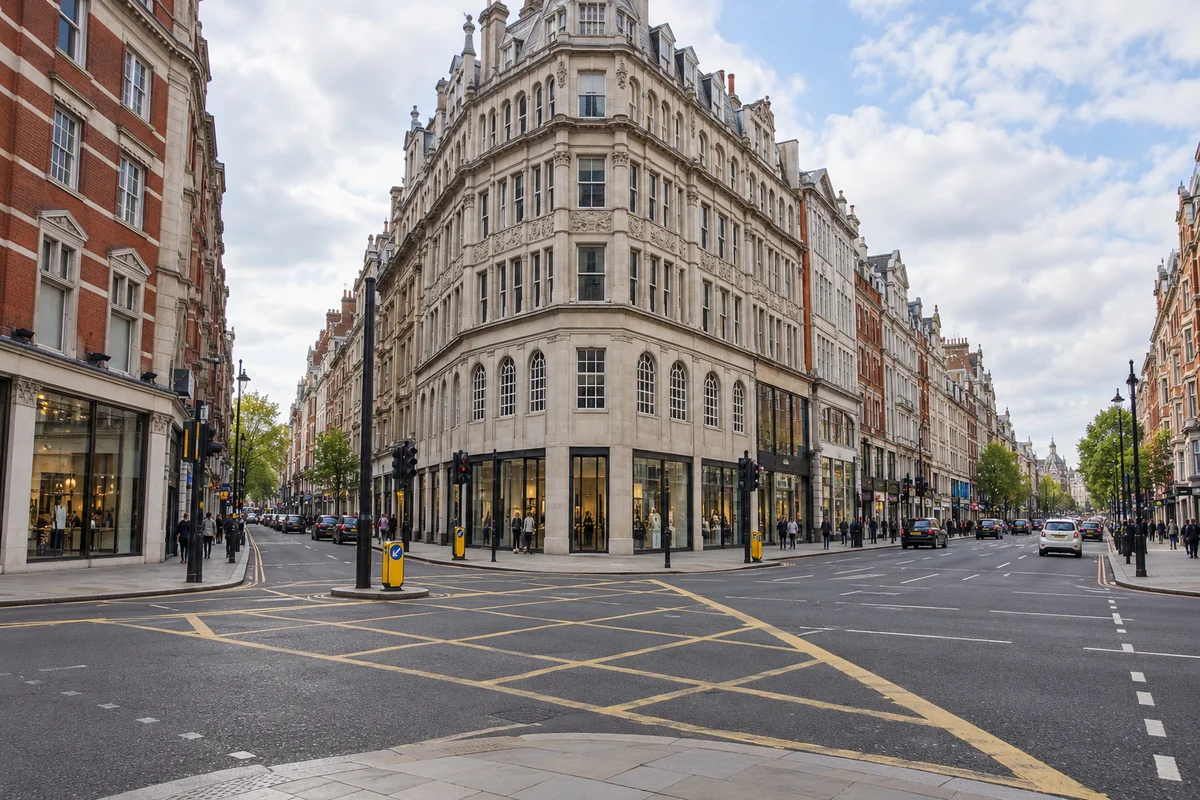
Where do the two streets separate?
Start at the building corner and follow each kerb independently. A branching street is easy to flatten into a single frontage. The example teaches that distinction without claiming a verified camera direction.
Three descriptions, not three promises
A camera entry is a short piece of navigation rather than a picture. The Knightsbridge entries give three positions: a camera looking south-west down Brompton Road, a setting called Scotch Corner, and a third camera on Brompton Road. These are location labels, not descriptions of what each image contains. Use them to orient a comparison, then let the visible crop determine whether a road line, corner or frontage can be studied.
The distinction between a description and a promise matters here. The catalogue is telling you where a public source sits and, for one entry, which way it faces. It is not telling you that the famous shop is in the frame, that the corner is clear, or that the road is running with traffic. Each of those is a question for the image in front of you. A camera near a landmark is not necessarily showing it, and a camera named for a street is not a survey of that street.
This is why the comparison is set up as three tasks rather than one quiz. A single correct answer would only test whether you had read the label. Assigning a task forces a different move: decide what this position can reasonably be asked, attempt it, and then let the frame overrule you. Where the feature is missing, the useful result is the missing feature, not a clever guess about what probably lies behind the bus.
Following the road
The Harrods camera is the one with the most specific description: the catalogue says it looks south-west down Brompton Road. That gives the view a direction, and a direction is something you can work with. Follow the kerb line and the carriageway as they recede, and note whether the composition gives you one dominant route towards a distant point or several competing lines. Then find the building edge on one side and describe where it meets the pavement.
The architectural fact worth carrying in is narrow but concrete. Historic England records the Brompton Road frontage as 1901–05 by C. W. Stephens, with pinky-buff terracotta facings by Doultons. Terracotta is fired clay, shaped while soft and then baked, which is why it can hold moulded detail and a warm colour without being carved stone. You are not asked to identify a maker from a pixelated image. The point is that a named building has a material and a date behind it, and that a faint colour in the frame can be checked against a real record rather than against the shop sign.
Keep the task modest. If the road bends out of the crop before its recession is legible, or a vehicle hides the point where wall meets pavement, the frame has not answered the question. Write the gap and move on. The fuller history of the store belongs in the Harrods district guide; this camera is here to teach the reading of a frontage beside a roadway.
Reading the corner
A corner is a useful question to test at the Scotch Corner entry. A corner is where two street edges meet, so the question is not how one road recedes but how the approaches fit together. Look for the point where pavement, kerb and building line turn, and count the road openings the frame actually admits. Two approaches are enough to make a corner; a third may be hinted at and then lost behind a building. Name the ones you can trace and say plainly which are outside the picture.
It is worth putting the name itself aside. Scotch Corner is shared with a motorway junction in North Yorkshire, and that accident of naming tells you nothing about this Knightsbridge setting. The catalogue identifies the setting but does not say which street edges appear. Treat the name as a convenient handle and let the geometry of the frame do the describing.
A corner also exposes a limitation of any still image. You can see that two edges meet and that a pavement has a shape, but the frame cannot tell you which direction the traffic was moving or how the signal phase arranged the vehicles. Those are conditions, not architecture, and they change between captures. Record the fixed geometry — the turn, the kerb, the height of the flanking buildings — and leave the movement out of your sentence.
Finding the shopfront edge
One possible exercise for the third camera on Brompton Road is to read a shopfront edge as a designed thing rather than a blur of glazing. The catalogue does not establish that a shopfront appears. A frontage is the face a building turns towards the street, and on a shopping street that face is rarely plain. It is divided into bays, pierced by entrances and display windows, and finished with a cornice or parapet that marks the top of the building’s public face. Follow that edge across the frame and look for rhythm.
Name one interruption and one stretch that continues. An entrance door, a change of window width or a projecting sign will break the run; between those breaks the edge holds its line. This is a task about interruption, not about brand recognition, and it works even when the store names are unreadable. If the ground floor is entirely hidden by parked vehicles or the crop stops above the shopfronts, then the frame cannot support the reading. That is a finding in itself.
The position is described, not the contents. A camera on Brompton Road might be trained on the upper storeys, on a junction, or on a stretch with no shopfront at all. The task is a test of the frame, and the frame is allowed to fail it. When it does, the honest note is not “the frontage is out of shot, so it must be further along the road”. The honest note is simply that this camera does not show the feature you wanted.
Assign the tasks
Use the board below to give each camera a task based on what the catalogue says about its position. Read the feedback, then decide whether the frame you have supports the task or whether you should record a gap instead.
Choose one question for each camera, then check whether its catalogue description and the frame support that task. Tick the gap box if the feature you need is not visible.
Harrods
the catalogue describes this camera as looking south-west down Brompton Road.
No task chosen yet.
Scotch Corner
the catalogue identifies this as a Knightsbridge camera setting, but does not describe which street edges appear.
No task chosen yet.
Brompton Road
the catalogue places this camera on Brompton Road.
No task chosen yet.
Three cameras, three tasks. Nothing is stored or sent; the choices last for this visit only.
- Harrods — the catalogue describes this camera as looking south-west down Brompton Road. Try a task only after checking the frame, and record a gap if its needed feature is not visible.
- Scotch Corner — the catalogue identifies this as a Knightsbridge camera setting, but does not describe which street edges appear. Try a task only after checking the frame, and record a gap if its needed feature is not visible.
- Brompton Road — the catalogue places this camera on Brompton Road. Try a task only after checking the frame, and record a gap if its needed feature is not visible.
Sources & further reading
Official references inform this guide. Check the responsible organisation for current access, opening times and travel advice.