

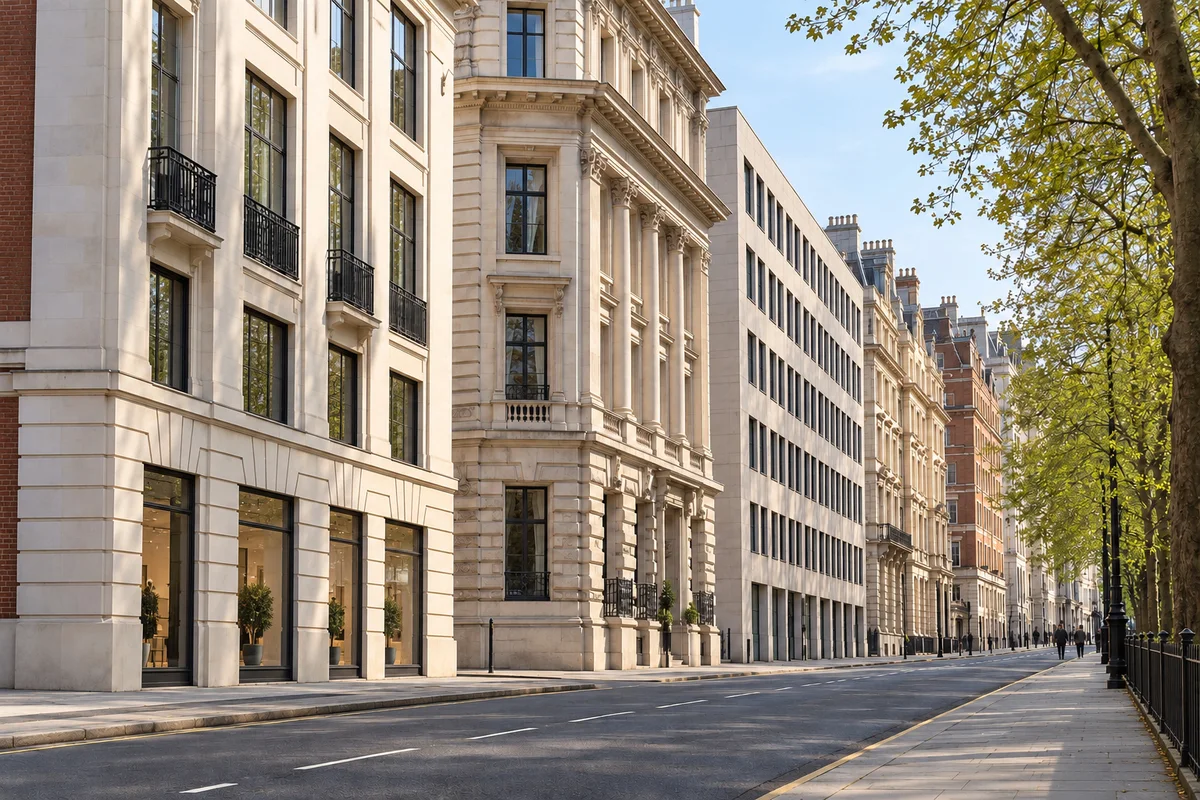
What happens to the spacing farther down the street?
The bays appear closer together with distance. That visual compression is a property of the view, not proof that the buildings shrink or touch. Compare equivalent features before comparing apparent size.
Two windows are not one moment
A comparison page can put two images beside one another, but that layout does not turn them into a synchronised pair. Each image has its own source and delivery path. Unless reliable capture times are provided and verified, you do not know whether the scenes were recorded at the same moment.
There may also be separate caching histories. A browser or intermediary can reuse a stored response under the applicable HTTP rules. Seeing two images refresh on the same page does not prove that the underlying frames were captured together. MDN’s caching guide explains why the delivery of a stored response and the original event that produced it are different questions.
It is still worth comparing them. A careful comparison begins with stable geometry and stays within each crop. Treat the joined display as a tool for looking, not as a shared clock or a measurement of simultaneous traffic.
A useful order is to name each place, note the camera label, describe one fixed edge in each frame, and only then mention a changeable object. If you cannot tell whether a vehicle belongs to the same moment in both images, omit the cross-image comparison. You can still say that a vehicle is visible in one particular frame without converting that sighting into a claim about relative activity.
Compare shape before activity
Look first at boundaries that persist: a road edge, bridge parapet, building line or edge of a square. Ask how the camera places those features inside the frame. Then notice what falls outside each crop. Two images can differ because their positions and directions differ, even if the scene in each is faithfully displayed.
Only after describing the geometry should you note changeable details such as vehicles. Those details belong to separate frames with unknown capture times. They cannot tell you which location is busier now, whether one queue has grown or whether an incident happened between the two pictures.
HTTP caching rules add another reason to be precise about timing: a response can be reused according to its freshness rules, while the page’s current appearance describes what was displayed to you. RFC 9111 defines those cache rules. It does not give a camera frame a verified capture timestamp.
Use a real pair
The Westminster study pairs the Bridge and Parliament Square. Give each image its own sentence. In the bridge view, note a line that leads through the frame, if it is visible. In the square view, note an edge that holds the surrounding space. If either feature falls outside the actual crop, leave it out of your description.
Piccadilly Green Park gives a different kind of comparison. The source names indicate separate locations, but they do not confirm that both cameras face the same space or include the same buildings. Use the place label as a prompt to inspect the image, not as a substitute for looking at it.
When your note includes the camera names and the feature you actually saw, another reader can understand the comparison without mistaking it for a simultaneous measurement.
Stop before explaining activity
Two stills cannot establish which street is busier at a shared time when their capture times are unverified. They cannot show what happened between captures, explain why traffic differs or establish conditions outside either frame. Different crops and camera positions are enough to make a simple count misleading.
For a current journey decision, consult the relevant transport information. For fixed orientation, a map or the visible architecture may be more useful. For movement, a clip can show a supplied sequence, but it still does not prove continuous coverage or a current capture time.
A good comparison is modest and specific: “This image shows a longer bridge edge; that one gives more space to the square.” The statement is useful because it tells the reader what to look for and leaves the unknown timing unknown.
Sources & further reading
Official references inform this guide. Check the responsible organisation for current access, opening times and travel advice.