

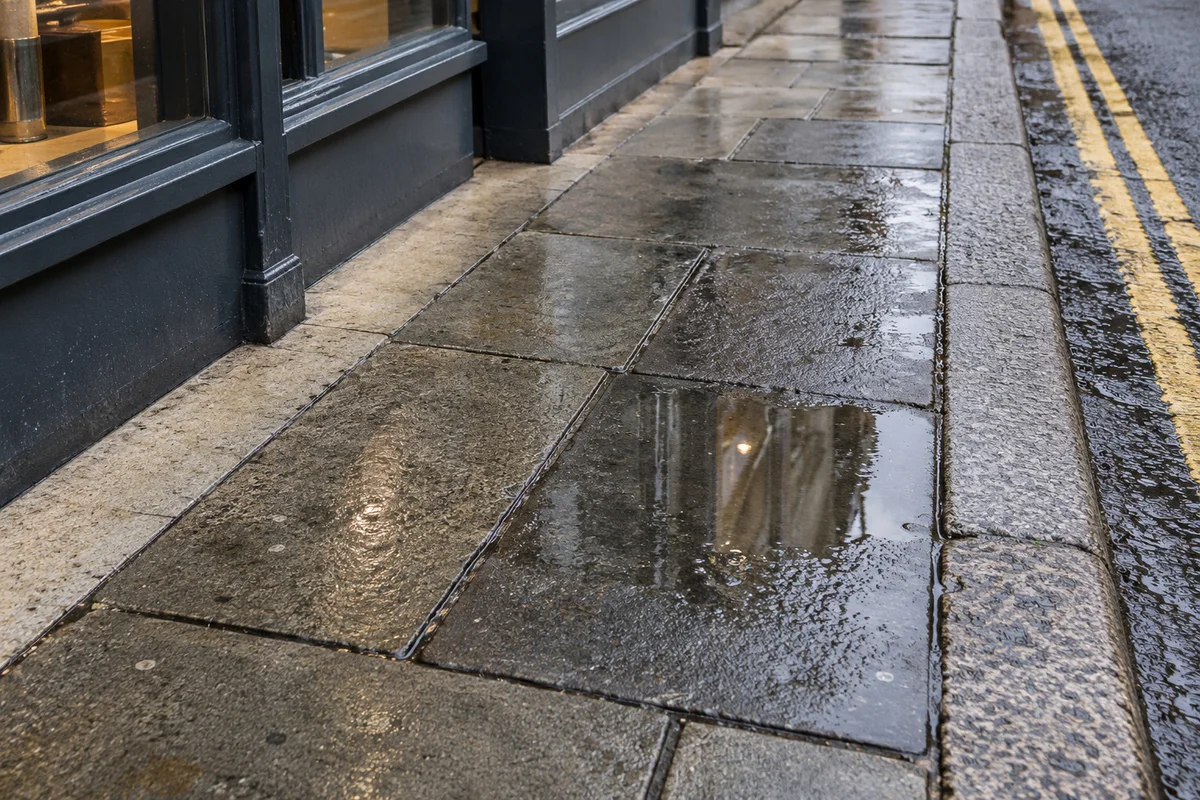
Which clues describe the surface, rather than the forecast?
Follow the shallow reflection, then the darker slabs and the sheltered strip beside the shopfront. Those are three visible surface differences. None establishes when rain fell, whether it is falling now or what comes next.
Describe the clue
Begin with the clue and nothing else. Choose Oxford Street at Selfridges or Piccadilly Circus when the available frame includes clear road detail, and name what is actually visible: light reflected on the carriageway, spray behind a vehicle, umbrellas above pedestrians, or drops close to the lens that soften the whole image. Each of those is a description before it is a weather report.
The temptation is to jump from the clue to the conclusion. A reflective surface looks wet; a wet surface must mean rain; therefore it is raining. Every step in that chain can fail. A surface can remain wet after rainfall stops, and strong lighting may simply make its reflections easier to see. The camera is useful for a scene, but it does not become a rain gauge by showing puddle-like reflections.
Describe the clue precisely and leave the interpretation for later. Where is the light reflected? Which fixed feature does it alter? Is the spray behind one vehicle or across the whole carriageway? Precision here is what makes the next step possible.
Two columns, two jobs
A worked example is easier in two columns. On the left, the visible clue; on the right, the question it leaves unanswered. Visible clue: light reflected across the carriageway. Unanswered question: is rain still falling at this location? Visible clue: spray behind a vehicle. Unanswered question: how much rain has fallen? Visible clue: umbrellas above the pavement. Unanswered question: how long will it last?
The columns do different work, and keeping them apart is the whole exercise. The left records what the image supports. The right holds the questions that need another kind of evidence. Copying an item from the right into the left is the common mistake, and it usually happens because the question is the more interesting one.
There is no failure in an empty right-hand column. A frame that supports three solid observations and leaves three questions open has done its job. The picture is evidence about a surface at one moment, and evidence about surfaces is worth having.
What the Met Office provides
Two Met Office products answer the two sides of that page. The observations guide deals with recent conditions at named observing locations, and also with radar and satellite imagery. Use it for recorded weather and for the wider picture, checking its time and place, because a station observation and a street image need not represent the same spot. A named observing location is not the pavement in front of the camera.
A forecast addresses the weather ahead. The Met Office explains that a location’s weather symbol should be read alongside its probability of precipitation. Use the forecast when you need to plan, and do not ask the image to guess the present from a wet-looking road. The products are complementary; confusing them makes both worse.
The distinction is not a technicality about agencies. It is a distinction between three questions that sound alike: what was recorded, what is likely next, and what this picture can show. Only the third belongs to the camera.
Both products carry a place and a time, and both should be read with them. An observation from a named station, a radar image and a street view are three different samples; they can be compared, but they cannot be substituted for one another. When the times do not match, say so rather than choosing the more convenient account.
The street’s material change
Wetness changes how a street looks, and those changes are worth recording even when the cause stays uncertain. A reflective carriageway can pull attention away from the building line; spray can briefly veil a frontage; a darker pavement may make a bright sign read more strongly. Describe where the light is reflected and which fixed feature it alters.
For a paired observation, choose one visible feature such as a kerb or a shopfront and note its appearance in two available captures. Do not call the difference a change in weather until the evidence supports that account. The forecast still belongs to the Met Office.
What the pair can show is a difference in appearance. What it cannot show is a rate, a total or a trend. Two frames taken at unknown times are two samples without a schedule, and the honest caption says so.
The useful question is not whether the scene looks wet but what the appearance supports. A dark patch on a pavement, a bright smear on a carriageway and a softened distance all belong in the left-hand column. Totals, rates and trends belong in the right. If a caption cannot be written without moving an item across the divide, the caption has gone beyond the evidence.
Keep the clue, keep the question
The habit worth taking away is a sentence with a stop in the middle. Light is reflected across the carriageway stops where the frame stops. A present-tense weather claim carries on past the evidence. Write the first sentence, and leave the second to the instruments that can support it.
The site’s observation notebook asks for a second look at the same feature, which suits this material well. Use it to record the clue on two occasions, keep the description identical, and put the weather question on a separate line where it belongs.
A camera trained on a London street is a good instrument for looking and a poor instrument for meteorology. Keeping the two roles apart is not caution for its own sake; it is what allows the observation to be trusted.
Label the claims
The statements below mix visible clues, claims about what comes next, and questions a single image cannot answer. Give each one a label. The feedback says which Met Office product, if any, is designed for the question.
Light is reflected across the carriageway.
Choose the label that fits this statement.
Spray appears behind a vehicle.
Choose the label that fits this statement.
Umbrellas are visible above the pavement.
Choose the label that fits this statement.
Conditions will ease within the hour at this location.
Choose the label that fits this statement.
The probability of precipitation shown beside a location’s weather symbol.
Choose the label that fits this statement.
How much rain has fallen at this spot since morning.
Choose the label that fits this statement.
Whether rain is still falling at this location.
Choose the label that fits this statement.
No statement labelled yet. Separate the observation from the forecast.
- Light is reflected across the carriageway. — A frame observation. That is a frame observation. It names a visible clue and stops there, without saying what the surface means or whether anything is falling.
- Spray appears behind a vehicle. — A frame observation. A visible clue, recorded as seen. The frame cannot say how much water produced it or whether the spray is still being thrown.
- Umbrellas are visible above the pavement. — A frame observation. Umbrellas are a visible feature of the scene. Their presence is an observation, not evidence about how long the condition has lasted.
- Conditions will ease within the hour at this location. — A forecast. A claim about what comes next is a forecast. The Met Office forecast is the product for it, and a street image cannot supply one.
- The probability of precipitation shown beside a location’s weather symbol. — A forecast. That figure belongs to the forecast. The Met Office explains that a location’s symbol should be read alongside its probability of precipitation.
- How much rain has fallen at this spot since morning. — Not knowable from the frame. A total needs recorded observations over time. One frame has no such record, even when the surface looks thoroughly wet.
- Whether rain is still falling at this location. — Not knowable from the frame. The frame cannot establish a present condition. That question belongs to recorded observation at a named place, checked for its own time and location.
Sources & further reading
Official references inform this guide. Check the responsible organisation for current access, opening times and travel advice.