

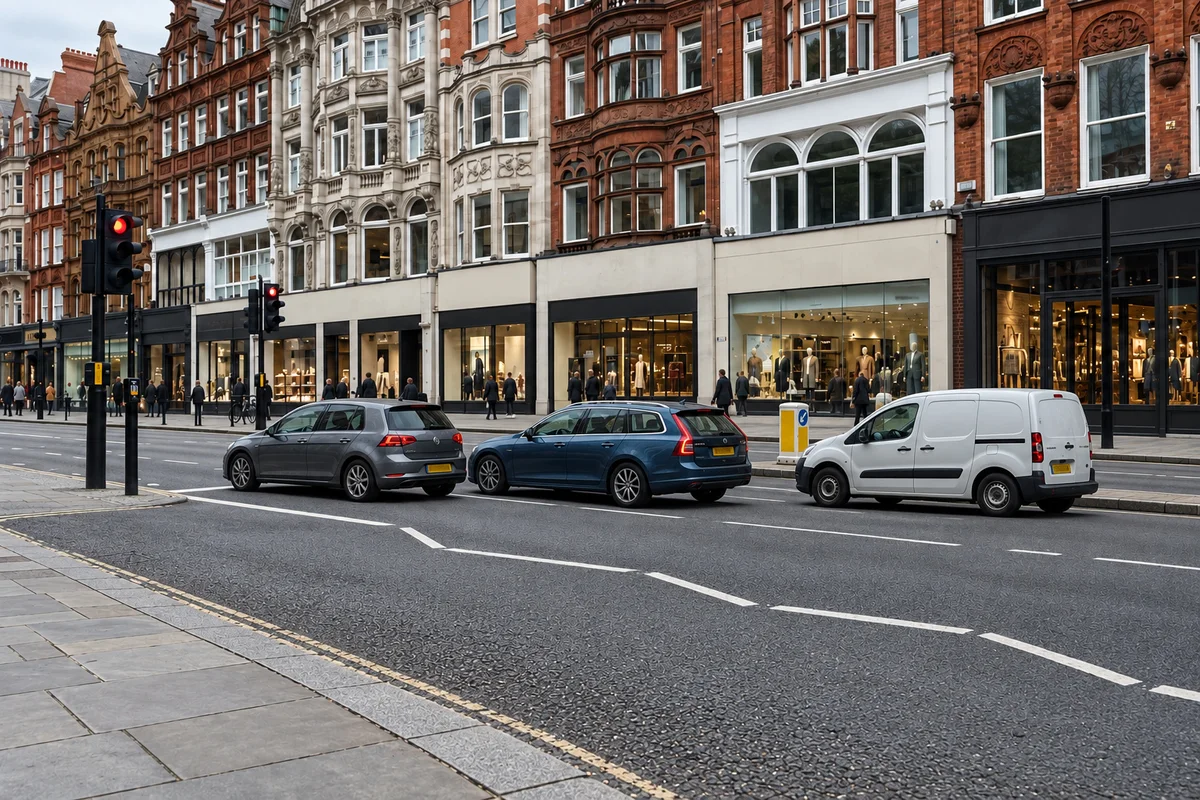
Does a row of vehicles prove a queue?
Compare spacing and position, then ask what would require another observation. Movement, waiting time and the cause of a pause are absent from a still image. Keep the vehicle arrangement as a description rather than a congestion verdict.
Start at the edge
A traffic image is most useful at its edges. Choose a frame with enough carriageway detail to distinguish vehicles: Parliament Square, Piccadilly Circus or Scotch Corner may provide a suitable view. Find where a line of traffic begins, and find where it passes beyond the crop. If a signal or a junction appears, note its relationship to the waiting vehicles.
A queue is a line of vehicles waiting or moving slowly towards a point they have not yet reached. The stop line is the transverse marking where they are expected to wait. Neither term tells you what caused the line or how long it has lasted. Vehicles gathered at a visible stop line establish a local queue, and that is all they establish on their own.
The edge of the frame is part of the evidence. A line that runs out of the picture has an unknown end, and describing it as though it continued for a mile is an invention. The phrase worth carrying is a bounded one: vehicles waiting between the near kerb and the visible junction.
List what the frame actually contains before you describe it: the near kerb, the lane markings, the visible stop line, the junction edge and the crop. That list is the caption’s inventory, and anything absent from it should not appear in the caption.
What the frame can and cannot say
A still image has no time base. It can show presence, position, spacing and direction of facing. It cannot show speed, because speed needs a before and an after. It cannot show duration, because a single exposure is one moment. It cannot show cause, because a signal phase, an incident and an ordinary build-up can produce identical arrangements.
It also cannot show a normal pattern. A busier-than-usual junction and a quieter-than-usual one can look the same in the absence of a baseline. The frame is one sample, not a survey, and it carries no record of the same place at the same hour on other days.
That list of limits is not a reason to ignore the image. Presence and spacing are genuinely informative: they say where vehicles are and how they relate to the road design. The discipline is to keep those claims and leave the rest to the traffic status service, which reports disruptions with a place and a time.
A hypothetical queue
An example makes the reading clearer, provided it stays hypothetical. Imagine a road with a visible stop line and a lane beyond it. A queue might fill one approach and leave another clearer; it might bend around a corner; or it might run out of the picture altogether.
Each of those descriptions says something about the relation between traffic and road design. A queue that fills one approach while another stays clear points to the geometry of the junction. A queue that bends around a corner shows that the visible straight is not the whole story. A queue that leaves the frame shows that the picture has a boundary.
None of them says how long the delay is, and none should be written as though the queue continued beyond what the frame contains. Perspective matters too: a line of large vehicles can conceal the gaps behind it, so apparent density is not measured density.
A fixed point, if a clip is available
If you request a clip, watch movement at one visible road position rather than counting everything that moves. Pick a lane, a stop line or the mouth of a junction, and follow that single point. A queue advancing shows that movement occurred during the captured interval. A queue staying still may show only part of a signal cycle.
Neither result gives the delay experienced by a driver arriving afterwards. A driver who reaches the junction after the clip ends is not represented in it. TfL describes JamCams as traffic imagery subject to possible interruptions, and on this site an image loading successfully does not establish when it was captured. Where capture time remains unestablished, describe the scene without treating it as a present-tense road report.
The single fixed point is what makes the clip readable. Watching the whole frame at once invites the eye to follow whatever moves fastest, which is rarely what the question needs.
Shape before story
The geometry of a line of vehicles is often more useful than its apparent size. Does it gather at a visible stop line, bend around a corner, or continue beyond the crop? At Scotch Corner a turning movement may complicate the foreground; at Parliament Square a broad civic setting can make one short line seem small. These are effects of composition, not measurements of delay.
TfL’s traffic status service lists reported disruptions and their context. Match the location and the time before connecting a notice to the picture, and say plainly when the two cannot be matched. A reported disruption somewhere in the same borough is not the same as the queue on screen.
A caption that contains a place within the frame keeps the observation useful: vehicles wait between the near kerb and the visible junction. It is modest, checkable and true to the image. The cause and the duration can follow from another source, or not at all.
Queue-reading positions
The schematic below is a diagram, not a camera view. Choose a position in the queue and read what a still image taken there can establish and what stays beyond it. The four columns of evidence — presence, spacing, direction and partial occupancy — are separated from speed, cause, duration and normal pattern.
On the approach
This is the stretch of carriageway before the waiting line. A still image taken here can establish some things and cannot establish others.
A still frame can show
- which lanes hold vehicles and which stay empty
- the direction each visible vehicle faces
- how much of the road surface is occupied
A still frame cannot show
- speed, because a still frame has no interval to divide distance by
- the cause of the arrangement
- how long the arrangement has lasted
- whether this is a normal pattern for the place and hour
Position chosen: On the approach. It can show which lanes hold vehicles and which stay empty; it cannot show speed, because a still frame has no interval to divide distance by.
- On the approach (the stretch of carriageway before the waiting line). Can show: which lanes hold vehicles and which stay empty; the direction each visible vehicle faces; how much of the road surface is occupied. Cannot show: speed, because a still frame has no interval to divide distance by; the cause of the arrangement; how long the arrangement has lasted; whether this is a normal pattern for the place and hour.
- At the stop line (the transverse marking where vehicles are expected to wait). Can show: that vehicles gather at a visible stop line, which is a local queue; the spacing between one vehicle and the next, as far as perspective allows; a vehicle held short of the line rather than over it. Cannot show: the signal phase that produced the waiting; an incident or an ordinary build-up, which can look alike; duration, or the delay a driver arriving later would meet.
- At the kerbside (the lane nearest the pavement edge). Can show: a vehicle occupying the kerbside lane and its position against the kerb; partial occupancy, where one lane is used and another is not; whether the vehicle sits parallel to the kerb. Cannot show: whether the vehicle is loading, waiting, parked or held in traffic; how long it has stood there; the parking or loading restriction that applies.
- At the junction mouth (the opening where one road meets another). Can show: whether vehicles occupy the mouth of the junction or are held short of it; the direction a visible vehicle is facing within the opening; the relationship between the queue and the junction edge. Cannot show: which signal phase produced the arrangement; the route a vehicle will take beyond the frame; cause, duration or the normal pattern of the junction.
Sources & further reading
Official references inform this guide. Check the responsible organisation for current access, opening times and travel advice.