

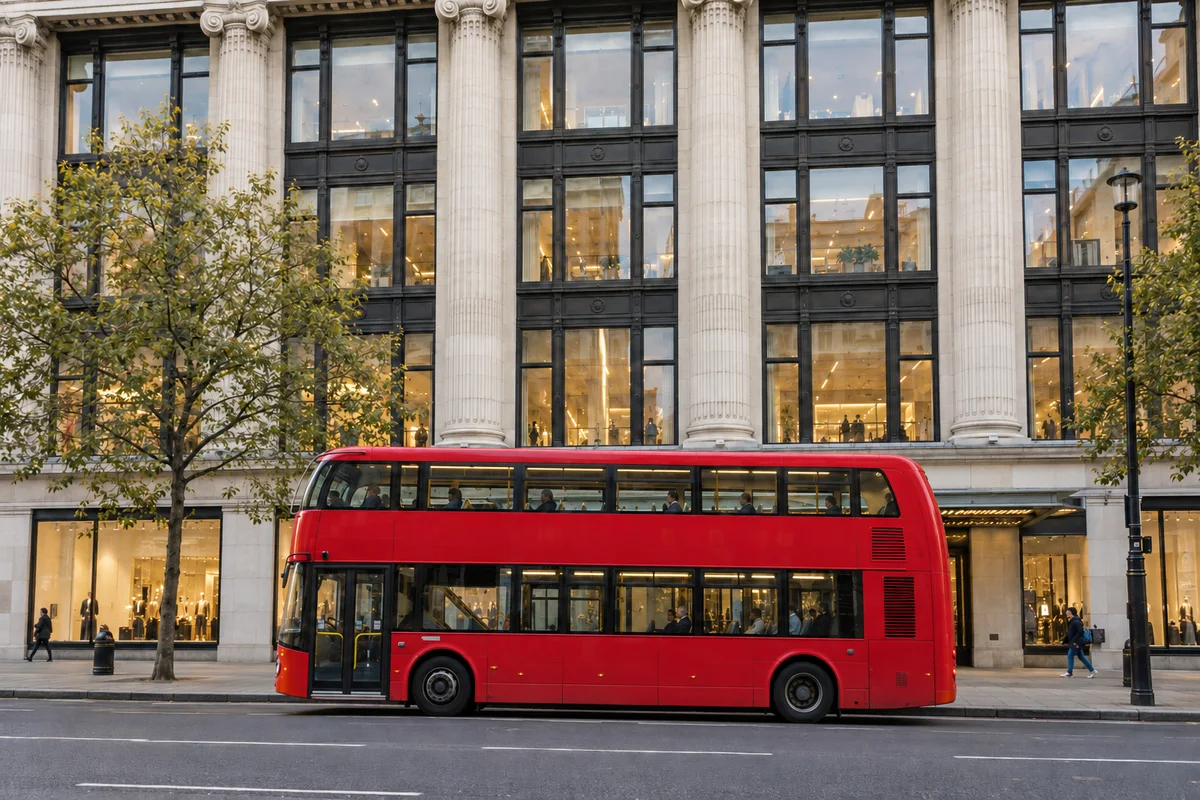
What does the bus hide?
Read the fa\u00e7ade above the roofline, then the bays interrupted by the bus below it. The visible outline is not the whole building. A single vehicle in an editorial example tells us nothing about service frequency or present traffic.
The red scheme
A red bus is one of the few London subjects that needs no introduction. London Museum dates the red scheme to 1908, the year the London General Omnibus Company took over its rival Vanguard and adopted Vanguard’s red. That company and the other London operators were eventually absorbed into London Transport, which made the colour official across the city.
The history explains the association, and it does not identify a working route in a photograph. The colour tells you that a vehicle belongs to a long London tradition; it does not tell you where the bus is going, which service it belongs to, or whether it is in service at all. Those are separate questions with separate evidence.
That distinction is worth holding before the first bus passes. The colour is the beginning of the reading, not the end of it. A photograph of a red vehicle is a photograph of a colour before it is a statement about transport.
The colour is a useful first clue precisely because it is so broad. It narrows the vehicle to a category and leaves the interesting questions open. A reader who writes only that a red bus is present has made a claim the picture can carry at any hour and in any weather.
A bus as a moving scale
A bus is an imperfect but helpful measure of a frontage. When it passes a recognisable building, compare its height with the visible ground floor and the run of upper windows. It may make the scale of a façade easier to grasp, and then hide the very doorway you were studying.
Scale is the relationship between sizes, and a moving object of roughly known height is a rough ruler. The word to keep is rough: perspective, the angle of the street and the position of the bus in the carriageway all distort the comparison. Use it to sense proportion, not to measure.
Try another camera or return later rather than supplying the obscured part from memory. You can learn from the size and movement of a bus even when its display cannot be read. The street, rather than the fleet, is the subject.
Frontages vary in how much they give away. A long, regular elevation may swallow a bus against it, while a building with a strong horizontal cornice gives the eye a line to compare. Choose a frontage with clear edges when the scale comparison is the point of the exercise, and accept that the bus will move on before the reading is complete.
Read the display before the route
Record a route number or a destination only when the display is legible. A red body, two decks or recognisable advertising cannot establish either. Bus visible is a perfectly serviceable note when that is all the picture supports.
TfL’s bus service planning guidelines distinguish night-only services from routes that run by day and take a changed route at night; both can use an N prefix. A readable prefix is useful context after dark, but it does not by itself show that a service runs only overnight. The camera is no timetable: a captured vehicle cannot establish the next departure or the service available when you arrive.
The display is also the hardest part of the vehicle to read at a distance. Lettering may be small, angled away from the lens or washed out by its own illumination. If the characters cannot be resolved, the honest note is that a bus is present and its route is not established.
What a clue can and cannot establish
Four clues are commonly available in a street view: the livery, the route or destination display, the vehicle shape, and the position in the carriageway. Each has a different evidential reach. The livery carries history and colour. The display carries a route only when it can be read. The shape carries presence. The position shows where the vehicle is in the frame; a sequence is needed to establish its direction of travel.
None of them carries service information. Frequency, next departure and the service available at your arrival belong to a timetable, not to a photograph. Keeping that line clear is what allows the visual clue to be used without overclaiming.
A useful habit is to write the clue and the limit in one sentence: a red double-decker passes the frontage and its route is not established. The sentence is short because the evidence is short.
A two-frame task
Compare two street types, such as the Westminster Bridge approach and the Piccadilly Circus junction. In a requested clip, follow one bus through the visible movement — entering, pausing or leaving — then identify a feature it reveals or hides. Along a road the vehicle may emphasise a strong direction through the picture; at a junction it may cross several layers of pavement and frontage, giving a different reading of the space.
The comparison is between compositions, not between services. One view shows a bus moving along a route; the other shows a bus intersecting a set of edges. Neither says how often the service runs, and neither should be asked to.
End with one sentence about the bus and one about the street it changed. The first is likely to be brief. The second is where the camera earns its keep.
Keep the two sentences separate. The bus sentence should describe the vehicle and its movement; the street sentence should describe what that movement changed. Mixed together, they invite a service claim the frame cannot support.
Bus clue reader
The schematic below is a diagram, not a camera frame. Choose one visible transport clue and read its reach. Every claim in the panel comes from the guide’s named sources; no route number, fleet detail or service claim is invented here.
Livery
The clue is the colour and finish of the body. It has a narrow evidential reach, and the two columns below mark its edge.
What it can establish
- the colour of the vehicle and the historical association of red with London’s buses
- that the vehicle belongs to a long London tradition, which London Museum traces to 1908
What it cannot establish
- a route number or a destination
- the operator, or whether the bus is in service
- anything about frequency or timetable
Clue chosen: Livery (the colour and finish of the body). It can establish the colour of the vehicle and the historical association of red with London’s buses; it cannot establish a route number or a destination.
- Livery (the colour and finish of the body). Can establish: the colour of the vehicle and the historical association of red with London’s buses; that the vehicle belongs to a long London tradition, which London Museum traces to 1908. Cannot establish: a route number or a destination; the operator, or whether the bus is in service; anything about frequency or timetable.
- Route or destination display (the illuminated panel at the front of the vehicle). Can establish: a route number or a destination, but only when the characters are legible in the frame; a readable N prefix, which TfL uses for night services and for some routes with changed night routing; the prefix alone does not show that a route runs only overnight. Cannot establish: how often the service runs; the next departure, or the service available when you arrive; anything a timetable would be needed to confirm.
- Vehicle shape (the body, decks and windows as a mass). Can establish: that a bus occupies the frame; a rough scale against a frontage: compare its height with the visible ground floor and the run of upper windows. Cannot establish: a route or a destination; the operator; anything beyond the vehicle’s presence and rough size.
- Position in the carriageway (where the vehicle sits against kerbs, lanes and junctions). Can establish: which way the vehicle faces in the still image; facing direction alone does not show its direction of travel; in a clip, whether it enters, pauses or leaves the visible roadway; how the vehicle relates to the pavement and frontage it passes. Cannot establish: why a vehicle paused, or for how long; the normal pattern of service; departure times or frequency, which belong to a timetable.
Sources & further reading
Official references inform this guide. Check the responsible organisation for current access, opening times and travel advice.