

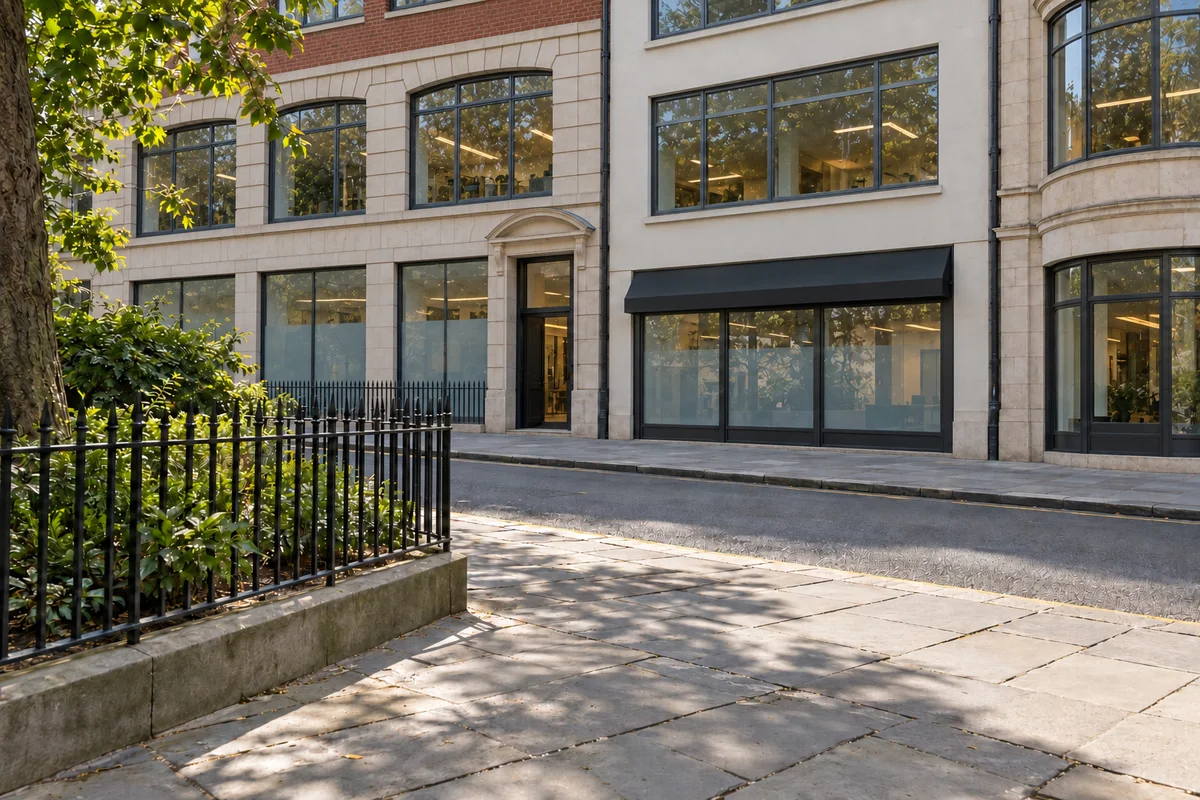
Which fixed features could anchor a second observation?
Use the railing corner, paving joints and window bays as reference points. Shadows can change without the objects moving. Fixing an observation to a stable feature makes a later comparison more precise.
Return to one feature
A repeat observation needs a fixed subject. Choose a pavement corner at Piccadilly Circus, a frontage near Oxford Street–Selfridges, or an approach at Albert Bridge. Describe the feature and its framing in the first entry, then return to the same camera and the same part of the street. Curiosity is the entry requirement here, not expertise, and one chosen feature will teach more than a tour of fifteen.
The camera angle can change, so check at each visit that the same part of the street is still visible. If it is not, say so rather than substituting whatever is now in the frame. A moved source or a changed crop is itself a finding about the record, and it belongs in the notebook beside the observations.
Fixing the subject is what makes comparison possible. Two views of the same corner can be laid side by side; two views of whatever happened to be interesting cannot. The discipline of this notebook is the discipline of returning to one place in one frame.
Three kinds of time
The notebook asks what you can say about capture time, and the honest answer is usually limited. Write the time you opened the page as viewing time. Record any legible provider timestamp as a label rather than as verified capture. The two are different kinds of evidence, and keeping them apart is the point of the field.
If weather context is added, give it its own location and time. The Met Office observations guide separates observing locations from mapped products such as radar, which is a useful caution: a weather observation is taken somewhere in particular, not everywhere at once. Provider markings on a camera image do not constitute an independently verified capture time, and the site does not claim one.
So there are three times to hold separately: when you looked, what the provider label says, and any weather reading with its own place and moment. None of them is a portrait of the street’s normal condition, and the notebook should never imply that any of them is.
The five fields
The observation notebook provides five prompts: what is actually visible; what the frame leaves out; what you can say about capture time; what changes in a second view; and what you would check next. They suit a repeat visit because each asks about the same chosen feature, and together they cover observation, omission, time and the next step.
An illustrative worked entry shows the format: “Piccadilly Circus, kerb beside the crossing. Viewed 14:10; provider label not verified. Kerb readable, near pavement hidden by a bus. Second view: framing unchanged, same kerb visible. Next: check the corner on an official map.” That is a format example, not an observation taken from a frame, and it shows how little the entry needs to assert in order to be useful.
Notice how the example treats the bus. It does not report traffic; it reports that the near pavement is hidden. The difference matters. A vehicle is an obstruction in a composition, not a measurement of how busy the street was, and the notebook records the first without pretending to know the second.
Two visits, not a day
Differences between captures — longer shadows, more artificial light, more vehicles at the chosen position — are worth recording as differences. They do not establish a normal daily pattern. Day of week, season, weather and framing all vary between visits, and a small number of views cannot untangle them.
Write the difference, then write the caution beside it. “More vehicles in the second view” is an observation; “the street is busier in the evening” is a general claim the notebook cannot support. The second is the sort of sentence that looks like a finding and is really a guess.
The notebook is a small, printable record of what changed among your own views. A later reader can follow the same five fields and see exactly where the comparison stops, which is a more useful outcome than a confident conclusion resting on two frames.
Keep the record honest
Three habits keep the record worth returning to. Date each visit by your own viewing time, keep provider labels separate, and record uncertainty as plainly as fact. A field that says “not visible” or “not verifiable” is doing its job when it prevents a later reader from assuming more than the frame supports.
The notebook on this page uses the same five fields. Add a visit, compare it with an earlier one, and print the summary if you want a paper copy. Everything you type stays in this page’s memory for this visit only; nothing is stored on your device or sent anywhere, so treat the entries as a working record rather than an archive.
Repeat-visit notebook
Complete the five fields for one visit to your chosen feature, then add another and compare them by field. Your entries are held in page memory only and disappear when the page is closed.
No visits recorded yet. Entries last for this visit only; nothing is stored or sent.
All five fields are kept in React memory on this page. Nothing is saved to your device, placed in a URL or sent anywhere, and everything disappears when the page is closed. Print this page to keep a paper copy of the summary below.
Five fields to complete for each visit: what is visible; what is left out; what can be said about capture time; what changes on a second view; what to check next.
Entries were held in the page’s memory only and were not stored or transmitted. Capture time, provider labels and viewing time are recorded separately.
Sources & further reading
Official references inform this guide. Check the responsible organisation for current access, opening times and travel advice.