

Look past the paint
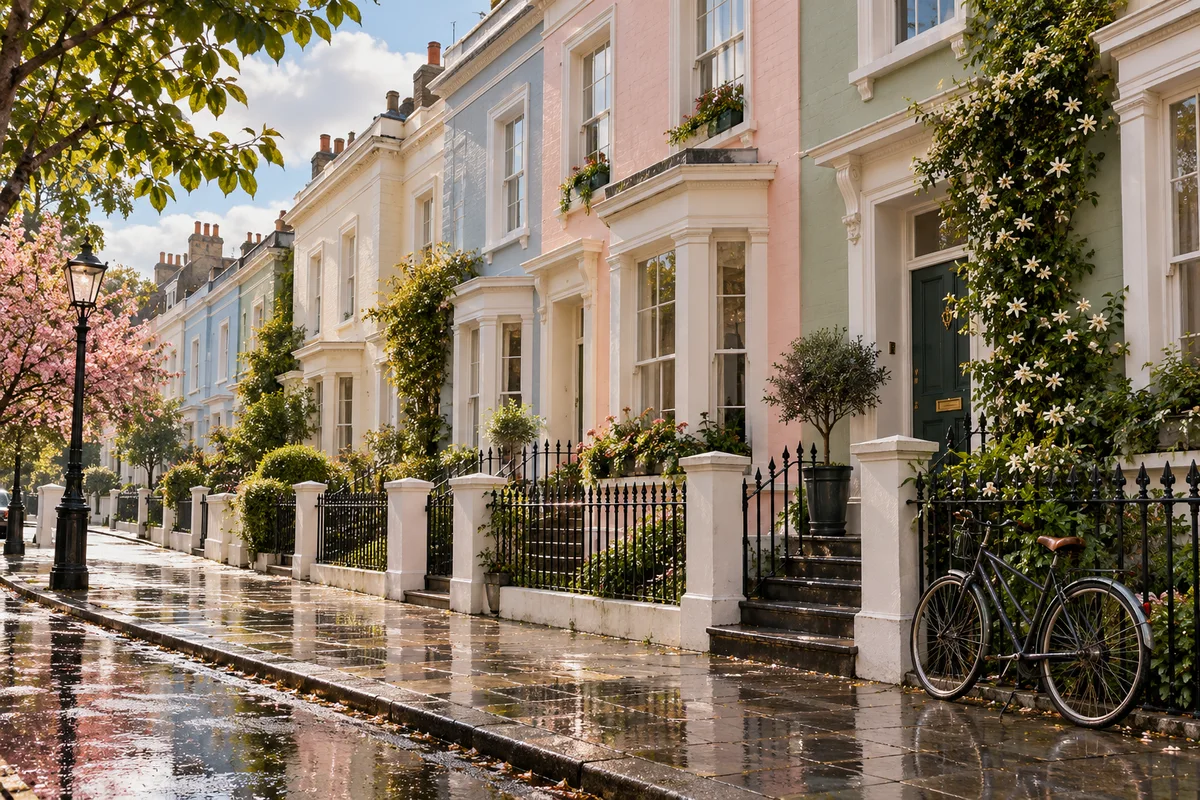
Pastel houses are an easy introduction to Notting Hill, but colour is only one part of a terrace. Start with the repeated openings: windows above windows, doorways meeting the pavement, a roofline carrying the sequence along the street. A terrace joins separate homes into a larger composition. Small differences become more visible once you have noticed what repeats.
In our illustration a bicycle and wet pavement bring the frontage down to a human scale. The picture does not identify a particular address, and its colours are an artist’s choices. Use it as a prompt to look at the relationship between one house and its neighbours. A change in window proportions or the level of an entrance can be more revealing than another attractive patch of paint.
A district of different streets
The Royal Borough’s conservation-area descriptions distinguish several neighbourhoods within this part of London. Colville, subsequently known as the Portobello Estate, was mainly developed between 1860 and 1875. The Ladbroke area has a predominantly Victorian and Edwardian character. The wider name “Notting Hill” gathers together streets with different development histories.
That is a useful correction to an overly uniform mental picture. A row of houses can illustrate one kind of residential frontage without representing every street in the district. When looking at a real building, consult the relevant conservation-area record before assigning it a date or describing its features as typical. The map helps connect a visible street to a documented area.
Source: the borough’s conservation-area descriptions and maps.
Portobello’s trading history
The council describes Portobello and Golborne Road Market as having a history reaching back to the nineteenth century. Its account of the area places the market within a diverse local community. This is a street with a trading history as well as a familiar visitor image; residential frontages alone cannot explain that part of its character.
For a market scene, notice how temporary displays change the scale of a street. Goods can occupy the space close to the eye while the upper floors continue the architectural rhythm overhead. Our residential illustration does not show a documented market layout. Comparing the two kinds of view is more useful than pretending the picture contains everything the neighbourhood is known for.
Source: the council’s account of Portobello and Golborne Road Market.
Follow a terrace
Choose a short stretch of the illustration or a residential frontage you can see. Work from the repeated structure toward individual details, then make one observation that does not depend on guessing an address.
These notes stay on this page. Nothing is saved or sent.
What rain changes in a picture
Wet pavement can make the lower part of a scene darker and more reflective. In an illustration, those choices guide the eye towards the brighter frontage above it. Look for the boundary between the pavement and the house: it gives the colour somewhere to begin. The bicycle supplies another distinct shape, interrupting the repetition without taking over the whole composition.
These are observations about the artwork, rather than a weather report or a promise of a quiet street. If you visit, leave room for the neighbourhood’s ordinary activity and consult official information for market arrangements. We have no Notting Hill camera. For a different illustrated waterside rhythm, continue to Little Venice and its canal junction.
Sources & further reading
Official references inform this guide. Check the responsible organisation for current access, opening times and travel advice.